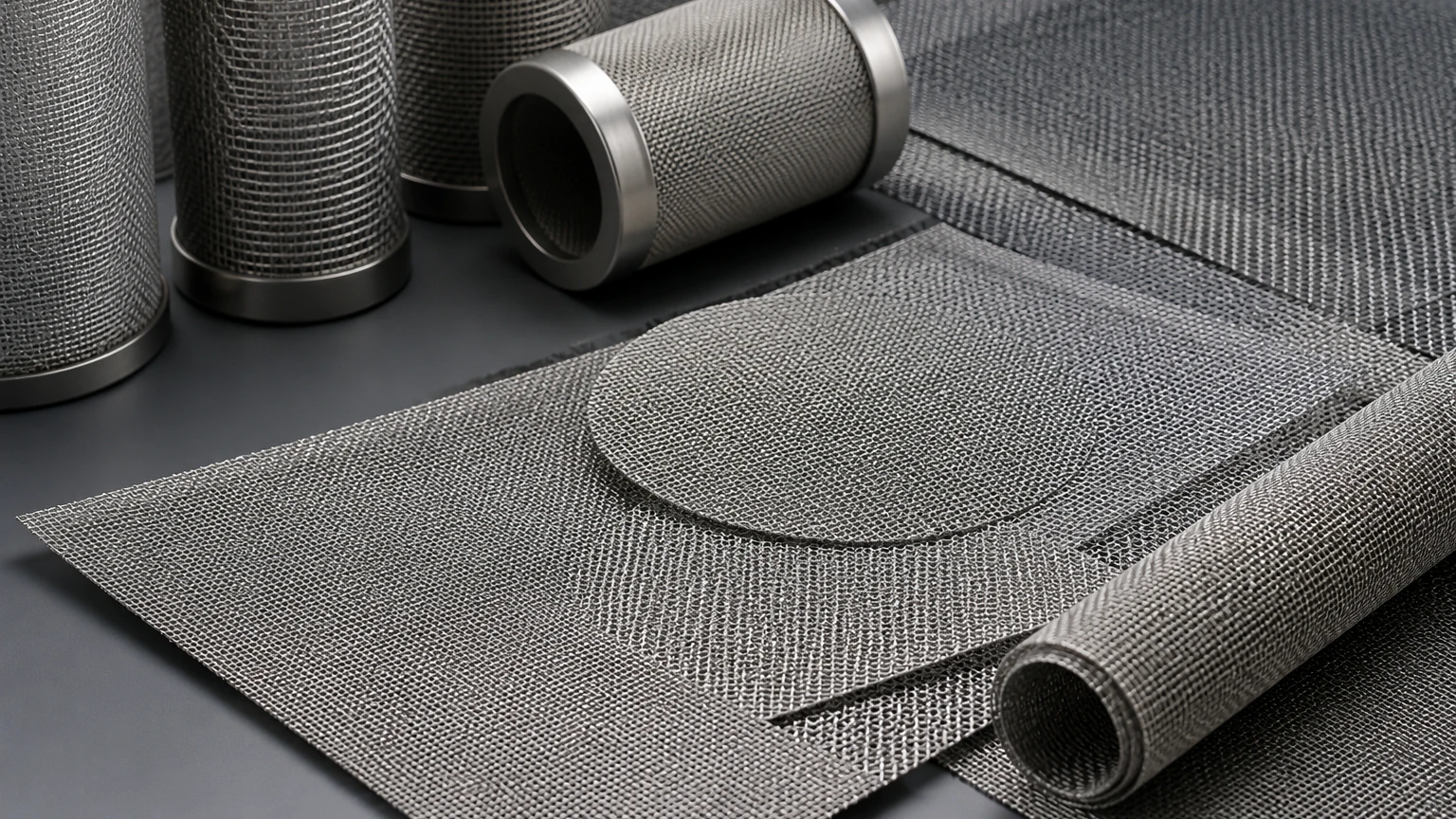
Sintered Wire Cloth
In the landscape of industrial filtration, the transition from standard woven wire mesh to sintered wire cloth represents a significant shift toward structural integrity and long-term reliability. For engineers and procurement teams managing high-pressure, high-temperature, or corrosive environments, understanding the technical nuances of sintered media is essential for optimizing process efficiency and reducing the total cost of ownership. Sintered wire cloth is not merely a filter medium; it is a multi-layered, diffusion-bonded composite engineered to overcome the mechanical limitations of traditional mesh.
The Sintering Process and Structural Integrity
Sintering is a thermal-mechanical process that transforms multiple layers of woven wire mesh into a single, integrated porous plate. Unlike traditional mesh, where individual wires are held in place only by the tension of the weave, sintered wire cloth utilizes diffusion bonding. This occurs in a high-temperature vacuum or inert gas furnace, where the contact points of the wires are fused at a molecular level without melting the base metal.
This bonding process ensures that the pore geometry remains fixed. In standard mesh, heavy flow or pressure surges can cause the wires to shift, leading to "pore migration" and a loss of filtration accuracy. By contrast, a sintered structure maintains its micron rating regardless of mechanical stress. For technical professionals, this stability is the primary reason to specify sintered media in critical applications such as pharmaceutical manufacturing or aerospace hydraulics, where consistent particle retention is non-negotiable.
Standard Configurations and Layering Strategies
The versatility of sintered wire cloth stems from its multi-layer construction. Engineers can customize the stack to balance filtration precision with mechanical strength. While custom configurations are common, the industry has gravitated toward several standard structures:
* Single-Layer Sintered Mesh: Primarily used to prevent wire migration in simple filtration tasks, providing a more rigid alternative to standard mesh.
* Two or Three-Layer Sintered Mesh: Often used for support or as a drainage layer in larger filter assemblies.
* Five-Layer Sintered Mesh: The industry standard for general industrial filtration. This configuration typically consists of a fine filter layer, two protective layers (one on each side), and two heavy-duty support/drainage layers. This design provides an optimal balance of high permeability and structural rigidity.
* Six-Layer Sintered Mesh: Adds an extra support layer, often used in fluidized beds or applications involving extreme mechanical loads.
By combining different weave types—such as plain square weave for support and Dutch weave for the filtration layer—manufacturers can create a composite that handles high differential pressures while maintaining a low pressure drop. This engineering flexibility allows the media to be tailored to specific viscosity and flow rate requirements.
Material Science in Sintered Wire Cloth
Material selection is the most critical factor in determining the lifespan of a filter in a B2B context. Sintered wire cloth is predominantly manufactured from stainless steel, but the specific grade must align with the chemical profile of the process fluid.
1. 304 Stainless Steel: Suitable for general industrial applications where corrosion risk is moderate and cost-efficiency is a priority.
2. 316L Stainless Steel: The preferred choice for chemical processing and marine environments. The "L" (low carbon) designation is vital in sintered products because it prevents carbide precipitation during the high-temperature sintering process, maintaining the material’s corrosion resistance at the bonded joints.
3. High-Performance Alloys: For extreme environments, materials like Hastelloy, Monel, and Inconel are used. These are typically specified in applications involving high concentrations of chlorides, acids, or operating temperatures exceeding 600°C.
When evaluating materials, engineers must also consider the thermal expansion coefficients. Since the sintering process bonds different layers together, using mismatched alloys can lead to internal stresses during thermal cycling, potentially causing delamination or cracking over time.
Performance Metrics: Micron Ratings and Permeability
When sourcing components from a manufacturer's Main Page, technical buyers must distinguish between nominal and absolute micron ratings. Sintered wire cloth is valued for its ability to provide an absolute rating, meaning it can guarantee that 100% of particles above a specific size will be captured. This is verified through bubble point testing and multipass testing.
Permeability is the second critical metric. A common misconception is that a finer micron rating automatically results in a higher pressure drop. However, because sintered wire cloth uses multiple drainage and support layers, the flow path is optimized. This allows for a high "void volume," which reduces the initial pressure drop and extends the time between cleaning cycles. In large-scale chemical plants, even a minor reduction in pressure drop can translate into significant energy savings for pump and compressor systems.
Operational Advantages in Demanding Environments
The move toward sintered media is often driven by the need for durability in harsh conditions. Several operational advantages set sintered cloth apart from other porous media like ceramic or polymer filters:
* High Mechanical Strength: The bonded structure can withstand high differential pressures, often up to 200 bar or more depending on the support structure. This makes it ideal for hydraulic systems and high-viscosity polymer melt filtration.
* Heat Resistance: Unlike polymer-based filters that degrade at relatively low temperatures, stainless steel sintered cloth can operate continuously at temperatures up to 480°C (in oxidizing atmospheres) or higher in reducing environments.
* Fixed Pore Size: As mentioned, the diffusion bonding prevents the wires from moving. This is essential for backwashing. In pulse-jet or back-flush systems, the filter is subjected to reverse pressure. Standard mesh would deform or "balloon," but sintered cloth remains rigid, ensuring effective particle release without damaging the media.
Maintenance, Cleaning, and Longevity
One of the most significant B2B advantages of sintered wire cloth is its cleanability. While many industrial filters are treated as consumables, sintered stainless steel components are often considered capital assets because they can be cleaned and reused multiple times.
Common cleaning methods include:
* Ultrasonic Cleaning: Utilizing high-frequency sound waves in a cleaning solution to dislodge fine particles trapped within the pores.
* Chemical Cleaning: Using acids, alkalis, or specialized solvents to dissolve organic or inorganic contaminants. This is highly effective for 316L and Hastelloy materials.
* Backwashing/Back-pulsing: Integrated into the filtration system to extend the interval between deep cleaning cycles.
* Burn-off/Pyrolysis: Used in polymer filtration to remove plastic residues by heating the filter in a controlled environment.
For the purchasing team, the higher initial cost of sintered media is offset by its longevity. A properly maintained sintered filter can last for years, whereas disposable cartridges might require replacement every few weeks, leading to higher long-term costs and increased waste.
Common Risks and Selection Pitfalls
Despite its robustness, sintered wire cloth is not immune to failure if improperly specified. The most common risk is delamination. If the sintering process is not perfectly controlled—due to insufficient temperature or pressure in the furnace—the layers may not bond correctly. Under the stress of high-pressure flow or backwashing, these layers can separate, leading to immediate filter failure.
Another risk is media migration from the edges. When sintered cloth is cut to size, the edges must be properly sealed or welded into a fitting. If the edge preparation is poor, small fragments of wire can break off and enter the downstream flow, which is catastrophic in pharmaceutical or food-grade applications.
Finally, users must be wary of blinding. While sintered cloth is easy to clean, certain types of sticky or fibrous contaminants can become permanently lodged in the multi-layer structure if the wrong weave type is selected. Consulting with a specialist to match the weave geometry to the contaminant profile is a necessary step in the design phase.
Procurement Considerations for OEM Projects
When engaging with a manufacturer for custom filtration solutions, providing comprehensive data is essential for a successful project. Engineering teams should be prepared to confirm the following:
1. Fluid Characteristics: Viscosity, density, and chemical composition (including pH levels).
2. Operating Parameters: Normal and maximum operating temperatures, flow rates, and maximum allowable pressure drop.
3. Filtration Requirements: Target micron rating (absolute) and the nature of the solids being removed (deformable vs. hard particles).
4. Mechanical Constraints: Dimensions, housing compatibility, and required end fittings (e.g., DOE, 222, 226, or custom flanges).
By addressing these factors, B2B buyers ensure that the resulting sintered wire cloth component is optimized for both performance and durability. Whether for a new installation or an upgrade of an existing system, the transition to sintered media provides a level of process control that standard mesh simply cannot match. For more information on custom configurations and technical specifications, reviewing the available options on the manufacturer’s Main Page can provide the necessary foundation for informed decision-making.