


Oil Filtration Systems
In industrial environments, the integrity of lubrication and hydraulic fluids is a primary determinant of machinery longevity and operational efficiency. Contamination within these fluids is responsible for a significant percentage of mechanical failures, leading to unplanned downtime and costly repairs. High-performance oil filtration systems are engineered to remove particulate matter, moisture, and chemical degradation products, ensuring that the fluid maintains its protective properties. For engineers and maintenance professionals, selecting the correct filtration technology involves a deep understanding of fluid dynamics, material science, and the specific demands of the application environment.
Kaifil specializes in the manufacture of precision stainless steel filtration components that serve as the core of robust oil filtration systems. By utilizing advanced wire mesh and sintered metal technologies, these systems provide the durability and filtration accuracy required in sectors ranging from heavy manufacturing to chemical processing.
Understanding the Critical Role of Oil Cleanliness
Industrial oils, whether used for lubrication, power transmission in hydraulic systems, or cooling, are subject to constant contamination. These contaminants generally fall into three categories: solid particulates, water, and chemical byproducts. Solid particles, such as metal shavings, silica, and soot, act as abrasives that accelerate the wear of bearings, gears, and pump components. Even microscopic particles—often smaller than the human eye can see—can bridge the lubricant film between moving parts, causing surface fatigue and erosion.
To quantify fluid cleanliness, the industry relies on standards such as ISO 4406. This standard uses a three-part code to represent the number of particles per milliliter of fluid that are larger than 4 µm, 6 µm, and 14 µm, respectively. Achieving and maintaining a specific ISO cleanliness level is the primary objective of any industrial oil filtration system. For high-pressure hydraulic systems, a target of 16/14/11 might be required, whereas general lubrication systems may operate effectively at 18/16/13. Selecting a filter element that can consistently hit these targets under varying load conditions is essential for system reliability.
Engineering Components of Industrial Oil Filtration Systems
The efficacy of oil filtration systems depends largely on the design and material composition of the filter element. While disposable cellulose or synthetic fiber filters are common in light-duty applications, industrial-grade systems often require the resilience of stainless steel.
Stainless steel wire mesh filters and filter cartridges offer several engineering advantages. Unlike fiber-based media, stainless steel is structurally rigid and resistant to "media migration," where bits of the filter material itself break off and enter the downstream flow. This is particularly critical in precision hydraulic systems where a single stray fiber could jam a servo valve.
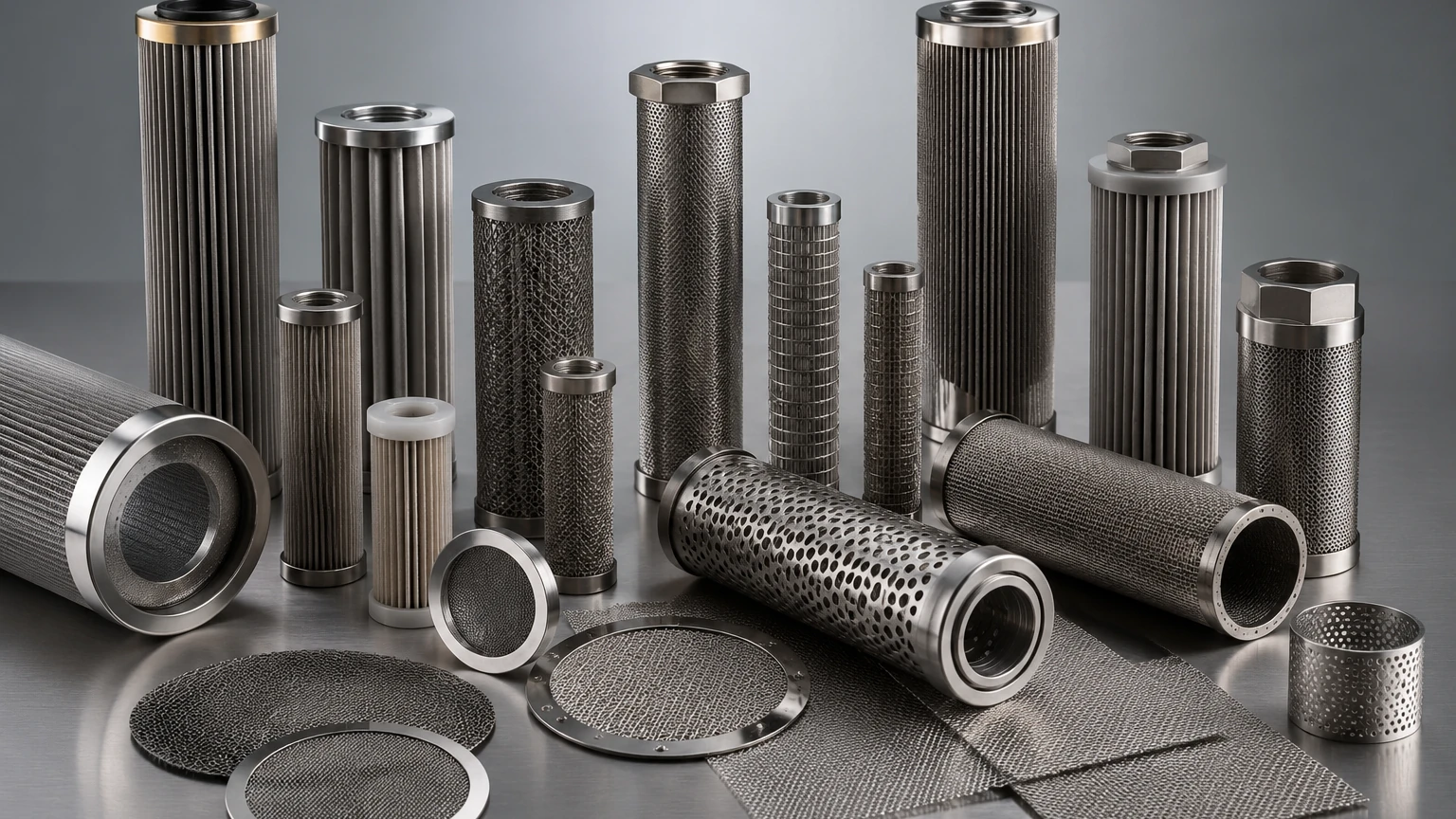
Kaifil’s stainless steel filter cartridges are designed to withstand high differential pressures without collapsing. The construction typically involves multiple layers of wire mesh, often including a support layer, a filtration layer, and a protective outer layer. This multi-layer approach ensures that the filtration surface remains stable even during the high-viscosity conditions encountered during cold starts or when filtering heavy gear oils.
Material Selection: Why Stainless Steel is Essential for Demanding Environments
In many B2B industrial sectors, the operating environment dictates the material requirements of the filtration system. Standard carbon steel or plastic components may fail when exposed to high temperatures, corrosive additives, or high-pressure surges. Stainless steel, specifically grades 304 and 316L, remains the gold standard for these applications.
1. Temperature Resistance: Oil filtration systems in power plants or steel mills often handle fluids at temperatures exceeding 200°C. Stainless steel maintains its mechanical strength and filtration accuracy at these levels, whereas polymer-based media may soften or degrade.
2. Chemical Compatibility: Modern industrial oils contain complex additive packages, including detergents, anti-wear agents, and corrosion inhibitors. Some of these chemicals can be aggressive toward synthetic seals and media. Stainless steel is inert to almost all industrial lubricants and hydraulic fluids.
3. Durability and Reusability: One of the most significant advantages of stainless steel elements in oil filtration systems is that they are often cleanable. Through ultrasonic cleaning or backflushing, the accumulated contaminants can be removed, restoring the element’s permeability. This reduces the total cost of ownership (TCO) by eliminating the need for frequent replacement and reducing hazardous waste disposal costs.
Technical Performance Metrics: Micron Ratings and Beta Ratios
When evaluating oil filtration systems, engineers must look beyond simple "micron ratings." A filter’s performance is more accurately described by its Beta Ratio ($β_x$), which measures the filtration efficiency for a specific particle size ($x$).
The Beta Ratio is calculated as the number of particles of a certain size in the upstream fluid divided by the number of particles of that same size in the downstream fluid. For example, a $β_{10} = 200$ means that for every 200 particles of 10 microns entering the filter, only one passes through. This equates to 99.5% efficiency. In contrast, a "nominal" rating is often poorly defined and may only capture 50% of particles at the stated size. For critical oil filtration systems, absolute-rated stainless steel mesh is preferred to ensure predictable and repeatable cleanliness levels.
Furthermore, the pore structure of the wire mesh—whether it is a plain weave, twilled weave, or Dutch weave—determines the balance between filtration fineness and flow capacity. Dutch weave patterns, for instance, provide a tortuous path for fluid, which enhances the capture of needle-like particles that might otherwise slip through a standard square mesh.
Flow Rate and Pressure Drop Management
A common challenge in designing oil filtration systems is managing the pressure drop ($ΔP$) across the filter element. As oil passes through the filtration media, it encounters resistance. If the resistance is too high, it can lead to power loss, reduced flow to critical components, or the opening of a bypass valve, which allows unfiltered oil to circulate.
Several factors influence pressure drop:
* Fluid Viscosity: High-viscosity oils (like ISO VG 320 or 460) create significantly more resistance than thin hydraulic fluids. Filtration systems for heavy oils require larger surface areas to keep the flux (flow per unit area) low.
* Contaminant Loading: As the filter captures particles, the available flow paths are restricted, causing $ΔP$ to rise over time.
* Media Geometry: Precision-engineered stainless steel mesh allows for a high percentage of open area, which minimizes initial pressure drop while maintaining strict particle retention.
Engineers must size the filtration system based on the maximum expected viscosity (usually at the lowest operating temperature) and the maximum flow rate to ensure the system remains efficient throughout its service life.
Customization and OEM Integration for Specialized Applications
Not every industrial application can be served by off-the-shelf filtration products. Space constraints, unique flow paths, or extreme pressure requirements often necessitate customized solutions. This is where Kaifil’s manufacturing expertise becomes a strategic asset for OEM partners.
Customization options for oil filtration systems include:
* Bespoke End Cap Designs: Ensuring compatibility with existing housings or manifold blocks using threaded, flanged, or O-ring seal interfaces.
* Reinforced Cores: For high-collapse pressure requirements, internal perforated cores or spiral-welded supports can be integrated into the filter cartridge.
* Pleated vs. Cylindrical Elements: Pleating the stainless steel mesh significantly increases the surface area within the same footprint, allowing for higher flow rates and longer service intervals.
By working closely with an experienced manufacturer, purchasing teams can develop filtration components that are perfectly matched to the specific kinematics and fluid properties of their machinery.
Maintenance Strategies and Total Cost of Ownership
The long-term value of oil filtration systems is realized through proactive maintenance and a focus on TCO. While the initial investment in high-quality stainless steel filters may be higher than disposable alternatives, the reduction in machine wear and the ability to clean and reuse the elements provide a rapid return on investment.
Effective maintenance involves monitoring the differential pressure across the filter. Modern systems often incorporate electrical or visual indicators that signal when the element has reached its dirt-holding capacity. Additionally, regular oil analysis (spectroscopy and particle counting) should be performed to verify that the filtration system is achieving the desired ISO cleanliness codes. If an element is cleaned, it is vital to use validated processes—such as controlled ultrasonic baths—to ensure that the mesh structure is not damaged and that all trapped particles are removed.
Conclusion
Selecting and implementing effective oil filtration systems is a technical necessity for any operation relying on high-value industrial machinery. By focusing on high-quality materials like stainless steel and understanding the nuances of Beta ratios, flow dynamics, and material compatibility, engineers can significantly enhance system reliability. Kaifil remains a dedicated partner in this process, providing the precision-engineered components required to keep industrial fluids clean and systems running at peak performance. For more information on custom filtration components and technical specifications, please visit the Main Page to review product options and application support.
