


Woven Wire Fence Options: A Technical Guide for Industrial Applications
In industrial environments, the selection of containment and barrier systems extends far beyond simple perimeter security. For engineers and facility managers, "fencing" often refers to machine guarding, safety partitions, and high-durability enclosures that must withstand corrosive chemicals, extreme temperatures, and mechanical stress. When evaluating woven wire fence options, the primary material of choice is high-grade stainless steel Woven Wire Mesh.
Unlike standard chain-link or welded wire alternatives, woven wire mesh offers a unique combination of structural integrity, customizable aperture sizes, and material longevity. This guide explores the technical considerations, material specifications, and engineering criteria necessary for selecting the right woven wire solutions for demanding industrial sectors, including chemical processing, food and beverage, and pharmaceutical manufacturing.
1. The Engineering Fundamentals of Woven Wire Mesh
Woven wire mesh is produced by weaving individual metallic wires over and under one another on industrial looms. This process creates a stable, consistent fabric that maintains its dimensional accuracy even under tension. In the context of industrial fencing and guarding, the "weave" determines the physical properties of the barrier.
Plain Weave vs. Twill Weave
The most common configuration for industrial barriers is the Plain Weave. In this setup, each warp wire (running lengthwise) passes alternately over and under each weft wire (running crosswise). This results in a highly stable mesh with precise openings, ideal for safety guards where visibility and airflow are required alongside physical protection.
For heavier applications requiring thicker wire diameters relative to the opening size, a Twill Weave may be employed. Here, each warp wire passes over and under two weft wires. This reduces the stress on the wire during the weaving process, allowing for a more flexible yet robust mesh that can be formed into complex enclosure shapes without compromising the integrity of the weave.
2. Material Selection: SS304 vs. SS316L
When reviewing woven wire fence options, the choice of alloy is the most critical factor in determining the total cost of ownership and the replacement cycle. Industrial environments frequently expose barriers to cleaning agents, humidity, and process chemicals.
Stainless Steel 304
SS304 is the industry standard for general-purpose industrial fencing. It provides excellent resistance to atmospheric corrosion and is suitable for most indoor machine guarding and dry-storage partitions. It is cost-effective and offers high tensile strength, ensuring that the mesh can withstand physical impacts without deforming.
Stainless Steel 316L
In environments involving high salinity, acidic vapors, or stringent sanitization protocols (such as in pharmaceutical or food processing plants), SS316L is the preferred specification. The addition of molybdenum in 316L provides superior resistance to pitting and crevice corrosion. Furthermore, the "L" (low carbon) designation ensures that the mesh remains resistant to intergranular corrosion after welding, which is essential if the mesh is to be secured into custom-fabricated frames.
3. Key Specifications for Industrial Barriers
To ensure a woven wire fence meets safety and operational requirements, engineers must define three primary variables: mesh count, wire diameter, and open area.
Mesh Count and Aperture
Mesh count refers to the number of openings per linear inch. For fencing and guarding, a lower mesh count with a larger aperture is typically used to allow for maximum visibility and ventilation. However, if the barrier is intended to prevent the passage of small debris or to act as a finger guard near moving machinery, a higher mesh count (smaller aperture) is required.
Wire Diameter (Gauge)
The diameter of the wire directly impacts the weight and impact resistance of the fence. Heavier gauges are used for high-traffic areas or where heavy equipment is operated. It is vital to balance wire diameter with aperture size; a wire that is too thick for a small aperture will significantly reduce the "Open Area" percentage.
Calculating Open Area
The percentage of open area is a critical calculation for barriers used in ventilated enclosures or around heat-generating machinery. The formula is:
Open Area % = (Aperture / (Aperture + Wire Diameter))² x 100
Maintaining a high open area ensures that cooling fans and HVAC systems can operate efficiently while the woven wire mesh provides the necessary physical protection.
4. Industrial Applications of Woven Wire Mesh Fencing
While traditional fencing focuses on boundaries, industrial woven wire mesh serves specialized functional roles across various sectors.
Machine Guarding and Safety Enclosures
In manufacturing plants, woven wire mesh is used to create safety perimeters around robotic arms, conveyors, and high-speed presses. The transparency of the mesh allows operators to monitor equipment safely from a distance, while the robust nature of stainless steel ensures that the guard can contain mechanical failures or ejected parts.
Cleanroom Partitions
In pharmaceutical and semiconductor manufacturing, partitions must be non-shedding and easy to decontaminate. Stainless steel woven mesh provides a sterile, durable alternative to plastic or painted steel barriers, which can chip or harbor microbial growth over time.
Architectural Filtration and Containment
Large-scale industrial facilities often use woven wire mesh for architectural cladding that doubles as a security fence. These panels provide fall protection on elevated walkways and prevent unauthorized access to sensitive areas like chemical storage tanks, all while maintaining natural light and airflow.
5. Customization and Installation Considerations
Standard off-the-shelf fencing rarely meets the specific needs of a complex industrial layout. Customization is often required to ensure seamless integration into existing infrastructure.
Framed Panels vs. Bulk Rolls
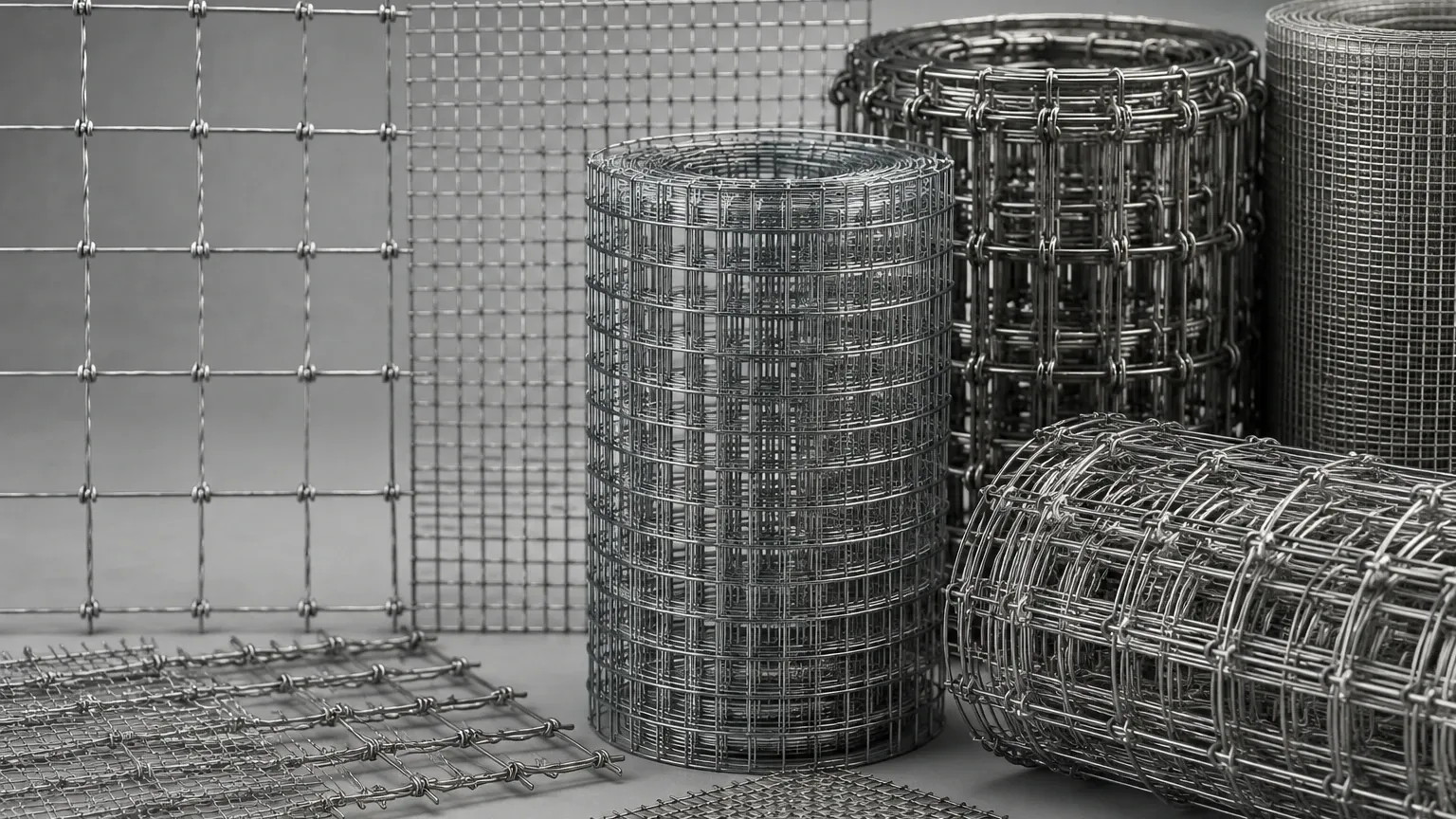
For large-scale perimeter fencing, purchasing woven wire mesh in bulk rolls is often the most economical choice. However, for internal safety guards and partitions, pre-fabricated framed panels are highly recommended. These panels are custom-sized and feature reinforced edges (often U-edging or angle iron frames) that simplify installation and eliminate sharp wire ends, which are a safety hazard for personnel.
Edge Treatments and Secondary Processing
When specifying woven wire fence options, consider the edge treatment. Options include:
* Raw Edges: Suitable for mesh that will be fully enclosed in a channel.
* Hemmed Edges: Folded edges for increased safety during handling.
* Welded Edges: TIG-welded to a frame for maximum structural rigidity.
6. Evaluating Risks and Selection Pitfalls
Choosing the wrong mesh specification can lead to premature failure or safety non-compliance. Common risks include:
* Galvanic Corrosion: This occurs when stainless steel mesh is fastened to a carbon steel frame without proper insulation. In the presence of moisture, the carbon steel will corrode rapidly at the contact points.
* Improper Tensioning: If the mesh is not correctly tensioned within its frame, it may sag or vibrate, leading to metal fatigue and eventual breakage.
* Underestimating Environmental Stress: In high-vibration environments, such as near heavy crushers or vibrating screens, standard mesh may suffer from wire-on-wire wear. Specifying a pre-crimped mesh can mitigate this by locking the wires more securely in place.
7. Total Cost of Ownership and Maintenance
While the initial investment in stainless steel woven wire mesh is higher than that of galvanized or plastic-coated options, the total cost of ownership is significantly lower in industrial settings. Stainless steel requires minimal maintenance—typically only periodic cleaning with water or mild detergents to remove dust and contaminants.
Because stainless steel does not rust, peel, or flake, it eliminates the risk of product contamination in food and pharmaceutical environments. Furthermore, the durability of the material means that replacement cycles are measured in decades rather than years, providing a more sustainable and cost-effective solution for long-term facility management.
Conclusion: Making an Informed Selection
Selecting from the available woven wire fence options requires a deep understanding of the mechanical and chemical demands of your specific application. By focusing on high-quality materials like SS304 and SS316L, and precisely defining mesh count and wire diameter, engineers can implement barrier solutions that enhance safety, ensure compliance, and provide lasting performance.
When sourcing these components, it is essential to work with a manufacturer capable of providing detailed technical specifications and customization options. Whether you require precision cut-to-size panels or high-volume rolls, the right woven wire mesh will serve as a foundational element of your facility's safety and operational efficiency.
