


Coconut Carbon Water Filter
In the landscape of industrial water treatment and liquid process engineering, the selection of filtration media is a critical decision that impacts both the purity of the final product and the operational efficiency of the system. Among the various types of activated carbon used in professional environments, the coconut carbon water filter has emerged as a preferred solution for high-precision applications. Derived from the shells of the *Cocos nucifera*, this renewable media offers unique structural properties that distinguish it from coal-based or wood-based alternatives.
For engineers and procurement specialists, understanding the technical nuances of coconut-shell activated carbon is essential for optimizing filtration systems. This guide examines the material science, performance metrics, and engineering considerations associated with coconut carbon filtration, providing a factual basis for selection in industrial contexts.
The Material Science of Coconut Shell Carbon
The efficacy of a coconut carbon water filter is primarily determined by its internal pore structure. Activated carbon is produced through a two-stage process: carbonization and activation. During carbonization, the coconut shells are heated in an oxygen-free environment to drive off volatile organic compounds. The resulting char then undergoes activation—typically steam activation at high temperatures (800°C to 1000°C)—which creates a vast network of internal pores.
Coconut shells are naturally dense and high in carbon content, which results in a highly developed microporous structure. In the context of activated carbon, pores are classified by size: micropores (less than 2 nm), mesopores (2 to 50 nm), and macropores (greater than 50 nm). Coconut-shell carbon is characterized by a high concentration of micropores, which accounts for approximately 85% to 90% of its total surface area. This high density of micropores makes it exceptionally effective at adsorbing small molecular weight contaminants, such as volatile organic compounds (VOCs), chlorine, and disinfection byproducts (DBPs).
From an engineering perspective, the hardness of the coconut shell is a significant advantage. The resulting carbon granules have high mechanical strength and low attrition rates. This means the media is less likely to break down into fines during backwashing or high-pressure flow conditions, ensuring a cleaner effluent and a longer service life for downstream precision filters.
Key Technical Parameters for Procurement
When evaluating a coconut carbon water filter for industrial use, several technical specifications must be analyzed to ensure the media meets the specific requirements of the application. These parameters provide a standardized way to compare different carbon grades and manufacturers.
Iodine Number
The iodine number is the most common parameter used to characterize activated carbon performance. It measures the milligrams of iodine adsorbed by one gram of carbon when the iodine concentration in the residual filtrate is 0.02 normal. For coconut carbon, iodine numbers typically range from 1,000 to 1,300 mg/g. A higher iodine number indicates a higher degree of activation and a greater surface area available for the adsorption of small molecules.
Ash Content
Ash content refers to the inorganic, non-carbonaceous mineral matter present in the filter media. In high-purity water applications, such as pharmaceutical or semiconductor manufacturing, low ash content is vital to prevent the leaching of minerals (such as silica or iron) into the process stream. Coconut-based carbon naturally has a lower ash content (typically 2% to 5%) compared to coal-based carbon (which can exceed 10%).
Apparent Density
Apparent density measures the mass of the carbon per unit volume. This is a critical factor for sizing filtration vessels and calculating the required contact time. High-quality coconut carbon generally has a density between 0.45 and 0.55 g/cm³. This density ensures that the bed remains stable under flow while providing sufficient porosity for adsorption.
Hardness and Abrasion Number
This metric quantifies the carbon's resistance to degradation. In industrial systems where high-velocity backwashing is frequent, a high hardness number (typically 95% or higher for coconut shells) is necessary to maintain the integrity of the filter bed and prevent premature media loss.
Coconut Carbon vs. Mineral-Based Alternatives
Choosing between coconut-shell carbon and mineral-based (bituminous or lignite coal) carbon involves weighing specific contaminant removal needs against cost and physical properties. While coal-based carbon is often more economical for large-scale municipal wastewater treatment, coconut carbon offers distinct advantages in precision industrial processes.
1. Pore Size Distribution: As noted, coconut carbon is predominantly microporous. Coal-based carbon has a broader distribution of pore sizes, including more mesopores and macropores. While this makes coal carbon better for removing larger organic molecules (like tannins or color-causing compounds), it is less efficient than coconut carbon for removing trace-level VOCs and chlorine.
2. Purity and Leaching: Because coconut shells are a botanical source, they contain fewer heavy metals and inorganic impurities than coal, which is a geological product. This makes coconut carbon the standard for the food and beverage industry and laboratories where water chemistry must remain strictly controlled.
3. Sustainability: Coconut shells are a renewable byproduct of the coconut industry. Utilizing this waste material for water filtration has a lower environmental footprint compared to the mining of coal, which is a finite fossil fuel.
Structural Configurations: GAC vs. Extruded Blocks
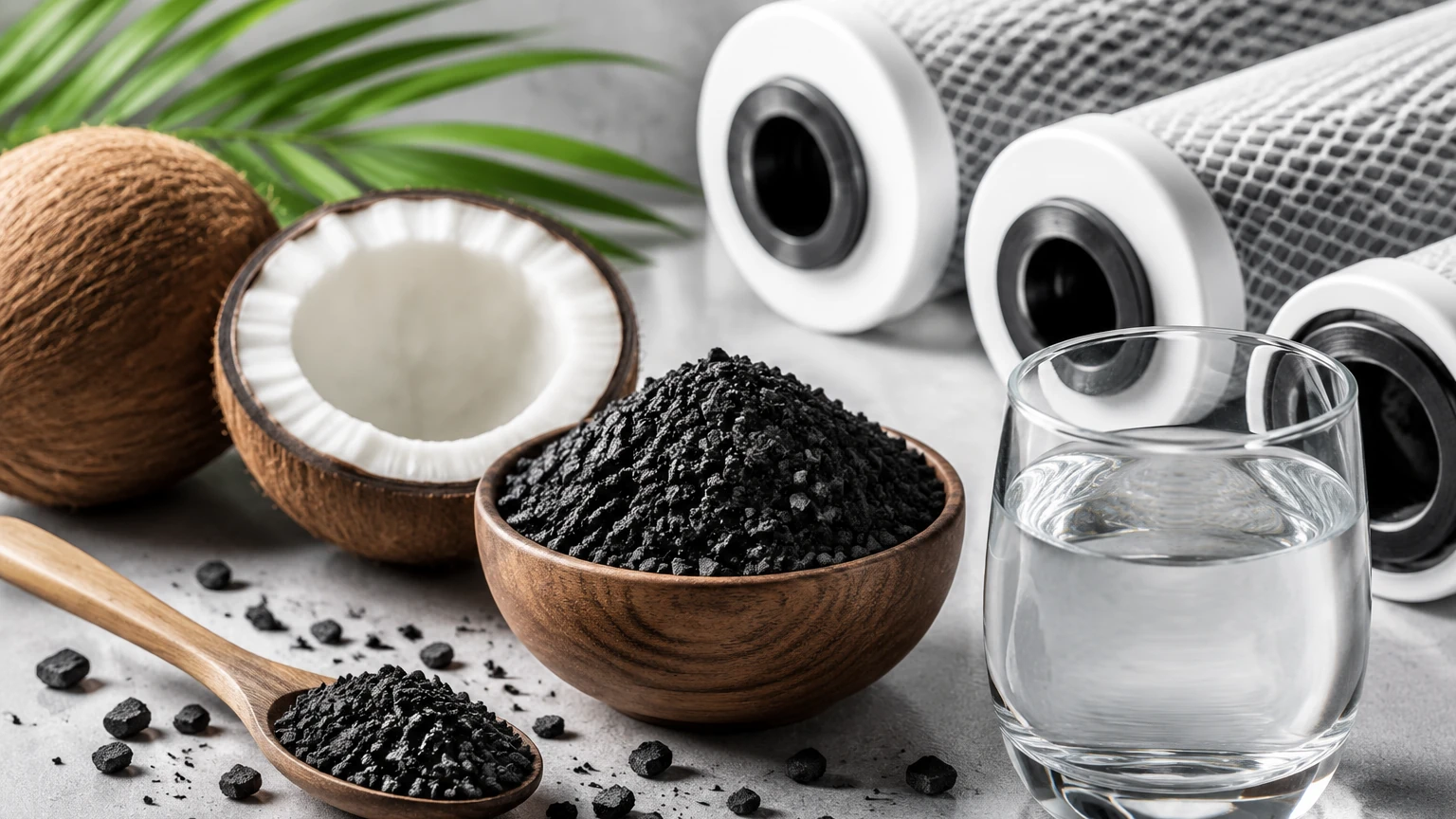
In industrial filtration, a coconut carbon water filter is typically deployed in one of two configurations: Granular Activated Carbon (GAC) or Carbon Blocks. The choice between these depends on the required flow rate, pressure drop constraints, and the target micron rating.
Granular Activated Carbon (GAC)
GAC filters consist of loose carbon granules packed into a vessel or cartridge. They are ideal for high-flow applications where low pressure drop is a priority. GAC is commonly used in large-scale pretreatment systems to protect reverse osmosis (RO) membranes from chlorine damage. However, GAC is susceptible to "channeling," where water finds the path of least resistance through the bed, potentially bypassing the media and reducing contact time.
Extruded and Pressed Carbon Blocks
Carbon blocks are manufactured by bonding fine carbon powder with a food-grade binder and then extruding or compressing it into a solid cylinder. This structure forces water to pass through a uniform matrix, eliminating the risk of channeling. Carbon blocks provide both chemical adsorption and mechanical filtration. Depending on the manufacturing process, they can achieve sub-micron ratings (e.g., 0.5 to 5 microns), allowing them to remove cysts like *Giardia* and *Cryptosporidium* in addition to chemical contaminants.
For engineers designing integrated systems, it is common to use a GAC stage for bulk chlorine removal followed by a carbon block for fine polishing and sediment control. For those seeking specialized housings and integrated components, visiting the Main Page of a professional manufacturer can provide insights into how these media are supported by stainless steel hardware.
Industrial Application and Chemical Compatibility
The versatility of coconut carbon allows it to be used across diverse industrial sectors. Its chemical compatibility and high adsorption capacity make it a staple in process water loops.
* Food and Beverage: Used to remove chlorine and off-flavors from ingredient water. The low ash content ensures that the water does not affect the pH or mineral balance of the final beverage.
* Pharmaceutical and Biotech: Employed as a pretreatment step to remove organic impurities and chlorine that could degrade sensitive downstream equipment or interfere with biological processes.
* Power Generation: Used in condensate polishing and boiler feed water treatment to remove organic acids that can cause corrosion in high-pressure steam systems.
* Chemical Processing: Utilized for the purification of chemical intermediates and the removal of trace organic pollutants from process effluent before discharge.
When specifying a filter for these applications, engineers must confirm that the housing materials—typically 304 or 316L stainless steel—are compatible with the process fluid and the operating temperatures. Coconut carbon itself is chemically inert in most aqueous environments, but the presence of strong oxidizers can cause the carbon to degrade over time.
Engineering Considerations for System Integration
Integrating a coconut carbon water filter into an industrial system requires careful calculation of hydraulic parameters. Two of the most critical factors are Empty Bed Contact Time (EBCT) and Pressure Drop (ΔP).
Empty Bed Contact Time (EBCT)
EBCT is the measure of how long the fluid remains in contact with the carbon media. It is calculated by dividing the volume of the carbon bed by the flow rate. For effective chlorine removal, an EBCT of 2 to 5 minutes is generally sufficient. However, for the removal of complex organics or chloramines, an EBCT of 10 minutes or more may be required. Sizing the filtration vessel correctly is essential to ensure that the EBCT meets the requirements for the specific contaminant being targeted.
Pressure Drop and Flow Rate
As fluid passes through a carbon block or GAC bed, it encounters resistance, resulting in a pressure drop. This drop increases as the filter accumulates sediment or as the flow rate increases. Engineers must ensure that the system's pumps can handle the maximum expected ΔP at the end of the filter's service life. Using high-quality stainless steel housings with precision-engineered internal distributors can help minimize turbulence and unnecessary pressure loss.
Micron Rating and Pre-filtration
While carbon blocks provide mechanical filtration, using them as the primary sediment filter can lead to premature clogging (blinding) of the carbon pores. To maximize the life of a coconut carbon water filter, it is often preceded by a stainless steel wire mesh filter or a pleated sediment cartridge. This ensures that the carbon media is reserved for chemical adsorption rather than physical particle removal.
Maintenance, Service Life, and Replacement Protocols
Unlike mechanical filters that can sometimes be cleaned or backwashed, the chemical adsorption capacity of activated carbon is finite. Once all the available pore sites are filled (exhausted), the carbon will no longer remove contaminants, and "breakthrough" occurs, where the concentration of the contaminant in the effluent equals that of the influent.
Monitoring for Breakthrough
In critical industrial processes, monitoring is usually performed through regular sampling and laboratory analysis or through online sensors (e.g., total organic carbon (TOC) analyzers or free chlorine sensors). A common practice is to use a lead-lag configuration, where two carbon filters are placed in series. When the lead filter reaches breakthrough, it is replaced, and the lag filter is moved to the lead position, ensuring continuous protection.
Replacement Cycles
The service life of a coconut carbon water filter depends on the contaminant load, flow rate, and the volume of carbon. In many industrial settings, filters are replaced on a scheduled basis (e.g., every 6 to 12 months) to prevent bacterial growth within the carbon bed, as the adsorbed organics can serve as a food source for microbes.
Sanitization
If the filtration system is part of a sanitary process, the carbon filter and its housing must be capable of withstanding sanitization procedures. While the carbon itself cannot be easily sterilized without losing some capacity, the use of stainless steel housings allows for steam-in-place (SIP) or hot water sanitization of the surrounding hardware.
Conclusion
The coconut carbon water filter represents a sophisticated intersection of natural material science and industrial engineering. Its high microporosity, mechanical durability, and low impurity profile make it an indispensable tool for achieving high-purity water in demanding sectors. By focusing on technical parameters such as iodine value, EBCT, and structural integrity, engineers can design filtration systems that deliver consistent performance and long-term reliability.
When sourcing these components, it is vital to partner with manufacturers who understand the complexities of industrial filtration. For technical specifications on housings and customized filtration assemblies that support coconut carbon media, professionals can Review product options and application support to ensure their systems are built to the highest engineering standards.
