


Fish Tank Filter Socks
In industrial-scale aquatic systems, public aquariums, and commercial aquaculture facilities, mechanical filtration serves as the primary defense against the accumulation of particulate matter. Fish tank filter socks are a critical component in these systems, positioned at the initial stage of the filtration cycle to capture detritus, uneaten feed, and organic debris before the water enters biological or chemical processing stages. While often viewed as simple consumables, the engineering behind these components—ranging from material selection to pore geometry—significantly impacts water quality, system maintenance cycles, and the overall operational efficiency of the facility.
For engineers and procurement professionals managing large-scale aquatic environments, selecting the appropriate filtration media requires a technical understanding of particle dynamics and material durability. As a specialist in custom stainless steel filtration, Kaifil provides high-performance alternatives to standard synthetic media, ensuring that even the most demanding industrial filtration requirements are met with precision. For more information on our full range of capabilities, visit our Main Page.
The Role of Mechanical Filtration in Aquatic Environments
Mechanical filtration via fish tank filter socks operates on the principle of physical separation. As water gravity-feeds from the primary display or culture tank into a sump or filtration manifold, it passes through the sock media. This process targets suspended solids (TSS), which, if left unmanaged, contribute to increased biological oxygen demand (BOD) and the elevation of ammonia, nitrite, and nitrate levels as organic matter decomposes.
From an engineering perspective, the efficiency of a filter sock is defined by its ability to maintain a high flow rate while maximizing particle retention. In commercial settings, where flow rates can reach hundreds of gallons per minute, the structural integrity of the filter sock and its mounting hardware is paramount. A failure in the mechanical stage can lead to the clogging of secondary systems, such as protein skimmers, UV sterilizers, and fine-pore biological media, leading to costly downtime and potential livestock loss.
Material Science: Felt vs. Mesh vs. Metal Media
Filter socks are generally categorized by their construction material, each offering distinct advantages based on the specific filtration goals of the system.
1. Polyester and Polypropylene Felt
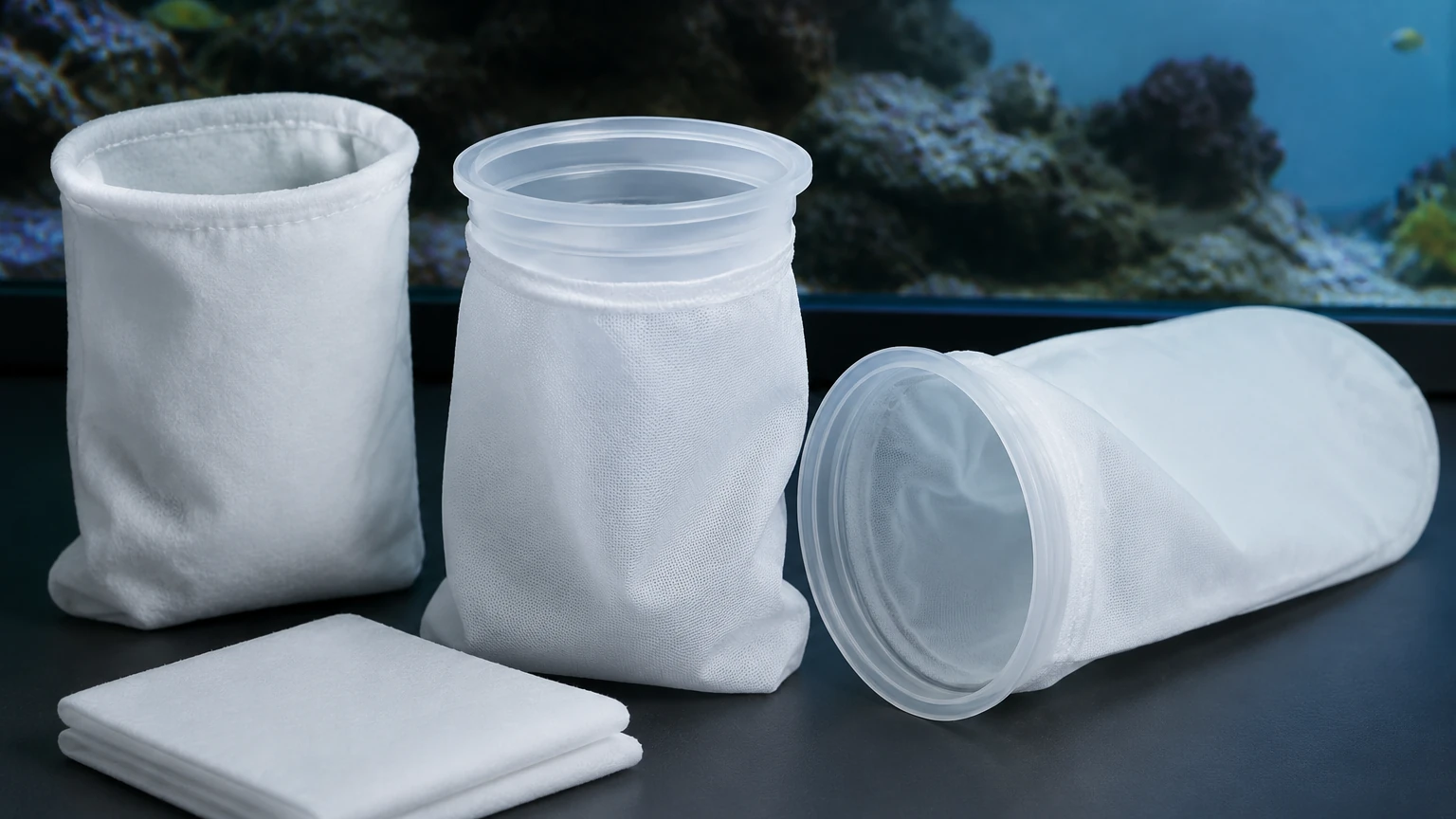
Felt socks are a form of depth filtration. They consist of a non-woven mat of fibers that create a tortuous path for water. Particles are trapped not just on the surface, but throughout the thickness of the material. This allows for a high dirt-holding capacity. However, felt media is prone to clogging more rapidly than mesh and can be difficult to clean thoroughly, often requiring high-pressure washing or chemical treatment to restore flow.
2. Nylon and Monofilament Mesh
Mesh socks provide surface filtration. They are constructed with a precise, woven grid of fibers. Because the openings are uniform, mesh socks offer a very predictable micron rating. They are significantly easier to clean than felt because the trapped particles remain on the surface. However, they have a lower total dirt-holding capacity, as they lack the internal volume of depth media.
3. Stainless Steel Wire Mesh
In industrial applications where durability and chemical resistance are required, stainless steel wire mesh components are increasingly preferred. Unlike synthetic fibers, 304 or 316L stainless steel does not degrade over time when exposed to ozone or harsh cleaning agents. These components offer superior structural rigidity, preventing the "blow-out" or stretching that can occur with fabric fish tank filter socks under high-pressure conditions. Engineers often specify metal mesh for permanent installations where the total cost of ownership (TCO) is reduced by eliminating the need for frequent disposable replacements.
Technical Specifications and Micron Ratings
The performance of fish tank filter socks is primarily measured by their micron rating, which defines the size of the particles the media is capable of intercepting. Common ratings in the industry range from 25 microns to 200 microns.
* Fine Filtration (25–50 Microns): These are used for polishing water to achieve maximum clarity. They capture very fine particulates but require frequent monitoring as they can clog within hours in high-bioload systems.
* Standard Filtration (100 Microns): Often considered the industry standard for reef systems and general aquaculture, providing a balance between water clarity and maintenance intervals.
* Coarse Filtration (200+ Microns): Used in systems with high debris loads or as a pre-filter to prevent larger solids from entering sensitive pump intakes.
When selecting a micron rating, engineers must calculate the expected pressure drop (delta P) across the media. As the sock traps particles, the resistance to flow increases. If the system is not designed with an adequate overflow or bypass mechanism, a clogged sock can lead to a sump overflow or a reduction in the turnover rate of the entire system.
Engineering Considerations for System Integration
Integrating fish tank filter socks into an industrial filtration skid requires more than just selecting a bag size. Several mechanical factors must be addressed during the design phase:
Flow Dynamics and Velocity
Water entering the sock should be distributed evenly to avoid localized high-velocity zones that can force particles through the media (particle migration). In large sumps, multiple socks are often used in parallel to distribute the flow, reducing the velocity through any single unit and extending the time between cleanings.
Bypass and Fail-Safe Mechanisms
In a B2B or commercial context, a clogged filter must not result in system failure. Professional filter sock holders are designed with an integrated bypass. When the water level rises inside a clogged sock, the excess water is diverted over a weir into the sump. While this temporarily bypasses the mechanical stage, it prevents the catastrophic loss of water from the system.
Material Compatibility
In saltwater applications or chemical processing, the choice of material is critical to prevent corrosion. While plastic rings and synthetic bags are common, high-end systems utilize 316L stainless steel for its resistance to pitting and crevice corrosion. This is particularly important in systems utilizing ozone (O3), which can rapidly degrade many common plastics and adhesives used in standard fish tank filter socks.
Maintenance, Durability, and Total Cost of Ownership (TCO)
For commercial operators, the labor cost associated with changing and cleaning filter socks often exceeds the cost of the socks themselves. Therefore, durability and ease of maintenance are key metrics.
Synthetic socks are typically cleaned via mechanical agitation in industrial washers. However, the fibers eventually fray, and the pore size becomes inconsistent. Stainless steel filtration components, such as those manufactured by Kaifil, offer a much longer service life. They can be cleaned using ultrasonic baths or backwashing cycles, maintaining their precise filtration accuracy for years. When evaluating the TCO, facilities must weigh the initial capital expenditure (CAPEX) of permanent metal filters against the ongoing operational expenditure (OPEX) of disposable synthetic bags.
Customization and OEM Solutions
Standard off-the-shelf filter socks may not meet the requirements of specialized research laboratories or large-scale public aquarium displays. Customization options often include:
* Custom Flange Designs: Ensuring a precision fit into existing proprietary filtration skids to eliminate bypass.
* Variable Lengths: Optimizing the surface area for specific sump depths.
* Reinforced Structures: Adding internal cages or supports to handle high-pressure differentials in pressurized filter housings.
At Kaifil, we specialize in translating these technical requirements into high-performance hardware. Our expertise in wire mesh and stainless steel fabrication allows us to support OEM partners and facility engineers in developing filtration solutions that exceed the limitations of standard consumer-grade products. Whether you require precision-engineered cartridges or custom metal mesh supports, our team provides the technical guidance necessary for optimal system performance. To explore our custom manufacturing capabilities, please visit our Main Page.
Conclusion
Fish tank filter socks are a vital, yet often overlooked, component of aquatic life support systems. By understanding the technical nuances of material science, micron ratings, and flow dynamics, engineers can significantly improve the water quality and operational reliability of their facilities. Transitioning from standard synthetic media to precision-engineered filtration solutions can lead to better performance, reduced waste, and a lower total cost of ownership in professional and industrial applications.
