


In industrial filtration, the precision of a separation process is dictated by the geometry and consistency of the filter media. For engineers and technical procurement teams, selecting woven wire mesh screens with fine opening sizes is a critical decision that impacts throughput, product purity, and equipment longevity. These specialized screens are engineered to provide precise apertures, often measured in microns, to facilitate the removal of particulate matter from liquids and gases in highly demanding environments.
At Kaifil, manufacturing these components requires a deep understanding of metallurgy, weaving physics, and fluid dynamics. This guide explores the technical considerations, material properties, and selection criteria essential for implementing fine-mesh filtration solutions in industrial applications.
The Technical Fundamentals of Fine Opening Mesh
The performance of Woven Wire Mesh is defined by three primary variables: mesh count, wire diameter, and aperture size. In standard industrial mesh, the aperture is the clear distance between two adjacent wires. However, as we move into the realm of fine opening sizes—typically defined as apertures below 100 microns—the complexity of the weave increases.
Mesh Count vs. Micron Rating
Mesh count refers to the number of openings per linear inch. While higher mesh counts generally correspond to smaller openings, the wire diameter plays a significant role in determining the final micron rating. For example, a 325-mesh screen using a 0.035mm wire will have a different effective opening than one using a 0.030mm wire. For engineers, the micron rating (the diameter of the smallest spherical particle that will be retained) is usually the more relevant metric than the mesh count alone.
The Role of Open Area
The percentage of open area is a vital calculation for determining flow capacity and pressure drop. In fine mesh screens, the open area is often lower than in coarse screens because thinner wires are required to maintain structural integrity at high mesh counts. Calculating the open area involves the formula:
*Open Area % = (Aperture / (Aperture + Wire Diameter))² x 100*
Maintaining a balance between a fine opening size and a sufficient open area is essential to prevent premature blinding and excessive system pressure.
Weave Patterns for Fine Filtration Requirements
Not all weave patterns are suitable for achieving fine opening sizes while maintaining mechanical stability. The choice of weave affects the screen's pore shape, surface smoothness, and resistance to deformation.
Plain and Twill Weaves
In a plain weave, each shute wire passes alternately over and under each warp wire. This is the most common weave for industrial screening but has physical limits when very fine openings are required because the bending of the wire (crimp) becomes too severe for thicker wires. To achieve finer apertures without sacrificing wire strength, a twill weave is often employed. In a twill weave, each shute wire passes over and under two warp wires, allowing for a heavier wire diameter relative to the opening size, which increases the durability of the screen.
Dutch Weave Variations
For the most demanding precision tasks, Dutch weaves are the industry standard. Unlike plain or twill weaves, Dutch weaves use different diameters for the warp and shute wires. The wires are driven together tightly, creating a "tortuous path" rather than a straight-through hole.
* Plain Dutch Weave: Provides a high-strength mesh with relatively fine openings and excellent flow rates.
* Twill Dutch Weave: Allows for the finest filtration levels, often reaching down to 1–5 microns. These are frequently used in high-pressure hydraulic systems and pharmaceutical processing.
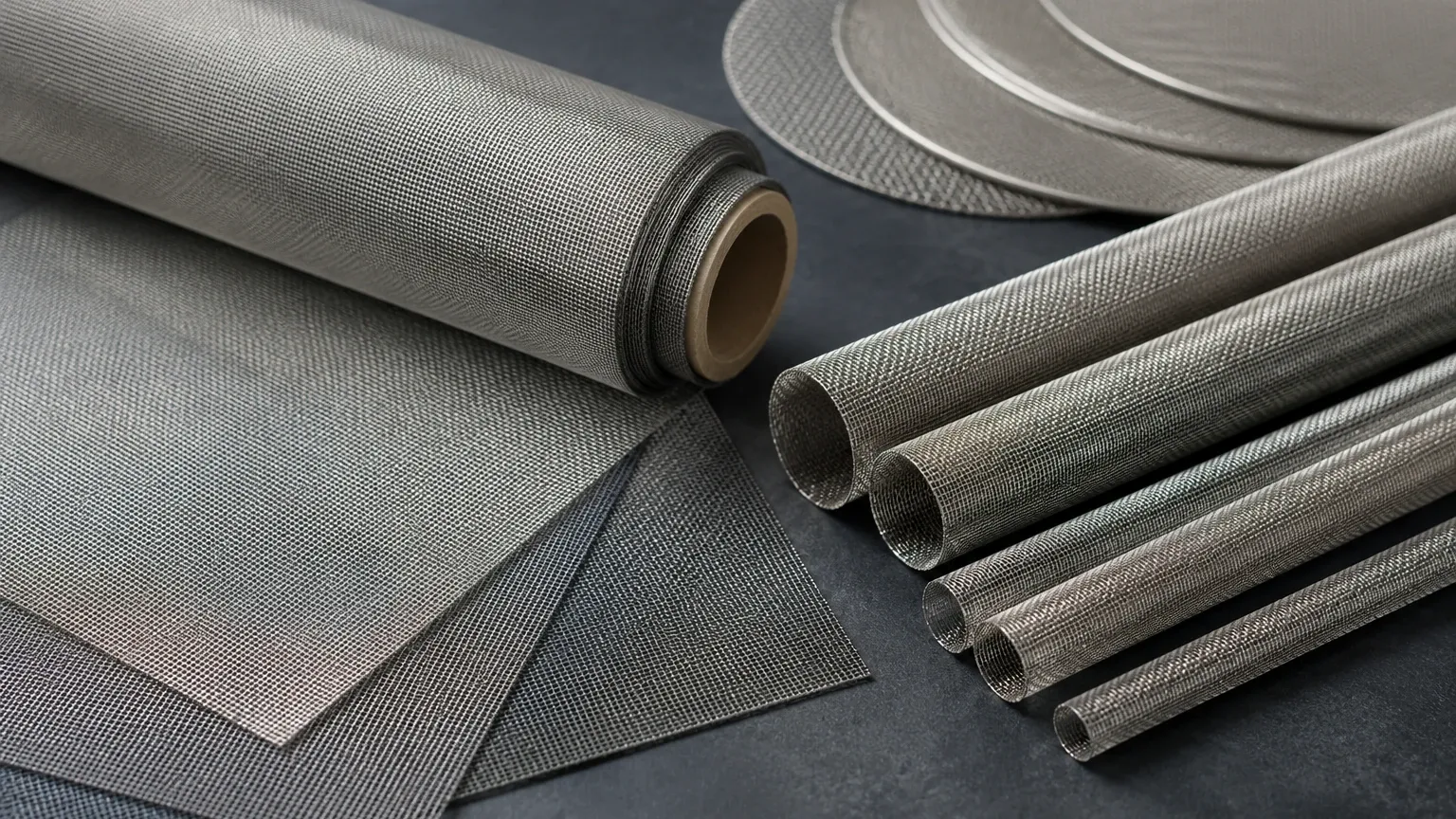
For those seeking specific configurations, Plain, twill and dutch woven wire mesh in SS304/316L — rolls, cut mesh and framed panels. Send mesh count or micron target for a technical quote. to ensure the weave pattern aligns with your pressure and retention requirements.
Material Selection for Chemical and Thermal Stability
The longevity of woven wire mesh screens with fine opening sizes depends heavily on the alloy selected. Because the wires in fine mesh are extremely thin, they are more susceptible to corrosion and mechanical wear than the thicker wires used in coarse screening.
Stainless Steel 304 and 316L
Stainless steel is the primary material for industrial filtration due to its balance of cost and performance.
* SS304: Suitable for general industrial use where mild corrosion resistance is required.
* SS316L: The preferred choice for chemical processing and marine environments. The addition of molybdenum and a lower carbon content provides superior resistance to pitting and intergranular corrosion, which is vital when dealing with the high surface-area-to-volume ratio of fine wires.
Specialty Alloys
In extreme environments, such as those involving highly acidic fluids or temperatures exceeding 800°C, specialty alloys like Inconel, Monel, or Hastelloy may be necessary. These materials maintain their tensile strength and oxidation resistance where standard stainless steels would fail, ensuring that the fine opening geometry remains stable over time.
Engineering Considerations: Flow Rate and Pressure Drop
When integrating fine mesh screens into a system, engineers must account for the initial and terminal pressure drop (ΔP). Fine openings inherently create more resistance to flow. If the mesh is too fine for the application, the velocity of the fluid through the apertures can increase significantly, leading to:
1. Particle Impingement: High-velocity particles can strike the wire mesh, causing mechanical erosion or forcing deformable particles through the openings.
2. Accelerated Blinding: Fine particles can become trapped within the weave (depth loading), rapidly reducing the effective open area.
3. Structural Fatigue: Excessive pressure differential across a fine mesh can cause the wires to shift or the mesh to bulge, compromising the filtration accuracy.
To mitigate these risks, it is often necessary to use a multi-layer approach where a fine mesh screen is supported by a coarser, heavier mesh or a perforated metal plate. This provides the necessary mechanical strength while allowing the fine mesh to perform the actual separation.
Quality Control and Verification of Fine Openings
For critical applications in the pharmaceutical or aerospace sectors, "nominal" filtration ratings are often insufficient. Verification of the actual opening size is required to ensure process safety. Kaifil utilizes several methods to validate the performance of our Woven Wire Mesh products:
* Optical Inspection: Using high-resolution digital microscopy to measure aperture consistency and wire diameter across the entire roll.
* Bubble Point Testing: A non-destructive test used to determine the largest pore size of a filter element by measuring the pressure required to force air bubbles through a liquid-saturated mesh.
* Glass Bead Testing: Passing calibrated glass spheres through the mesh to determine the absolute retention rating.
Ensuring that the mesh meets ISO 9044 standards for industrial wire cloth is a baseline requirement for any high-performance filtration system.
Maintenance and Cleaning of Fine Mesh Screens
The total cost of ownership for filtration components is heavily influenced by their cleanability. Unlike disposable polymer filters, stainless steel woven wire mesh screens with fine opening sizes are designed to be cleaned and reused. However, the cleaning method must be compatible with the delicate nature of the fine wires.
Ultrasonic Cleaning
For fine meshes, ultrasonic cleaning is often the most effective method. High-frequency sound waves create cavitation bubbles that dislodge particles trapped deep within the weave without the need for mechanical scrubbing, which could damage the fine wire structure.
Backwashing and Chemical Cleaning
In automated systems, backwashing (reversing the flow) can extend the interval between deep cleanings. If the mesh is used in food or chemical processing, chemical CIP (Clean-In-Place) procedures using caustic or acidic solutions can be used, provided the mesh material (e.g., SS316L) is compatible with the cleaning agents.
Applications of Fine Opening Mesh Screens
Fine mesh screens are utilized across a spectrum of industries where precision is non-negotiable:
* Pharmaceuticals: Used in the recovery of active pharmaceutical ingredients (APIs) and the filtration of sterile fluids.
* Food and Beverage: Critical for the clarification of juices, oils, and syrups, ensuring that no microscopic contaminants reach the final product.
* Hydraulics: Fine Dutch weave screens protect sensitive valves and actuators from particulate wear in high-pressure systems.
* Water Treatment: Used in micro-screening processes to remove fine silt and biological matter before membrane filtration.
Conclusion: Selecting the Right Filtration Partner
Choosing the correct woven wire mesh screens with fine opening sizes involves more than just selecting a micron rating. It requires a comprehensive evaluation of the fluid characteristics, operating pressures, and environmental conditions. By focusing on precision manufacturing and material integrity, Kaifil provides filtration solutions that meet the rigorous standards of modern industry.
Whether you require customized filter cartridges or bulk rolls of high-precision mesh, understanding the technical nuances of weave patterns and material properties is the first step toward optimized filtration performance. Engineers should prioritize suppliers who can provide documented verification of aperture accuracy and technical support for complex integration challenges.
Download Woven Wire Mesh Screens with Fine Opening Sizes as a PDF
