


In industrial filtration and separation processes, the selection of the correct filter medium is a critical engineering decision that directly impacts throughput, product purity, and equipment longevity. Among the various options available, Woven Wire Mesh remains a primary choice due to its mechanical strength, heat resistance, and precise aperture control. However, the performance of the mesh is not solely determined by the material alloy; the specific weave pattern—the geometric arrangement of the wires—defines the functional characteristics of the medium.
Understanding the different types of woven wire mesh is essential for engineers and procurement teams tasked with optimizing filtration systems. Each weave type offers a unique balance of flow capacity, particle retention, and structural integrity. This guide provides a technical overview of the primary weave structures, their engineering trade-offs, and the criteria for selecting the appropriate configuration for demanding industrial applications.
Comparative Analysis of Primary Types of Woven Wire Mesh
The geometry of a weave is determined by the way the warp wires (running lengthwise) and the shute or weft wires (running crosswise) intersect. These patterns are categorized based on their complexity and the resulting aperture shape.
1. Plain Weave
Plain weave is the most fundamental and widely used type of woven wire mesh. In this configuration, each shute wire passes alternately over and under each warp wire. This results in a square aperture with high dimensional stability.
* Engineering Characteristics: It offers the highest open area relative to wire diameter, making it ideal for applications requiring high flow rates and low pressure drops.
* Typical Use Cases: General screening, protective guards, and coarse filtration where high throughput is prioritized over extreme precision in sub-micron ranges.
2. Twill Weave
In a twill weave, each shute wire passes alternately over and under two warp wires. This staggered arrangement allows for the use of heavier wire diameters than would be possible in a plain weave of the same mesh count.
* Engineering Characteristics: Twill weave is more flexible than plain weave and can support higher mechanical loads. It is often employed when a fine mesh count is required but the wire must be thick enough to withstand significant pressure or abrasion.
* Typical Use Cases: Fine chemical filtration, hydraulic fluids, and applications where the mesh is subject to frequent cleaning or mechanical stress.
3. Plain Dutch Weave
Unlike plain or twill weaves, Dutch weaves utilize different wire diameters for the warp and shute. In a Plain Dutch Weave, a limited number of thicker warp wires are interwoven with a high number of thinner shute wires. The result is a dense, "zero-open-area" appearance when viewed directly, as the shute wires are driven close together.
* Engineering Characteristics: This structure creates a tortuous path for fluids, providing excellent particle retention. It is characterized by high mechanical strength and a relatively low pressure drop compared to its filtration fineness.
* Typical Use Cases: High-pressure liquid filtration, fuel filters, and gas purification.
4. Twill Dutch Weave
Combining the principles of twill and Dutch weaves, the Twill Dutch Weave involves shute wires passing over and under two warp wires in a dense arrangement. This allows for the highest density of wires and, consequently, the finest filtration ratings.
* Engineering Characteristics: It can achieve absolute filtration ratings in the 5 to 20-micron range. The overlapping wires create a stable, rigid structure that can handle extreme differential pressures.
* Typical Use Cases: Critical pharmaceutical processing, aerospace filtration, and high-purity chemical production.
5. Reverse Dutch Weave
As the name suggests, the Reverse Dutch Weave flips the standard Dutch configuration. It uses a high number of thick warp wires and a lower number of thinner shute wires.
* Engineering Characteristics: This results in a mesh with exceptional tensile strength along the length of the roll. It is particularly effective in automated filtration systems where the mesh is under constant tension.
* Typical Use Cases: Continuous plastic melt filtration, high-pressure sand control in oil and gas, and horizontal leaf filters.
Engineering Considerations: Micron Rating and Open Area
When evaluating the types of woven wire mesh, engineers must reconcile two often-competing factors: filtration accuracy (micron rating) and flow capacity (percentage of open area).
Micron Rating: Nominal vs. Absolute
* Nominal Micron Rating: This refers to the ability of the mesh to retain a certain percentage of particles of a specific size. It is often used for plain and twill weaves where the aperture is a simple square.
* Absolute Micron Rating: This is the diameter of the largest hard spherical particle that will pass through the mesh under specified test conditions. For Dutch weaves, where the openings are triangular and complex, the absolute rating is the standard metric for precision.
The Role of Open Area
The percentage of open area (POA) determines the flow velocity and the rate of pressure increase as the filter cakes. A higher POA reduces the initial pressure drop but may compromise the structural integrity of the mesh if the wire diameter is too thin. In high-viscosity applications, such as polymer filtration, calculating the POA is vital to prevent pump cavitation or media deformation. For those requiring specific configurations, Plain, twill and dutch woven wire mesh in SS304/316L — rolls, cut mesh and framed panels. Send mesh count or micron target for a technical quote. can provide the necessary data for flow calculations.
Material Selection for Demanding Industrial Environments
The performance of Woven Wire Mesh is heavily dependent on the alloy used. While various metals are available, stainless steel remains the industry standard for its balance of cost and performance.
AISI 304 Stainless Steel
304 is the most common grade, offering good corrosion resistance and excellent forming properties. It is suitable for most atmospheric conditions and many mild chemical environments. However, it is susceptible to pitting and crevice corrosion in chloride-rich environments (such as seawater or certain food processing brines).
AISI 316L Stainless Steel
316L contains molybdenum, which significantly enhances its resistance to chlorides and acids. The "L" denotes low carbon content, which prevents carbide precipitation during welding, ensuring that the mesh remains corrosion-resistant at the joints. This is the preferred material for pharmaceutical, marine, and aggressive chemical applications.
High-Temperature Alloys
For applications exceeding 400°C, such as catalyst recovery or hot gas filtration, specialized alloys like Inconel or Monel may be required. These materials maintain their mechanical properties and oxidation resistance at temperatures where standard stainless steels would fail.
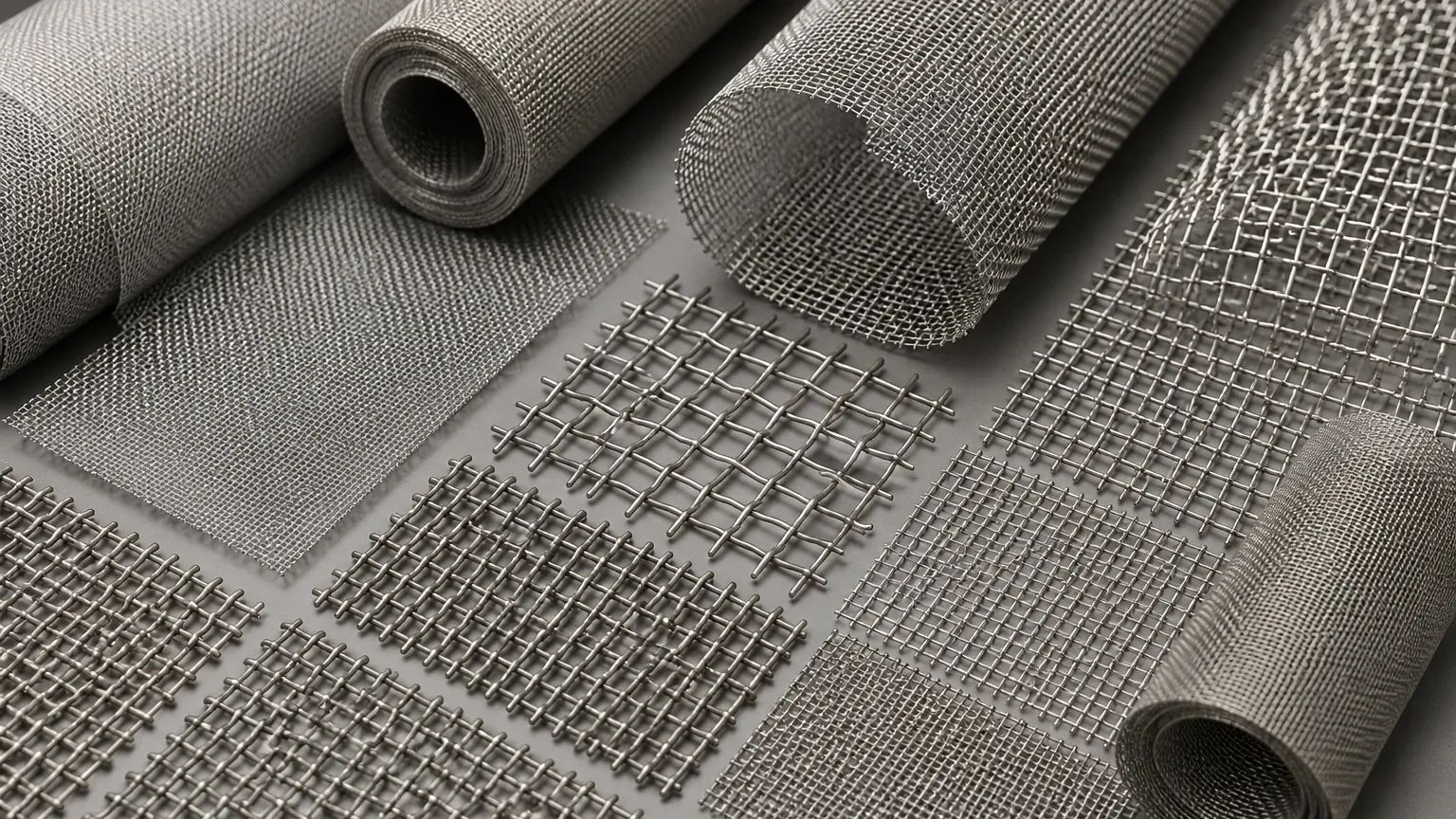
Identifying and Mitigating Common Selection Risks
Selecting the wrong mesh type or material can lead to catastrophic system failure, including media migration, premature clogging, or chemical contamination. Engineers should be aware of the following risks:
1. Media Migration: In low-quality mesh, wires may shift or break under high pressure, allowing metal fragments or unfiltered particles to pass downstream. Specifying a weave with high stability, such as a twill or Dutch weave, can mitigate this.
2. Blinding and Plugging: If the particle size is very close to the aperture size, particles can become wedged in the mesh (blinding). Selecting a weave that allows for easier backwashing or cake release, such as certain Dutch weaves, can extend the service life between cleanings.
3. Corrosion Fatigue: In systems with fluctuating pressures and corrosive fluids, the mesh wires are subject to cyclic stress. If the material is not properly matched to the chemical environment, micro-cracks can form, leading to sudden failure.
4. Inaccurate Micron Ratings: Not all manufacturers adhere to strict tolerances. It is essential to confirm that the mesh has been produced to international standards (such as ISO 9044) to ensure that the filtration performance matches the design specifications.
Technical Checklist for Procurement and Engineering Teams
Before finalizing a purchase or design specification for Woven Wire Mesh, technical teams should confirm the following parameters with the manufacturer:
* Mesh Count: The number of wires per linear inch in both directions.
* Wire Diameter: Specified for both warp and shute wires, as these may differ in Dutch weaves.
* Aperture Size: The clear distance between wires, which defines the filtration limit.
* Thickness: The overall thickness of the woven medium, which affects its fit in filter housings.
* Surface Treatment: Does the application require ultrasonic cleaning, degreasing, or passivation to ensure purity?
* Form Factor: Will the mesh be supplied as bulk rolls, cut-to-size circles, or integrated into framed panels or cartridges?
By systematically evaluating the different types of woven wire mesh against the specific requirements of the process—including fluid chemistry, temperature, pressure, and target particle size—engineers can ensure a filtration solution that provides both high efficiency and a low total cost of ownership. Kaifil’s expertise in manufacturing custom stainless steel filtration components ensures that these technical nuances are addressed from the initial material selection through to final production.
