


Reticulated Foam Suppliers
In the landscape of industrial filtration and material science, reticulated foam stands as a critical component for applications ranging from HVAC systems and acoustic dampening to sophisticated fluid management. For engineers and procurement professionals, identifying the right reticulated foam suppliers involves more than a simple price comparison. It requires a deep understanding of pore geometry, material compatibility, and the manufacturing precision necessary to ensure consistent performance in demanding environments.
Reticulated foam is characterized by its highly open, three-dimensional structure. Unlike standard flexible foams, which contain a mix of open and closed cells, reticulated foam undergoes a secondary manufacturing process—typically thermal or chemical "zapping"—that removes the cell membranes, leaving only the skeletal strands. This results in a material with high porosity, low density, and a predictable surface area, making it an ideal medium for filtration. When evaluating suppliers, technical teams must scrutinize the supplier’s ability to control these skeletal structures to meet specific industrial tolerances.
Understanding the Technical Specifications of Reticulated Foam
The primary metric used by reticulated foam suppliers to categorize their products is Pores Per Inch (PPI). This measurement defines the coarseness or fineness of the foam and directly impacts both filtration efficiency and pressure drop. Common industrial grades range from 10 PPI (very coarse) to 100 PPI (very fine).
However, PPI is not the only factor. Engineers must also consider the "void volume," which in high-quality reticulated foams typically exceeds 95%. This high void volume allows for high flow rates with minimal resistance. Suppliers should provide detailed data on the following:
* Cell Diameter: While PPI gives a general idea, actual cell diameter measurements provide a more precise understanding of the particles the foam can trap.
* Density: Measured in pounds per cubic foot (PCF) or kilograms per cubic meter, density influences the mechanical strength and durability of the foam.
* Tensile Strength and Elongation: These metrics are vital for applications where the foam is subjected to mechanical stress or needs to be stretched over a frame.
For high-performance industrial applications where reticulated foam may not provide sufficient chemical or thermal resistance, many engineers transition to more robust solutions. You can explore these alternatives on the Kaifil Main Page, where stainless steel filtration components offer a different set of performance characteristics for extreme environments.
Key Criteria for Evaluating Reticulated Foam Suppliers
When vetting reticulated foam suppliers, the focus should be on manufacturing consistency and technical support. Because the reticulation process (the removal of cell membranes) can be volatile, batch-to-batch consistency is a common challenge in the industry.
1. Reticulation Method Consistency
Suppliers generally use one of two methods: thermal reticulation (combustion) or chemical reticulation (leaching). Thermal reticulation is often preferred for its ability to produce a cleaner skeletal structure without chemical residues. A reliable supplier should be transparent about their process and how they ensure that 100% of the membranes are removed without weakening the structural strands.
2. Testing and Validation Capabilities
Does the supplier have in-house testing for pressure drop (delta P) across different flow velocities? Can they provide certificates of conformance for pore size distribution? In B2B procurement, especially for the pharmaceutical or aerospace sectors, documented proof of performance is non-negotiable.
3. Fabrication and Secondary Processing
Most industrial applications require foam to be cut, shaped, or bonded to other materials. Leading reticulated foam suppliers offer value-added services such as CNC contour cutting, die-cutting, laminating, and impregnating the foam with specialized coatings (such as carbon for odor control or ceramic slurries for high-heat applications).
Material Selection: Polyurethane, Ceramic, and Metal Foams
The term "reticulated foam" most commonly refers to polyurethane, but the underlying structure can be translated into other materials for specialized industrial use. Suppliers typically specialize in one or more of the following:
Polyurethane (PU) Foam
This is the most common type, available in two main chemistries:
* Polyester-based: Offers excellent resistance to hydrocarbons, oils, and fuels. It is the standard choice for many automotive and industrial filtration tasks.
* Polyether-based: Superior resistance to moisture and hydrolytic degradation. This is essential for water treatment or outdoor applications where the foam will be exposed to humidity.
Ceramic Foam
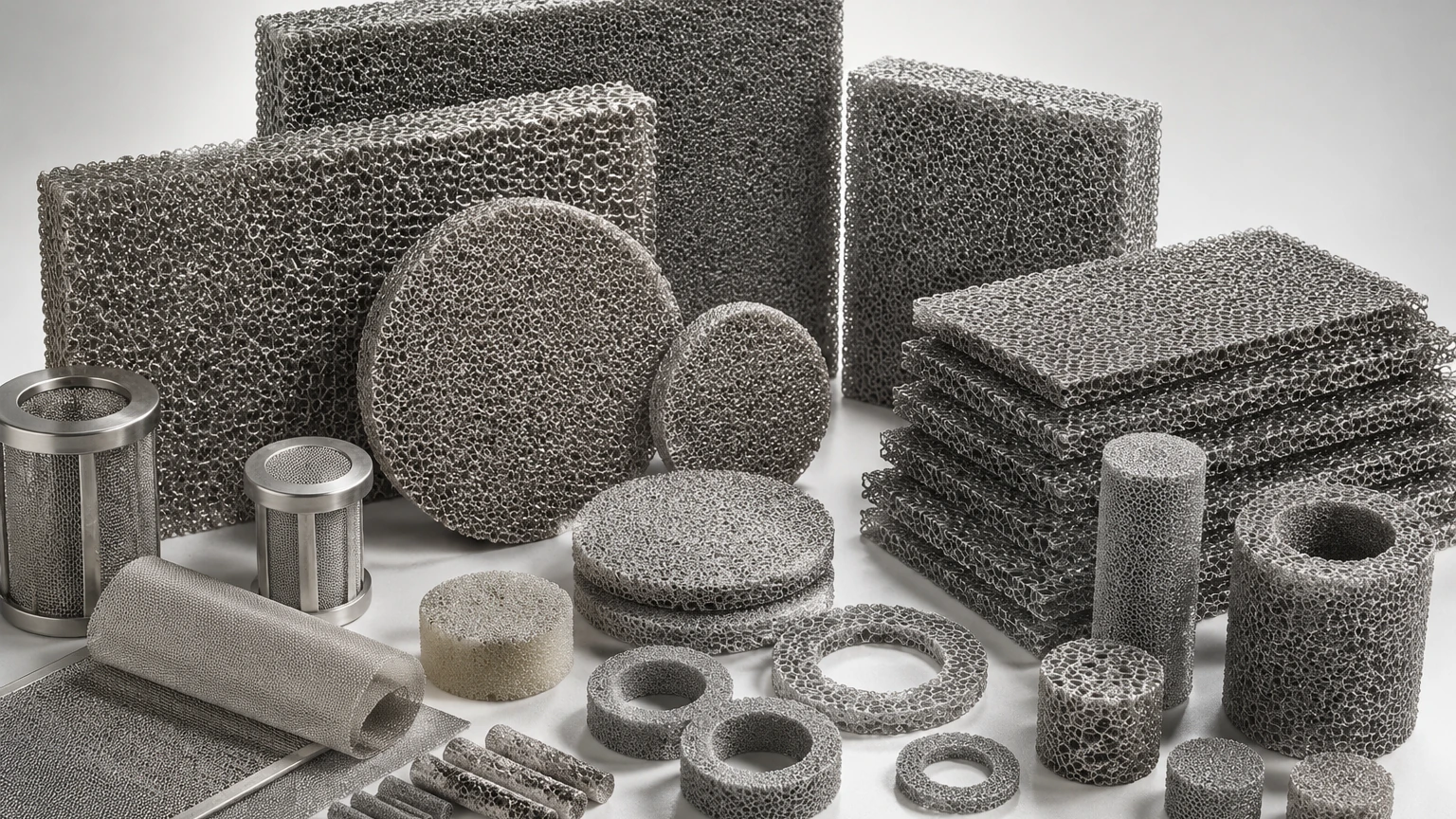
By using reticulated PU foam as a template, suppliers can create ceramic foams. The PU foam is coated in a ceramic slurry and then fired in a kiln. The PU burns away, leaving a ceramic replica. These are used in molten metal filtration and high-temperature gas filtration.
Metal Foam
Similar to ceramic foam, metal foams (often nickel, copper, or aluminum) are produced using reticulated foam as a precursor. These provide the high surface area of foam with the thermal conductivity and structural integrity of metal. For applications requiring the highest levels of durability and cleanability, however, custom-engineered stainless steel mesh filters are often the preferred alternative to metal foams.
Comparing Reticulated Foam with Stainless Steel Filtration Media
For engineers, a common decision point is whether to utilize a reticulated foam or a stainless steel filter. While reticulated foam is cost-effective and excellent for depth filtration in low-pressure systems, it has limitations that stainless steel addresses.
Durability and Reusability: Reticulated foam, particularly PU-based, has a finite lifespan. It can degrade over time due to UV exposure, chemical attack, or mechanical wear. In contrast, stainless steel filters are designed for long-term use and can be cleaned and reused multiple times. This significantly reduces the total cost of ownership in high-volume industrial processes.
Pressure and Temperature Limits: Standard reticulated foams cannot withstand the high pressures found in hydraulic systems or the extreme temperatures of steam filtration. In these scenarios, the precision-engineered cartridges and wire mesh solutions found on the Kaifil Main Page provide the necessary structural rigidity.
Filtration Precision: While reticulated foam is excellent for "nominal" filtration, stainless steel wire mesh allows for "absolute" filtration ratings. This precision is critical in industries like pharmaceutical manufacturing or food and beverage processing, where bypassing even a small percentage of contaminants is unacceptable.
Quality Assurance and Manufacturing Standards in Foam Production
A supplier’s quality management system (QMS) is the backbone of their reliability. For reticulated foam, specific quality concerns include "closed cells" (areas where the reticulation process failed) and "slugs" (dense areas of unexpanded polymer).
ISO Certification: At a minimum, suppliers should be ISO 9001 certified. This ensures that they have documented processes for handling raw materials and inspecting finished goods.
Environmental Compliance: Given the chemicals involved in foam production and reticulation, compliance with REACH and RoHS is essential for global supply chains. Furthermore, the degassing process—where residual gases from the reticulation combustion are removed—must be handled correctly to ensure the foam is safe for end-use.
Lot Traceability: In the event of a field failure, the ability to trace a specific filter back to its production batch and raw material lot is vital. High-tier suppliers maintain rigorous traceability records for every shipment.
Engineering Considerations for Custom Filtration Solutions
Choosing between reticulated foam suppliers often comes down to who can provide the best engineering support during the design phase. A "catalog-only" supplier may be cheaper, but an engineering-led supplier can help optimize the filter's geometry to improve system efficiency.
Integration and Housing
How will the foam be seated in the housing? Because foam is flexible, it requires a secure bypass-free seal. Suppliers who understand the mechanical properties of the foam can suggest compression ratios that ensure a tight fit without collapsing the cell structure.
Multi-Stage Filtration
In many industrial air and liquid systems, reticulated foam serves as a pre-filter. It captures large particulates, extending the life of more expensive, finer filters downstream. An expert supplier can help design a multi-stage system where the PPI of the foam is matched to the micron rating of the secondary stainless steel or membrane filter.
Chemical Compatibility Testing
Before finalizing a supplier, it is standard practice to perform immersion tests. If the application involves specialized solvents or high-pH cleaning agents, the supplier should provide sample plaques for compatibility testing. This prevents catastrophic failures where the foam might swell, soften, or disintegrate within the process stream.
Conclusion: Selecting the Right Partner
The search for reticulated foam suppliers should be guided by the specific technical demands of the application. While polyurethane foams offer versatility and low initial costs for air and light liquid filtration, the selection process must be rigorous to ensure batch consistency and material integrity.
For many technical professionals, the limitations of foam—specifically regarding temperature, pressure, and chemical volatility—lead them to seek out more permanent filtration solutions. By comparing the performance of reticulated media with the precision of custom stainless steel components, purchasing teams can make informed decisions that balance performance with long-term operational costs. For those requiring high-precision, durable, and custom-manufactured metal filtration solutions, the resources and product specifications available on the Kaifil Main Page serve as an authoritative guide for industrial excellence.
