


Sand Filter Oil and Gas
In the upstream and midstream sectors of the energy industry, the management of produced solids is a fundamental engineering challenge. The term "sand filter oil and gas" refers to a broad category of filtration systems and components designed to remove formation sand, proppant, and other solid particulates from the production stream. Effective sand management is critical not only for protecting downstream equipment such as pumps, valves, and separators but also for maintaining the integrity of the wellbore and ensuring the longevity of the entire production facility.
For engineers and procurement professionals, selecting the correct filtration technology requires a deep understanding of particle size distribution (PSD), fluid dynamics, and material science. Whether the application involves wellhead desanding or fine particulate removal in refinery processes, the reliability of the filter media—often constructed from high-grade stainless steel—determines the total cost of ownership and operational efficiency.
The Critical Function of Sand Filtration in Oil and Gas Operations
Sand production is an inherent risk in many hydrocarbon reservoirs, particularly those in unconsolidated formations. When fluids are extracted, the drag forces can mobilize sand grains, carrying them into the wellbore. If left unmanaged, this sand leads to severe mechanical issues, including erosion of high-velocity components, clogging of flow lines, and the accumulation of solids in separator vessels, which reduces residence time and separation efficiency.
Sand filter systems in oil and gas are deployed at various stages. At the wellhead, high-capacity desanders use centrifugal force or coarse screens to remove the bulk of the solids. Further downstream, more precise filtration is required to protect sensitive instrumentation and secondary recovery processes like water injection. In these stages, the filtration accuracy shifts from millimeters to microns, necessitating the use of sophisticated metal mesh and sintered components.
From a technical perspective, the goal of a sand filter is to achieve a balance between solids retention and fluid permeability. A filter that is too fine will clog rapidly, leading to frequent backwashing or replacement, while a filter that is too coarse will allow damaging particles to pass through. Engineering teams must therefore analyze the specific characteristics of the reservoir sand to determine the optimal slot size or pore rating for the filter media.
Technical Mechanisms of Sand Management and Solids Removal
Sand filtration in the oil and gas context typically utilizes two primary mechanisms: surface filtration and depth filtration.
Surface Filtration
Surface filtration occurs when particles are trapped on the upstream side of the filter media. In oil and gas applications, this is often achieved using wedge wire screens or thin layers of stainless steel wire mesh. The advantage of surface filtration is the ease of cleaning; backwashing or mechanical scraping can effectively remove the filter cake, restoring the flow rate. This is particularly useful in high-volume sand filters where the solids load is significant.
Depth Filtration
Depth filtration involves a thicker medium, such as a multi-layered sintered mesh or a packed bed of sand/gravel. Particles are trapped within the tortuous paths of the media. This method is highly effective for removing smaller "fines" that might pass through a simple surface screen. In many advanced oil and gas sand filters, a combination of these methods is used. For example, a stainless steel cartridge might feature a graded pore structure that captures larger particles on the outer layers and finer particles deeper within the mesh matrix.
The Role of Wire Mesh
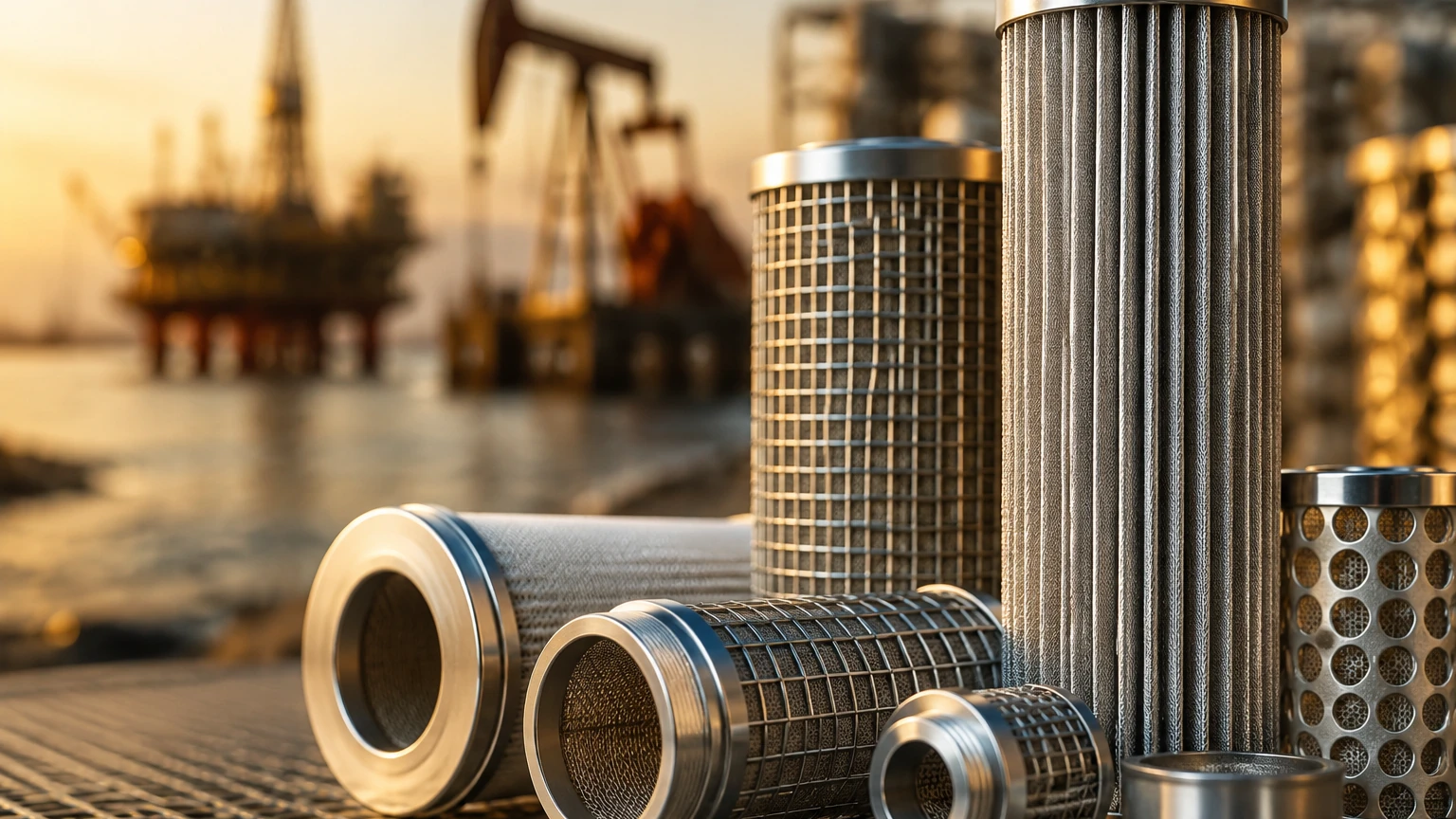
Stainless steel wire mesh is a preferred material for these filters due to its predictable pore size and mechanical strength. Unlike synthetic fibers, metal mesh can withstand the high pressures and temperatures characteristic of oil and gas production. The weave pattern—such as plain weave, twilled weave, or Dutch weave—is selected based on the required filtration accuracy and the need for structural stability under differential pressure.
Material Selection and Engineering Specifications for Harsh Environments
The environment in which a sand filter oil and gas system operates is often highly corrosive and abrasive. Consequently, material selection is one of the most critical engineering decisions. Standard carbon steel is rarely sufficient for the internal components of these filters due to the presence of hydrogen sulfide (H2S), carbon dioxide (CO2), and high-salinity produced water.
Stainless Steel Grades
* 304/304L: Suitable for basic industrial applications but often lacks the corrosion resistance needed for sour gas or high-chloride environments.
* 316/316L: The industry standard for many oil and gas filtration components. The addition of molybdenum provides better resistance to pitting and crevice corrosion in chloride-rich fluids.
* Duplex and Super Duplex: Used in highly aggressive offshore environments. These alloys offer superior mechanical strength and resistance to stress corrosion cracking (SCC), allowing for thinner, lighter filter designs that can still withstand extreme pressures.
Erosion Resistance
In addition to chemical corrosion, filtration media must resist mechanical erosion. High-velocity sand particles can quickly wear down the edges of filter slots or mesh wires. Hardening treatments or the use of specialized alloys are often employed to extend the service life of the filter elements. When designing custom solutions, engineers must account for the "sand jetting" effect, where localized high-velocity flow through a partially clogged filter can accelerate wear on the surrounding material.
Performance Evaluation: Flow Rates, Pressure Drop, and Filtration Efficiency
When evaluating a sand filter for oil and gas applications, three primary metrics are used: filtration efficiency, differential pressure (ΔP), and flow capacity.
Filtration Efficiency and Micron Ratings
Filtration efficiency is defined by the percentage of particles of a certain size that the filter can successfully retain. In the oil and gas industry, this is often expressed as an "absolute" or "nominal" rating. An absolute rating implies that 99.9% of particles larger than the specified micron size are captured. For sand control, engineers often use the D50 or D10 metrics from a sieve analysis to match the filter's pore size to the reservoir's particle size distribution.
Differential Pressure (ΔP)
As solids accumulate on the filter media, the resistance to flow increases, leading to a rise in differential pressure. A well-designed sand filter must have a low initial ΔP to maximize the available pressure for production. Monitoring the ΔP is the primary method for determining when a filter requires cleaning or replacement. If the ΔP exceeds the structural limits of the filter element, the mesh may deform or rupture, leading to a catastrophic "bypass" of solids.
Flow Capacity
The flow capacity is determined by the open area of the filter media. High-performance stainless steel mesh filters are designed to maximize the open area while maintaining structural integrity. This allows for higher flow rates through a smaller footprint, which is a critical consideration for offshore platforms where space and weight are at a premium.
Maintenance Protocols and Extending the Service Life of Filter Components
The total cost of ownership for a sand filter oil and gas system is heavily influenced by its maintenance requirements. In many cases, these filters are designed to be "permanent" or "semi-permanent," utilizing automated backwash cycles to clear the media without interrupting production.
Backwashing and Cleaning
Backwashing involves reversing the flow of fluid through the filter to dislodge the accumulated sand. The effectiveness of this process depends on the design of the filter element. For instance, wedge wire and certain types of Dutch weave mesh are particularly easy to clean because their geometry prevents particles from becoming permanently wedged in the openings. In more severe cases, ultrasonic cleaning or chemical soaking may be required to remove scale or organic deposits that backwashing cannot reach.
Replacement Cycles
Despite effective cleaning, filter elements eventually reach the end of their functional life due to fatigue, erosion, or irreversible fouling. Engineers should establish clear replacement cycles based on historical ΔP data and periodic inspections. Using high-quality OEM components ensures that the replacement filters meet the original design specifications, maintaining the safety and efficiency of the system.
Custom Engineering and OEM Integration for Specialized Applications
No two oil and gas reservoirs are identical, and therefore, off-the-shelf filtration solutions are often inadequate. Customization is frequently required to address specific challenges such as ultra-fine sand, high-viscosity fluids, or extreme temperature fluctuations.
Professional manufacturers specialize in developing bespoke filtration components that integrate seamlessly into existing sand filter housings. This includes the engineering of custom support structures to prevent mesh pleats from collapsing under high pressure and the selection of specialized gaskets and seals that are compatible with the chemical composition of the produced fluids.
By working with a manufacturer that understands both the mechanical requirements of the filter and the chemical realities of the oilfield, operators can optimize their solids control strategy. This collaborative approach leads to filters that not only capture sand more effectively but also offer a longer service life and lower maintenance costs. For more information on our full range of stainless steel filtration components and custom OEM solutions, visit our Main Page.
Conclusion: Ensuring Operational Integrity Through Precise Filtration
In the demanding world of oil and gas production, sand filtration is not merely a utility but a critical safeguard for the entire infrastructure. The transition from wellhead sand traps to high-precision stainless steel filter cartridges represents a sophisticated engineering response to the challenges of reservoir management. By focusing on material durability, precise pore sizing, and robust mechanical design, engineers can effectively mitigate the risks associated with sand production.
Selecting the right sand filter oil and gas solution involves a comprehensive analysis of the production environment and a commitment to high-quality filtration media. As the industry continues to push into more challenging environments—such as deepwater and high-pressure/high-temperature (HPHT) reservoirs—the role of precision-engineered metal filters will only become more vital. Investing in reliable filtration technology is a prerequisite for achieving sustainable, long-term production goals while minimizing the risks of equipment failure and costly downtime.
