


Stainless Steel Cartridge Filter Housing
In industrial filtration systems, the stainless steel cartridge filter housing serves as the critical pressure vessel that contains and supports filter elements. Its primary function is to direct the flow of fluid through the filtration media while maintaining system integrity under varying pressures and temperatures. For engineers and procurement teams in the chemical, pharmaceutical, and food and beverage sectors, selecting the appropriate housing is as vital as the selection of the filter cartridge itself. A mismatch between the housing design and the operational requirements can lead to bypass, mechanical failure, or premature clogging of expensive filter elements.
As a specialized manufacturer, Kaifil provides comprehensive insights into the engineering considerations required to optimize these components for demanding industrial environments. This guide explores the technical specifications, design variations, and selection criteria necessary for implementing a robust filtration solution.
Engineering Fundamentals of Stainless Steel Cartridge Filter Housings
The performance of a stainless steel cartridge filter housing is fundamentally tied to its material composition and structural design. Stainless steel is the preferred material for industrial housings due to its inherent resistance to corrosion, ability to withstand high temperatures, and ease of sterilization.
Material Selection: 304 vs. 316L
Most industrial housings are fabricated from either Grade 304 or Grade 316L stainless steel.
- Grade 304: Suitable for general industrial applications, including water treatment and less aggressive chemical processes. It offers excellent mechanical properties and cost-effectiveness.
- Grade 316L: Contains molybdenum, which provides superior resistance to chlorides and pitting corrosion. The "L" designation signifies low carbon content, which is essential for preventing carbide precipitation during welding, ensuring the structural integrity of the housing in high-purity or highly corrosive environments like pharmaceutical manufacturing or marine applications.
Pressure Ratings and Compliance
Industrial housings must be designed to handle the maximum operating pressure of the system, including potential pressure spikes. Standard housings are often rated for 100 PSI to 150 PSI, but high-pressure applications in hydraulic systems or specialized chemical processing may require custom-engineered vessels rated for 300 PSI or higher. Compliance with international standards such as the ASME Boiler and Pressure Vessel Code or the Pressure Equipment Directive (PED) in Europe is a key indicator of manufacturing quality and safety.
Key Selection Criteria for Industrial Applications
When specifying a stainless steel cartridge filter housing, engineers must evaluate several variables to ensure the unit meets the specific needs of the process. Oversizing a housing can lead to unnecessary capital expenditure and increased footprint, while undersizing leads to high differential pressure and reduced filter life.
Flow Rate and Differential Pressure
The housing must be sized to accommodate the maximum required flow rate while maintaining a low initial differential pressure (clean pressure drop). A high velocity within the housing can cause turbulence, which may dislodge particulates from the filter media or lead to erosion of the internal surfaces. Generally, the clean pressure drop across the housing and cartridge combined should not exceed 2-3 PSI for liquid applications.
Chemical Compatibility and Temperature
Beyond the stainless steel shell, the seals and O-rings must be compatible with the process fluid. Common materials include EPDM, Viton (FKM), Silicone, and PTFE-encapsulated gaskets. Temperature also dictates material choice; high-temperature steam sterilization (SIP) in pharmaceutical lines requires seals that can maintain their elasticity and sealing force under thermal cycling.
Filtration Accuracy and Cartridge Type
The housing design must match the specific end-cap configuration of the filter cartridges being used. Whether the system utilizes Double Open End (DOE) cartridges or Single Open End (SOE) designs with 222 or 226 O-ring configurations, the internal seat and compression plate must ensure a leak-proof seal to prevent bypass of unfiltered fluid.
Design Variations and Customization Options
Industrial filtration requirements vary significantly, necessitating different housing configurations. Customization is often required to integrate the housing into existing piping or to meet specific sanitary standards.
Single vs. Multi-Cartridge Housings
- Single Cartridge Housings: Ideal for low-flow applications, pilot plants, or point-of-use filtration. They are compact and easy to maintain.
- Multi-Cartridge Housings: Used for high-capacity industrial processes. These housings can hold anywhere from 3 to over 100 cartridges. They are designed with internal baffle plates to distribute flow evenly across all elements, ensuring uniform loading and maximizing the service life of each cartridge.
Closure Mechanisms
The method used to seal the housing head to the body impacts both safety and ease of maintenance:
- V-Band Clamps: Provide a quick-opening solution for low to medium-pressure applications. They are lightweight and suitable for frequent cartridge changes.
- Swing Bolt Closures: Designed for high-pressure or heavy-duty applications. They provide a more robust seal and are preferred in processes where safety and pressure vessel integrity are paramount.
Surface Finishes and Sanitary Requirements
In the food, beverage, and pharmaceutical industries, the internal surface finish of the stainless steel cartridge filter housing is critical. Surfaces are often mechanically polished or electropolished to achieve a specific roughness average (Ra), typically less than 0.8 μm or 0.4 μm. This prevents bacterial growth and ensures that the housing can be effectively cleaned using Clean-in-Place (CIP) protocols.
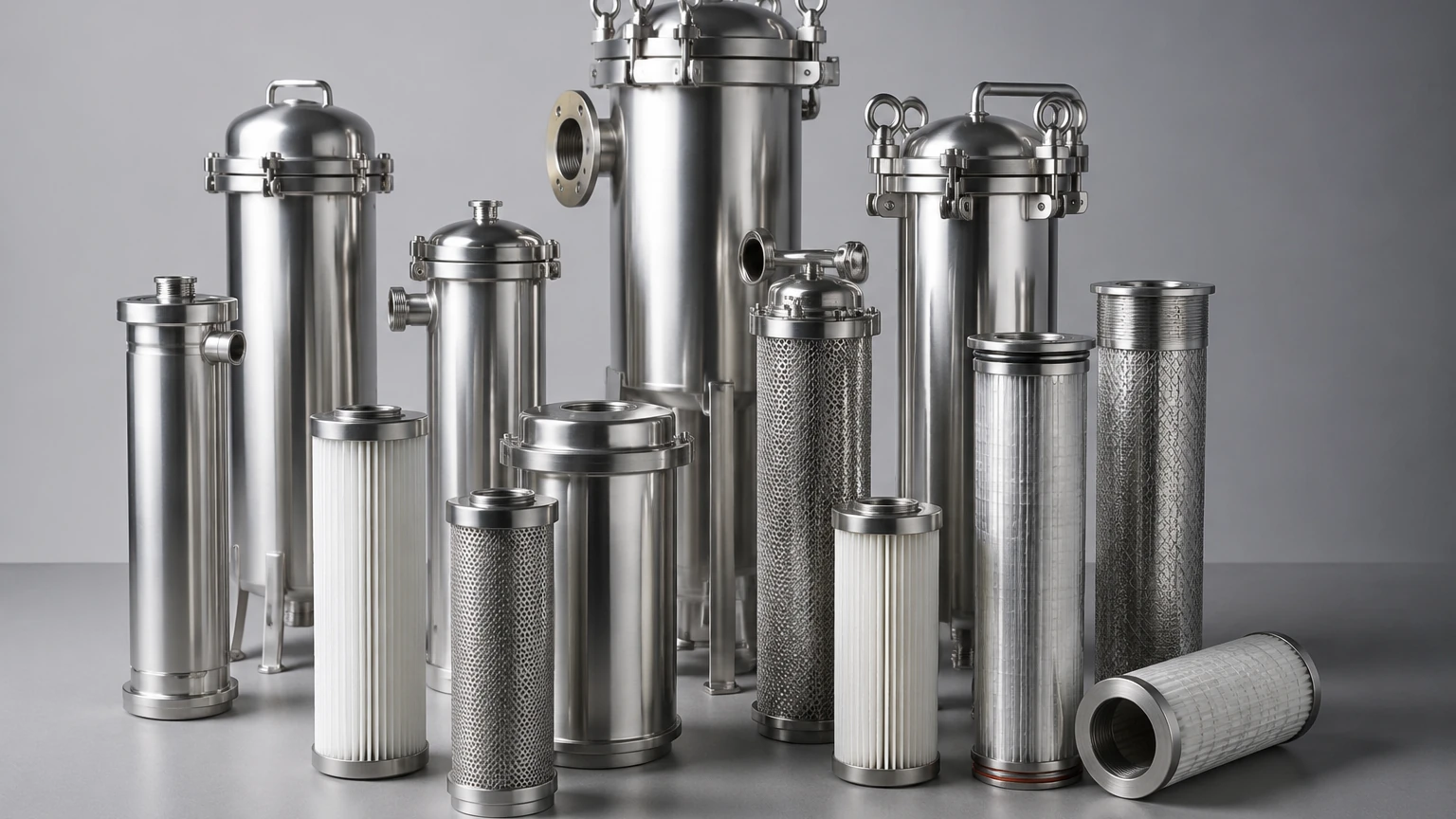
Integration with Stainless Steel Filter Cartridges
To achieve optimal filtration performance, the housing must be perfectly paired with high-quality filter elements. Kaifil specializes in manufacturing both the housings and the custom stainless steel filter cartridges, ensuring a seamless fit and reliable sealing.
Sealing Mechanisms and Bypass Prevention
The most common point of failure in a filtration system is bypass at the cartridge seal. In a stainless steel cartridge filter housing, the internal hardware—such as the tie rod, seal plate, and spring assembly—must apply consistent pressure to the cartridge gaskets. For SOE cartridges, the locking tabs (such as those on a Code 7/226 fitting) provide a mechanical lock that prevents the cartridge from unseating during back-pressure surges.
Custom Internal Components
For specialized applications, internal components can be customized. This includes the addition of perforated core supports for high-viscosity fluids or the modification of the inlet/outlet orientations (e.g., side-in/side-out or bottom-in/bottom-out) to simplify installation in tight spaces.
Operational Considerations: Maintenance and Replacement Cycles
Maintaining a stainless steel cartridge filter housing involves more than just changing the filter elements. Technical teams must monitor the system to ensure long-term reliability and cost-effectiveness.
Pressure Drop Monitoring
Housings should be equipped with differential pressure gauges. Monitoring the increase in pressure drop over time allows operators to schedule maintenance before the filter elements reach their terminal pressure drop, which could lead to cartridge collapse or bypass.
Cleaning and Sterilization
Stainless steel housings are valued for their durability during cleaning. In many industries, the housing remains in place while being subjected to caustic cleaning agents or high-pressure steam. It is essential to verify that the housing design eliminates "dead legs" or stagnant zones where contaminants could accumulate. Regular inspection of the O-rings and gaskets is necessary, as these components are prone to wear and should be replaced during every cartridge change-out or according to a preventive maintenance schedule.
Total Cost of Ownership and ROI
While the initial investment in a high-quality stainless steel cartridge filter housing may be higher than plastic or lower-grade metal alternatives, the total cost of ownership is significantly lower over the life of the equipment.
1. Durability: A well-maintained stainless steel housing can last for decades, even in harsh industrial environments.
2. Reduced Downtime: Features like swing-bolt closures and optimized internal designs reduce the time required for cartridge change-outs.
3. Process Integrity: High-precision manufacturing prevents bypass, protecting downstream equipment and ensuring product quality, which avoids the high costs associated with product recalls or equipment damage.
For engineers seeking to optimize their filtration processes, consulting with a manufacturer that understands the nuances of both the housing and the filter media is essential. Kaifil’s expertise in custom stainless steel filtration solutions allows for the development of integrated systems that meet the most stringent industrial requirements.
To explore specific configurations for your application or to learn more about our manufacturing capabilities, you can Review product options and application support on our main page. Whether you require a standard single-cartridge unit or a complex multi-cartridge system for chemical processing, selecting the right stainless steel cartridge filter housing is the first step toward achieving reliable, efficient, and long-term filtration performance.
