


Stainless Steel Mesh Oil Filter
In industrial environments, the integrity of lubrication and hydraulic systems depends heavily on the quality of filtration. A stainless steel mesh oil filter serves as a critical component in protecting high-precision machinery from particulate contamination. Unlike disposable synthetic or paper-based media, stainless steel mesh offers a combination of mechanical strength, thermal stability, and chemical resistance that is essential for demanding B2B applications. For engineers and procurement teams, selecting the right filtration solution requires a deep understanding of material properties, weave structures, and the specific operational parameters of the machinery involved.
At Kaifil, we specialize in manufacturing high-performance filtration components tailored to the rigorous standards of global industrial sectors. To explore our full range of capabilities, you can visit our Main Page to review product options and application support.
Material Science: Why Stainless Steel is Preferred for Oil Filtration
The choice of material is the foundation of filter performance. In industrial oil filtration, the most common materials used are AISI 304 and 316L stainless steel. Each offers distinct advantages depending on the fluid chemistry and the environment.
AISI 304 Stainless Steel
Grade 304 is the standard industrial choice for many oil filtration applications. It provides excellent mechanical strength and good corrosion resistance against most organic and inorganic oils. It is cost-effective and suitable for systems where the operating environment is not excessively corrosive. However, in environments with high chloride content or specific chemical additives, 304 may be susceptible to pitting.
AISI 316L Stainless Steel
For more aggressive environments, particularly in chemical processing or marine applications, 316L is the preferred material. The addition of molybdenum enhances its resistance to pitting and crevice corrosion. Furthermore, the "L" designation indicates a lower carbon content, which improves weldability and prevents sensitization—a critical factor when the stainless steel mesh oil filter must be integrated into a housing via precision welding.
Engineering the Weave: Micron Ratings and Flow Dynamics
The performance of a stainless steel mesh oil filter is not determined solely by the material, but by the geometry of the wire weave. The weave pattern dictates the micron rating, the open area, and the pressure drop across the filter element.
Plain Weave and Twill Weave
Plain weave is the most straightforward pattern, where each shute wire passes over and under each warp wire. This provides a consistent pore size and is ideal for surface filtration. Twill weave, where wires cross over two and under two, allows for the use of heavier wires in a given mesh count, providing increased strength for high-pressure applications without sacrificing the micron rating.
Dutch Weave Variations
For fine filtration, Plain Dutch Weave (PDW) and Twilled Dutch Weave (TDW) are utilized. These patterns feature a higher density of shute wires, creating a tortuous path for particles. This results in a much finer filtration capability—often down to 5 or 10 microns—while maintaining the structural integrity required to withstand high differential pressures. Dutch weaves are particularly effective in hydraulic oil systems where removing microscopic silt is vital for preventing valve stiction and pump wear.
Performance Advantages in High-Stress Environments
Industrial oil systems often operate under conditions that would cause traditional media to fail. The stainless steel mesh oil filter is engineered to excel in these high-stress scenarios.
Temperature Stability
Synthetic filters often have a maximum operating temperature of 100°C to 120°C. In contrast, stainless steel mesh can operate at temperatures exceeding 400°C (depending on the housing and seals). This is crucial for high-temperature lubrication systems found in power plants, refineries, and heavy manufacturing.
Pressure Resistance and Mechanical Strength
Oil systems can experience significant pressure spikes, especially during cold starts when oil viscosity is high. Stainless steel mesh possesses high tensile strength and resistance to deformation. When reinforced with perforated metal cores or support layers, these filters can withstand high differential pressures (ΔP) without collapsing, ensuring that the filtered contaminants are not bypassed back into the system.
Chemical Compatibility
Modern industrial oils often contain complex additive packages, including detergents, anti-wear agents, and friction modifiers. Stainless steel is inert to the vast majority of these chemicals, ensuring that the filter media does not degrade or leach contaminants into the oil stream over time.
Selection Criteria for Industrial Engineers
When specifying a stainless steel mesh oil filter, engineers must look beyond the basic dimensions. Several technical factors must be confirmed to ensure the filter meets the system's requirements.
1. Viscosity and Flow Rate: The viscosity of the oil significantly impacts the pressure drop. High-viscosity gear oils require a larger surface area or a coarser mesh compared to low-viscosity hydraulic fluids to maintain the same flow rate without exceeding the bypass valve setting.
2. Filtration Efficiency (Beta Ratio): It is essential to distinguish between nominal and absolute filtration ratings. A nominal rating indicates the ability to stop a percentage of particles, while an absolute rating (often achieved with Dutch weaves) ensures that no particles larger than the specified micron size pass through the mesh.
3. Contaminant Loading Capacity: The "dirt-holding capacity" determines how long a filter can remain in service before the pressure drop reaches a critical level. For systems with high contamination levels, pleated mesh designs are often used to maximize the available surface area within the same footprint.
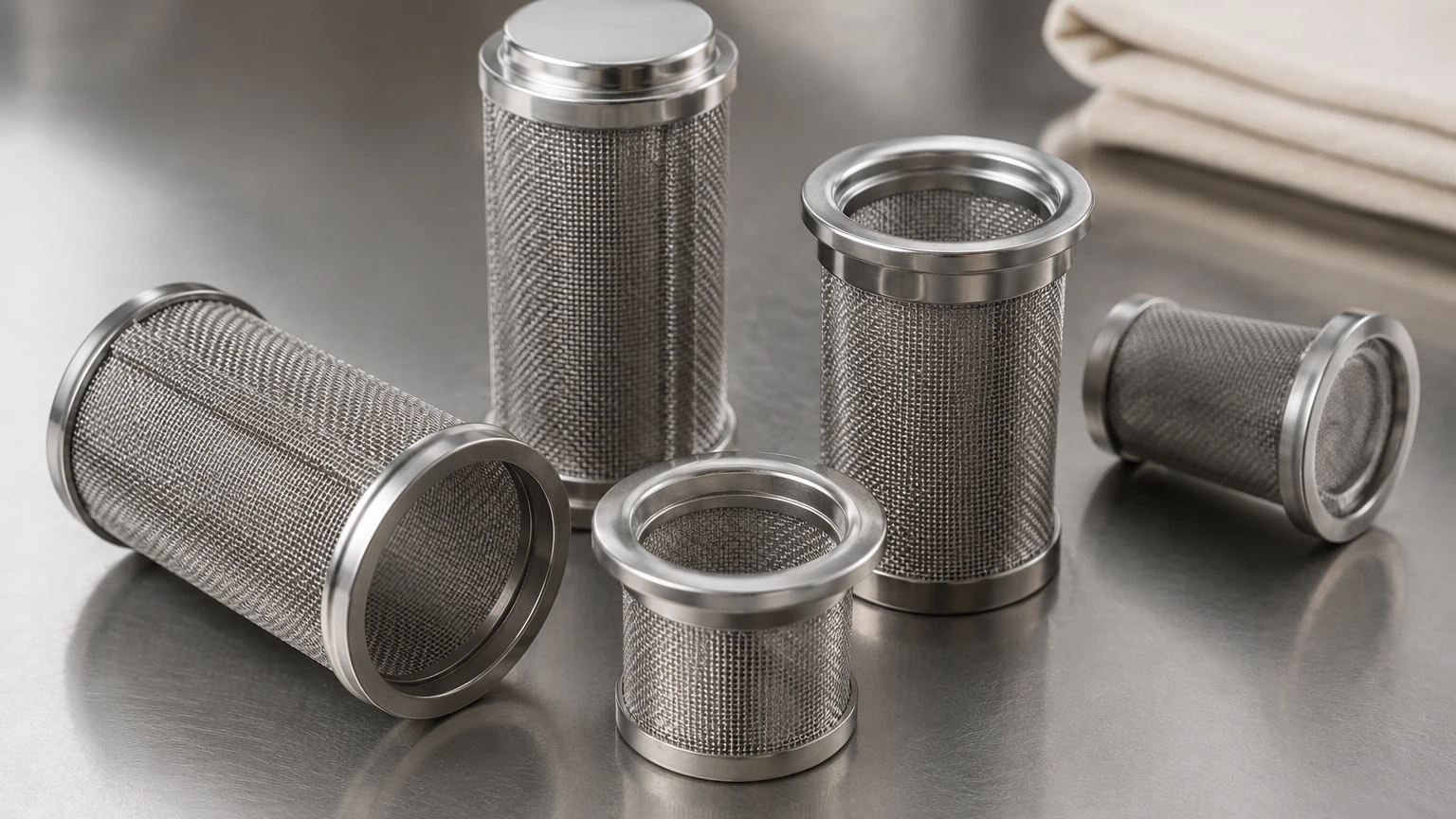
Customization and OEM Integration
No two industrial systems are identical, which is why customization is a core component of effective filtration. At Kaifil, we understand that a standard off-the-shelf solution may not meet the specific spatial or performance constraints of a proprietary machine design.
Customization options for a stainless steel mesh oil filter include:
* End Fitting Geometry: Whether the system requires NPT threads, SAE flanges, O-ring seals, or bayonet mounts, precision machining ensures a leak-proof interface.
* Structural Reinforcement: For high-flow applications, we can integrate internal support tubes or external cages made from perforated stainless steel to prevent mesh migration or fatigue.
* Multi-Layer Sintering: In extreme cases, multiple layers of mesh are sintered together to create a rigid, porous plate that combines fine filtration with the strength of a solid metal component.
By working closely with our engineering team, customers can develop OEM filtration components that are optimized for their specific equipment, reducing the risk of premature failure and improving overall system reliability.
Maintenance, Cleaning, and Total Cost of Ownership (TCO)
One of the most significant B2B advantages of the stainless steel mesh oil filter is its cleanability. While the initial acquisition cost is higher than disposable filters, the Total Cost of Ownership (TCO) is often much lower over the life of the equipment.
Cleaning Protocols
Unlike fiberglass or paper, stainless steel mesh can be cleaned and reused multiple times. Common cleaning methods include:
* Ultrasonic Cleaning: High-frequency sound waves create cavitation bubbles that dislodge fine particles trapped deep within the mesh weave.
* Backwashing: Reversing the flow of clean fluid or air through the filter can effectively remove surface-loaded contaminants.
* Chemical Cleaning: Using compatible solvents to dissolve varnishes or oxidized oil deposits that have adhered to the wire surfaces.
Replacement Indicators
Despite their durability, mesh filters are not infinite. Engineers should monitor the pressure drop across the filter. If the baseline pressure drop after cleaning begins to rise, it may indicate that the mesh is becoming permanently blinded or that the wire structure is experiencing fatigue. Establishing a clear maintenance schedule based on these metrics ensures that the filtration system remains an asset rather than a liability.
Conclusion: Making an Informed Procurement Decision
Choosing a stainless steel mesh oil filter is a strategic decision that impacts the longevity and efficiency of industrial machinery. By focusing on material grade, weave precision, and the ability to customize the component for specific operational stresses, engineering teams can ensure superior protection for their systems.
Reliability in filtration is not just about the mesh; it is about the manufacturing expertise behind it. From initial material selection to the final quality control of the finished cartridge, every step must align with the technical requirements of the application. For those seeking technical guidance or customized manufacturing for industrial filtration, we invite you to explore our Main Page to learn more about how our engineering capabilities can support your filtration goals.
