


Commercial and Industrial Water Filtration Systems
Commercial and industrial water filtration systems are critical infrastructure components designed to remove physical, chemical, and biological contaminants from water supplies used in large-scale operations. Unlike residential systems, these industrial-grade solutions must withstand high flow rates, extreme pressures, and varying temperatures while maintaining precise filtration accuracy. For engineers and facility managers, selecting the appropriate filtration technology is not merely a matter of water purity; it is a strategic decision that impacts equipment longevity, process efficiency, and overall operational costs.
In the context of industrial manufacturing, water often serves as a raw material, a cooling medium, or a cleaning agent. Any failure in the filtration process can lead to downstream contamination, equipment scaling, or catastrophic system failure. This guide explores the technical foundations of commercial and industrial water filtration, focusing on the engineering considerations required to implement robust, stainless steel-based filtration solutions.
Understanding the Architecture of Industrial Water Filtration
The architecture of commercial and industrial water filtration systems is typically categorized by the stage of treatment and the specific mechanism of particle removal. In many industrial environments, a multi-stage approach is utilized to protect sensitive downstream equipment like Reverse Osmosis (RO) membranes or high-precision nozzles.
Surface vs. Depth Filtration
Industrial filters generally operate on two principles: surface filtration and depth filtration.
1. Surface Filtration: This involves a thin layer of material, such as stainless steel wire mesh, where particles larger than the pore size are trapped on the upstream side of the medium. These are often preferred in industrial settings because they are easier to clean and provide a more predictable micron rating.
2. Depth Filtration: These filters utilize a thick medium (such as multi-layered sintered metal) to trap particles throughout the entire thickness of the material. Depth filters are excellent for handling high concentrations of contaminants but may require more complex cleaning protocols or eventual replacement.
For heavy-duty industrial applications, stainless steel components are the industry standard. They offer superior mechanical strength compared to plastic or polymer alternatives, ensuring that the filter does not bypass or collapse under sudden pressure spikes.
Material Selection: The Role of Stainless Steel in High-Performance Systems
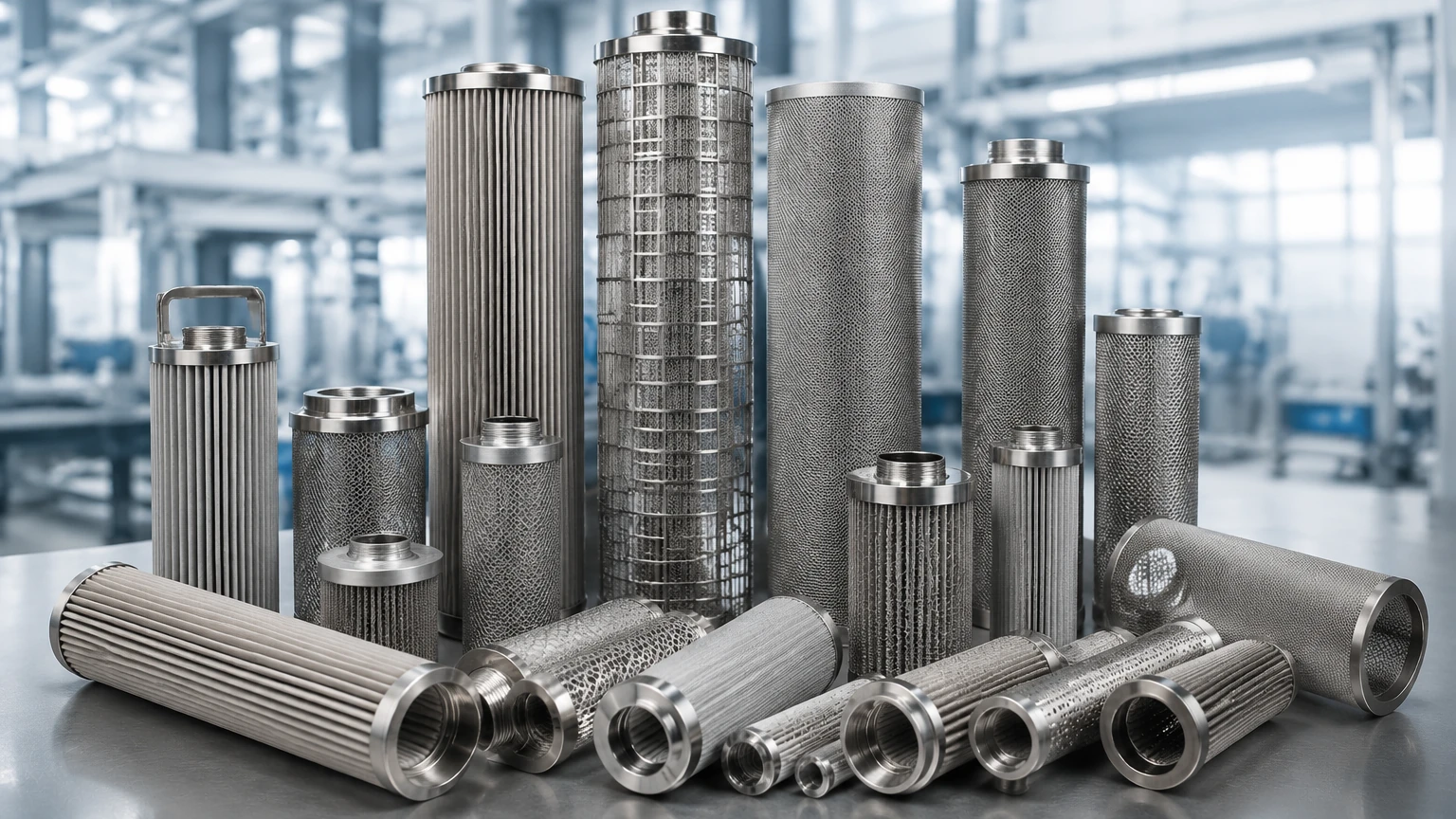
When designing or specifying commercial and industrial water filtration systems, material compatibility is the first line of defense against corrosion and system degradation. Stainless steel is the preferred material for industrial filter cartridges and mesh because of its durability and resistance to various chemical environments.
304 vs. 316L Stainless Steel
* Type 304 Stainless Steel: This is the most common grade used in commercial water filtration. It provides excellent corrosion resistance for standard water treatment applications and is cost-effective for general industrial use.
* Type 316L Stainless Steel: For more demanding environments, such as chemical processing or applications involving high chloride levels (brackish water), 316L is required. The addition of molybdenum enhances its resistance to pitting and crevice corrosion. The "L" denotes low carbon content, which is essential for components that require welding, as it prevents carbide precipitation and maintains corrosion resistance at the weld joints.
Beyond corrosion resistance, stainless steel allows for high-temperature sterilization and steam-in-place (SIP) procedures, which are mandatory in the pharmaceutical and food and beverage industries. To explore specific material grades and their applications, engineers can refer to the Main Page for detailed technical specifications.
Technical Parameters: Flow Rate, Micron Rating, and Pressure Drop
Specifying a filtration system requires a deep dive into the fluid dynamics of the application. Engineers must balance three primary factors: micron rating, flow rate, and allowable pressure drop.
Micron Rating: Absolute vs. Nominal
A common point of confusion in industrial procurement is the distinction between nominal and absolute micron ratings.
* Nominal Micron Rating: This indicates the filter's ability to trap a major percentage (usually 60% to 90%) of particles of a specific size. It is an approximation and may allow some larger particles to pass through.
* Absolute Micron Rating: This refers to the diameter of the largest hard spherical particle that will pass through the filter under specified test conditions. In critical industrial processes, absolute-rated stainless steel wire mesh is used to ensure that no particles above a certain threshold contaminate the process.
Pressure Drop (Delta P)
Pressure drop is the difference in pressure between the inlet and the outlet of the filter. Every filter introduces some resistance to flow. As the filter accumulates debris, the pressure drop increases.
In commercial and industrial water filtration systems, it is vital to calculate the "clean pressure drop" to ensure the pump system can handle the resistance. If the initial pressure drop is too high, the filter will reach its terminal pressure drop (the point where it must be cleaned or replaced) too quickly, leading to excessive maintenance cycles.
Application-Specific Filtration Requirements
Different industries have unique demands that dictate the design of the filtration component.
Chemical Processing
In chemical plants, water filtration systems must handle aggressive solvents and high temperatures. Stainless steel filter cartridges are often the only viable option because they do not leach chemicals into the process stream and can withstand the structural stress of high-viscosity fluids.
Food and Beverage
Filtration in this sector focuses on hygiene and the removal of spoilage organisms. Filters must be constructed with smooth surfaces to prevent bacterial growth and must comply with sanitary standards. Precision metal filter components are used here because they can be mechanically cleaned and reused, reducing the waste associated with disposable plastic cartridges.
Hydraulic and Cooling Systems
Industrial machinery relies on cooling water to maintain operational temperatures. In these systems, filtration is used to remove scale and silt that could clog heat exchangers. Robust wire mesh filters are ideal for this application as they can handle the high flow rates required for large-scale cooling towers.
Maintenance, Cleaning, and Total Cost of Ownership
One of the primary advantages of utilizing stainless steel components in commercial and industrial water filtration systems is the ability to clean and reuse the filter media. While the initial capital expenditure (CAPEX) for stainless steel is higher than for disposable filters, the total cost of ownership (TCO) is often lower over the life of the system.
Cleaning Methods
1. Backwashing: Reversing the flow of water through the filter to dislodge accumulated particles. This is common in automated industrial systems.
2. Ultrasonic Cleaning: Using high-frequency sound waves in a cleaning solvent to remove fine particles from deep within the mesh or sintered structure.
3. Chemical Cleaning: Using acids or alkalis to dissolve specific types of scaling or organic buildup, provided the filter material is compatible.
Replacement Cycles
Even permanent stainless steel filters have a service life. Engineers should monitor the integrity of the mesh for signs of fatigue or mechanical damage. A well-maintained stainless steel filter cartridge can last for years, whereas disposable filters may need replacement every few weeks, leading to higher operational expenses (OPEX) and significant environmental waste.
Custom Engineering and OEM Solutions for Filtration Components
Standard off-the-shelf filters often fail to meet the specific geometric or performance requirements of specialized industrial equipment. This is where custom engineering becomes essential.
OEM (Original Equipment Manufacturer) filtration solutions allow for the customization of:
* End Cap Configurations: Ensuring a perfect seal within existing filter housings (e.g., DOE, 222, 226, or threaded connections).
* Reinforcement Layers: Adding internal cores or external shrouds to prevent media migration or collapse in high-pressure environments.
* Pleating Designs: Increasing the surface area of the filter media to allow for higher flow rates and longer intervals between cleanings within a compact footprint.
When sourcing custom components, it is important to work with manufacturers who understand the nuances of metal fabrication and filtration physics. Precise welding and assembly are required to ensure that the micron rating remains consistent across the entire surface of the filter.
Critical Questions for Engineers Before Purchasing
Before finalizing the design of commercial and industrial water filtration systems, technical teams should confirm the following data points:
* What is the precise nature of the contaminant? (Is it hard, abrasive, soft, or organic?)
* What are the maximum and minimum operating temperatures? (This influences material and gasket selection.)
* What is the maximum allowable pressure drop? (This determines the required surface area and pleat density.)
* What are the regulatory requirements? (Does the system need to meet specific industry certifications?)
* What is the cleaning protocol? (Can the system be taken offline for manual cleaning, or is an automated backwash system required?)
By addressing these factors during the design phase, companies can avoid the common pitfalls of undersized or incompatible filtration systems, which often lead to increased downtime and maintenance costs.
Conclusion
Commercial and industrial water filtration systems are foundational to modern industrial efficiency. By prioritizing high-quality materials like stainless steel and focusing on precise engineering parameters—such as absolute micron ratings and calculated pressure drops—engineers can ensure their systems remain reliable under the most demanding conditions. Whether for chemical processing, food production, or large-scale water treatment, the transition from disposable solutions to durable, custom-engineered metal filtration components represents a significant step toward operational excellence and long-term cost savings. For more information on custom filtration engineering and product options, visit the Main Page to consult with technical experts.
Download Commercial and Industrial Water Filtration Systems as a PDF
