


Types of Reactors
In industrial chemical processing, the reactor is the core component where raw materials are transformed into finished products through controlled chemical reactions. For engineers and procurement specialists, selecting the appropriate equipment from the various types of reactors available is a critical decision that impacts yield, safety, and long-term operational costs. Beyond the vessel itself, the integration of high-performance filtration systems is often necessary to protect downstream equipment, recover expensive catalysts, or ensure product purity.
Industrial reactors are generally categorized based on their operation mode (batch vs. continuous), the phases of the reactants involved (homogeneous vs. heterogeneous), and the mechanical design of the vessel. This guide explores the engineering principles behind the most common reactor types and the technical considerations for integrating filtration solutions into these demanding environments.
Fundamental Classification of Industrial Reactors
At the highest level, reactors are classified by their flow patterns and how they handle time and space. The choice between a batch or continuous system depends on production volume, the kinetics of the reaction, and the required degree of control over the process variables.
Batch Reactors
A batch reactor is a closed system where reactants are loaded into the vessel, the reaction proceeds over a specific time, and the products are then discharged. This cycle includes charging, heating/reacting, cooling, and discharging.
Batch reactors are favored for small-scale production, pharmaceutical manufacturing, and processes involving complex, multi-step reactions. Their primary advantage is versatility; a single vessel can be used for different products with minimal reconfiguration. However, they suffer from higher labor costs per unit of product and significant downtime between batches. From a filtration perspective, batch processes often require external filtration units or internal leaf filters to separate solids from the liquid product once the reaction is complete.
Continuous Stirred-Tank Reactors (CSTR)
The CSTR, also known as a backmix reactor, operates at a steady state where reactants are continuously fed into the tank and products are continuously withdrawn. The key characteristic of a CSTR is that the contents are perfectly mixed, meaning the composition and temperature are uniform throughout the vessel and identical to the exit stream.
CSTRs are ideal for liquid-phase reactions where constant temperature control is required. Because the concentration of reactants is immediately diluted upon entering the tank, CSTRs are often used when high concentrations might lead to unwanted side reactions. Engineers frequently link multiple CSTRs in series to achieve higher conversion rates.
Plug Flow Reactors (PFR)
Unlike the CSTR, the Plug Flow Reactor (often a long tube or pipe) operates under the assumption that the fluid moves through the reactor as a series of coherent "plugs." Each plug has a uniform composition, but the composition changes as the plug moves along the length of the reactor. There is no mixing in the axial direction, but perfect mixing in the radial direction.
PFRs generally offer higher conversion per unit volume than CSTRs for most chemical reactions. They are commonly used for large-scale, high-pressure gas-phase reactions. Because there are no moving parts like agitators, PFRs are often easier to maintain, though temperature control can be more challenging due to the potential for hot spots along the tube length.
Specialized Heterogeneous Reactors
Many industrial processes involve multiple phases—such as a gas reacting with a solid catalyst or a liquid. These require specialized types of reactors designed to maximize the contact area between phases.
Fixed-Bed Reactors
In a fixed-bed reactor, the vessel is filled with solid catalyst particles, and the gaseous or liquid reactants flow through the bed. The catalyst remains stationary. These reactors are the workhorse of the petrochemical industry, used for processes like ammonia synthesis and catalytic reforming.
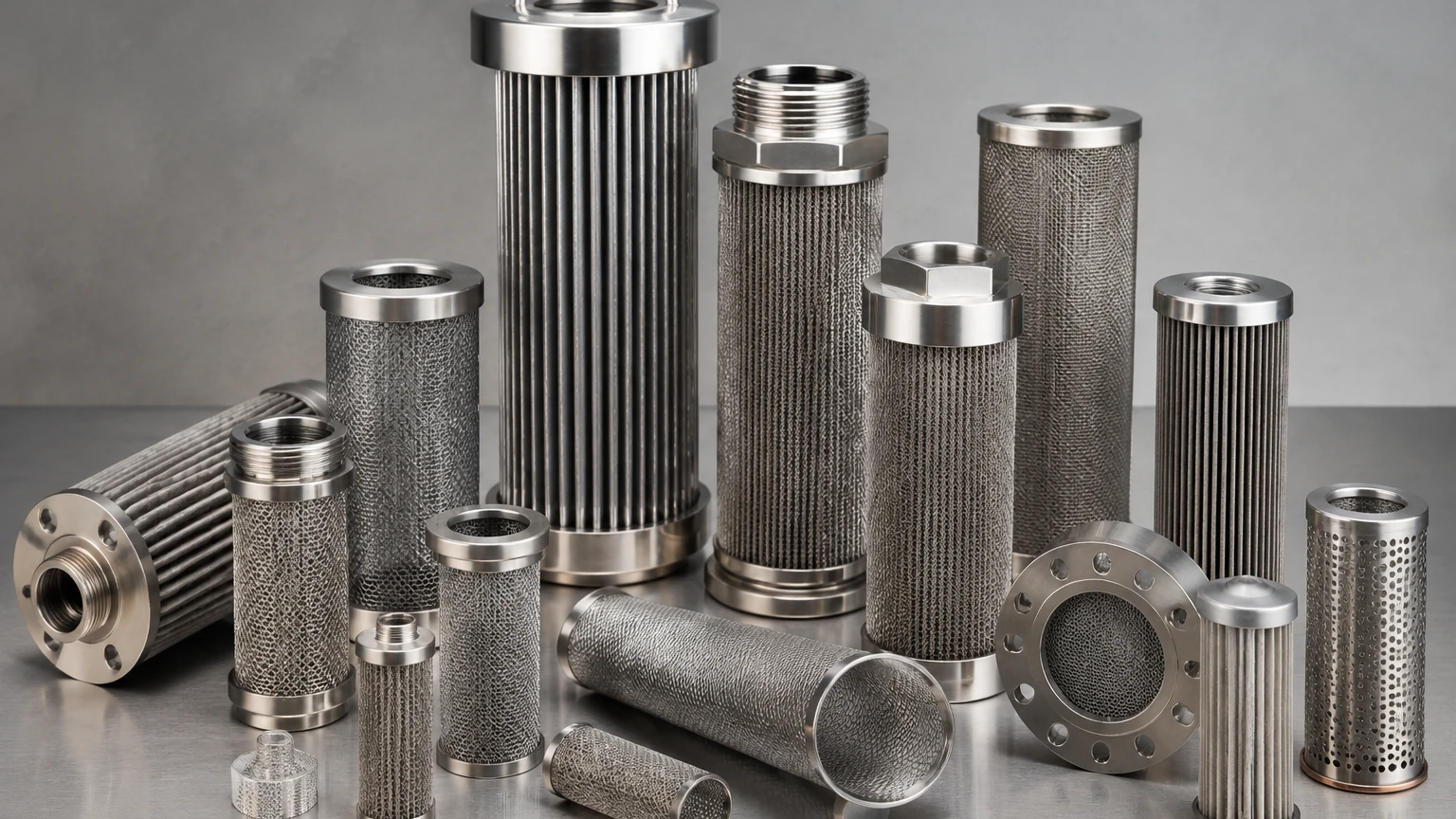
A primary engineering concern in fixed-bed reactors is the pressure drop across the bed and the potential for catalyst migration. This is where precision filtration becomes essential. Stainless steel wire mesh supports and retention screens are used to hold the catalyst in place while allowing the fluid to pass through with minimal resistance. If the catalyst breaks down into fines, downstream stainless steel filter cartridges are required to prevent these particles from contaminating the final product or damaging pumps.
Fluidized-Bed Reactors
Fluidized-bed reactors suspend solid catalyst particles in an upward-flowing stream of gas or liquid. At a certain flow velocity, the solid particles behave like a fluid, providing excellent heat and mass transfer characteristics. This design is common in catalytic cracking and wastewater treatment.
The high-velocity environment in fluidized beds can lead to significant attrition of the catalyst. To manage this, engineers must specify robust filtration systems at the reactor outlet. High-temperature gas filtration using sintered metal mesh or custom stainless steel components is often necessary to capture and return catalyst fines to the bed.
The Critical Role of Filtration in Reactor Systems
Regardless of the types of reactors utilized, filtration is rarely an optional component. It serves several vital functions in the industrial process chain:
1. Catalyst Recovery: Many industrial catalysts use precious metals (e.g., platinum, palladium). Losing even a small percentage of these solids to the waste stream can be financially devastating. Custom wire mesh filters are designed to capture these particles for reuse.
2. Product Purification: In pharmaceutical and food-grade applications, the final product must be free of any particulate matter. Stainless steel filter cartridges with precise micron ratings ensure that the output meets stringent purity standards.
3. Equipment Protection: Downstream of the reactor, sensitive equipment like heat exchangers, compressors, and high-pressure pumps can be easily damaged by solid debris or catalyst fines. Installing a protective filter is a standard safety measure.
4. Feedstock Pre-filtration: To prevent the reactor bed from fouling or the catalyst from being poisoned, incoming raw materials often pass through a filtration stage to remove impurities.
For those seeking technical specifications on filtration components compatible with these reactor systems, you can Main Page to review product options and application support provided by Kaifil.
Engineering Considerations for Reactor Filtration Components
When selecting filtration hardware for an industrial reactor, engineers must look beyond simple micron ratings. The harsh environments inside or immediately following a reactor demand specific material and structural properties.
Chemical and Thermal Compatibility
Reactors often operate at extreme temperatures and pressures, involving corrosive acids or bases. Stainless steel (typically 304L or 316L) is the industry standard due to its oxidation resistance and mechanical strength at high temperatures. In more aggressive environments, specialized alloys like Hastelloy may be integrated into the wire mesh design to prevent premature failure.
Pressure Drop and Flow Rates
In continuous systems like PFRs or CSTRs, maintaining a consistent flow rate is essential for achieving the desired residence time. A filter that clogs too quickly or creates an excessive pressure drop will disrupt the steady-state operation. Engineers must calculate the "clean pressure drop" and determine the "terminal pressure drop" at which the filter must be cleaned or replaced.
Mechanical Durability
In fluidized beds or reactors with high-speed agitation, filtration components are subjected to constant vibration and abrasive particles. Precision-welded stainless steel cartridges and reinforced wire mesh structures are necessary to withstand these mechanical stresses without shedding fibers or bypassing fluid.
Maintenance and Total Cost of Ownership
While the initial purchase price of a reactor and its associated filtration system is significant, the total cost of ownership (TCO) is driven by maintenance cycles and downtime.
* Cleanability: Unlike disposable polymer filters, stainless steel filtration components are often cleanable via backwashing, ultrasonic cleaning, or chemical baths. This significantly reduces the long-term cost of consumables.
* Replacement Cycles: Predicting the life expectancy of a filter involves monitoring the pressure differential across the unit. In many batch processes, the filter is cleaned or replaced between every run to prevent cross-contamination.
* Customization: Off-the-shelf filters rarely meet the exact needs of a specialized reactor. Working with a manufacturer that provides OEM and customized filtration solutions allows for the optimization of the filter’s surface area, connection types, and micron retention to match the specific kinetics of the reaction.
Conclusion
Understanding the various types of reactors—from the versatile batch vessel to the high-efficiency plug flow reactor—is only the first step in designing a successful industrial process. The performance of these reactors is inextricably linked to the quality of the auxiliary systems that support them.
By integrating high-quality stainless steel filtration solutions, engineers can protect their catalysts, ensure product consistency, and minimize operational downtime. Whether the application involves chemical processing, pharmaceutical synthesis, or water treatment, the selection of filtration components should be treated with the same technical rigor as the selection of the reactor itself. For more information on custom filtration engineering and material selection, visit the Kaifil Main Page to explore how precision-engineered metal filters can optimize your specific reactor configuration.
