


Industrial Cartridge Dust Collector
In modern industrial processing, maintaining air quality and managing particulate matter is a critical operational requirement. The industrial cartridge dust collector serves as a primary solution for capturing airborne contaminants across various sectors, including chemical processing, pharmaceuticals, and metalworking. Unlike traditional baghouses, cartridge-based systems utilize pleated media to provide a significantly higher surface area within a compact footprint. For engineers and facility managers, selecting the right filtration components is not merely about compliance but about optimizing system longevity, reducing energy consumption, and ensuring the purity of the process environment.
As a specialized manufacturer of stainless steel filtration solutions, Kaifil provides the precision-engineered components required to sustain high-performance dust collection in demanding environments. Understanding the technical nuances of these systems—from material compatibility to airflow dynamics—is essential for making informed procurement decisions. You can Review product options and application support on our Main Page to see how custom metal filtration components integrate into these industrial systems.
The Mechanics of Cartridge Filtration in Industrial Environments
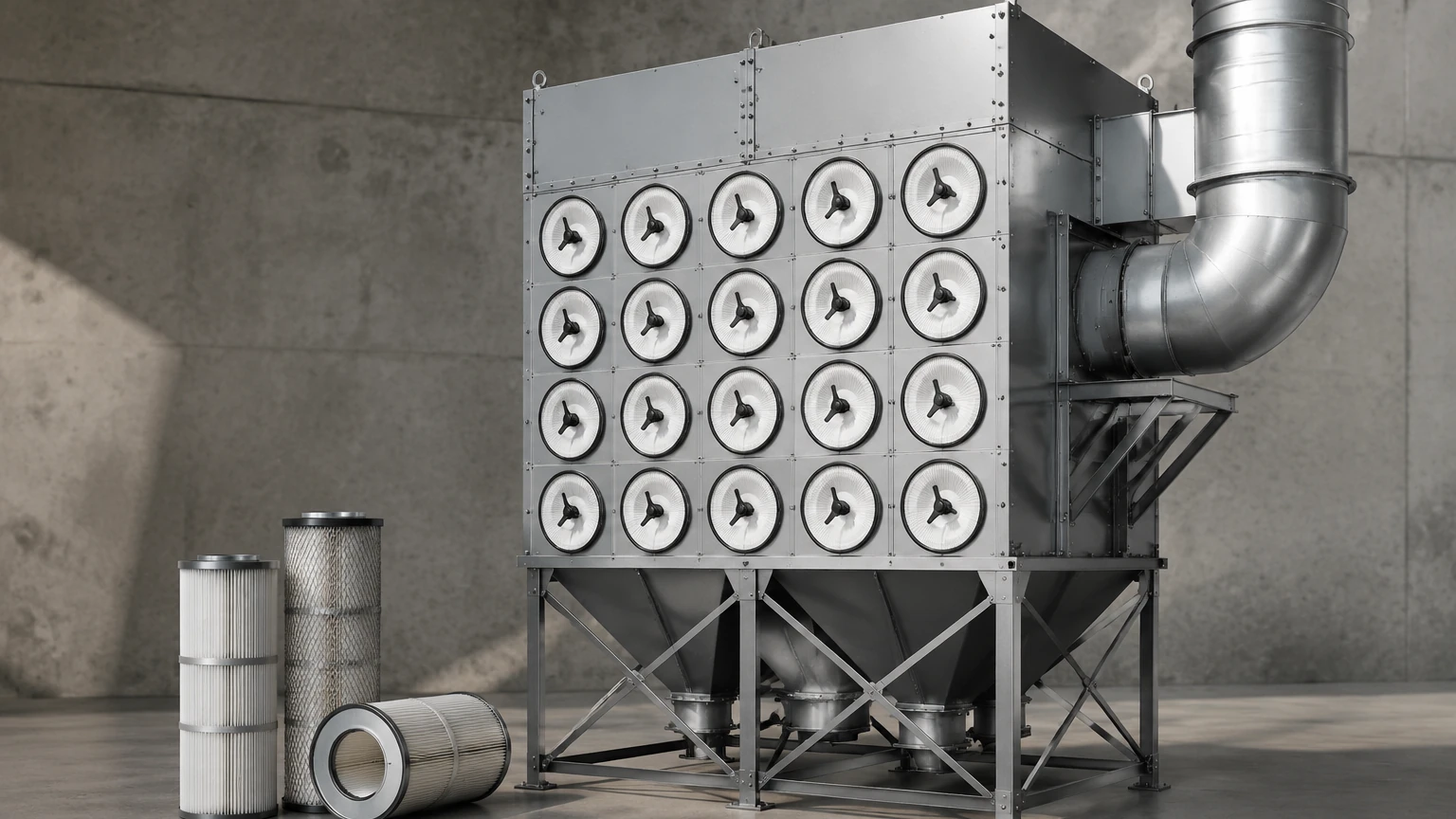
An industrial cartridge dust collector operates on the principle of surface filtration. The system draws contaminated air through a series of filter cartridges, where particulates are trapped on the exterior surface of the media while clean air passes through to the plenum and is eventually exhausted or recirculated.
The defining feature of the cartridge is its pleated design. By folding the filtration media, manufacturers can increase the effective filtration area by up to 20 to 30 times compared to a flat sheet of the same dimensions. This high surface-to-volume ratio allows for lower upward velocities and higher efficiency in capturing fine dust.
Pulse-Jet Cleaning Systems
Most modern industrial cartridge dust collectors utilize a pulse-jet cleaning mechanism. As dust builds up on the filter surface, the pressure drop across the media increases. Once a predetermined setpoint is reached, a high-pressure burst of compressed air is injected into the center of the cartridge. This creates a shockwave that flexes the media and dislodges the "dust cake," which then falls into a collection hopper. The effectiveness of this process depends heavily on the structural integrity of the filter cartridge and the quality of the support mesh used in its construction.
Material Considerations: The Role of Stainless Steel and Wire Mesh
While many standard dust collectors use cellulose or synthetic polyester media, heavy-duty industrial applications often require more robust materials. In environments involving high temperatures, corrosive chemicals, or stringent hygiene standards (such as food and beverage or pharmaceutical processing), stainless steel filtration components become indispensable.
Durability in Harsh Conditions
Standard synthetic media may degrade when exposed to temperatures exceeding 200°F (93°C) or when subjected to acidic or alkaline vapors. Stainless steel wire mesh filters, often used as pre-filters or primary elements in specialized industrial cartridge dust collectors, offer superior thermal stability and chemical resistance. Grades such as 304 and 316L are commonly employed to ensure the filter does not oxidize or lose structural form under stress.
Precision and Cleanability
Precision metal filter components allow for exact micron ratings, which is vital for processes requiring high-purity air. Furthermore, metal-based cartridges are often washable and reusable, providing a lower total cost of ownership compared to disposable synthetic filters that must be replaced frequently in high-load environments. Kaifil’s expertise in custom stainless steel wire mesh ensures that these components meet the specific permeability and strength requirements of the application.
Performance Metrics: Evaluating Efficiency and Air-to-Cloth Ratios
When evaluating an industrial cartridge dust collector, engineers must look beyond the initial purchase price and focus on technical performance metrics that dictate long-term operational costs.
Filtration Efficiency and Micron Ratings
Efficiency is typically measured by the Minimum Efficiency Reporting Value (MERV) or specific micron ratings. For industrial dust, sub-micron particles (those smaller than 1 micrometer) are often the most difficult to capture and the most hazardous to health. High-quality cartridges should be rated to capture at least 99.9% of particles at a specific micron size. In precision applications, the use of sintered metal mesh can provide even tighter control over particle passage.
Air-to-Cloth (A/C) Ratio
The Air-to-Cloth ratio is the volume of air passing through the collector (measured in Cubic Feet per Minute, or CFM) divided by the total square footage of the filtration media. A lower A/C ratio generally leads to a longer filter life and lower pressure drop, as the air moves more slowly through the media. For heavy dust loads or very fine particulates, engineers often specify a lower A/C ratio to prevent "blinding" or premature clogging of the pleats.
Pressure Drop (Delta P)
The pressure drop is the difference in air pressure between the dirty side and the clean side of the filter. A high pressure drop indicates that the filter is clogged or that the system is undersized, forcing the fan to work harder and consume more energy. Monitoring Delta P is the primary method for determining when a cartridge needs cleaning or replacement.
Addressing Challenges in Specialized Industrial Applications
Not all dust collection needs are the same. Different industries present unique challenges that require customized filtration designs.
* Chemical Processing: In these environments, the dust may be corrosive or reactive. Filtration components must be made from non-reactive materials like 316L stainless steel to prevent contamination of the product and degradation of the filter itself.
* Food and Beverage: Hygiene is the priority. Filters must be constructed with food-grade materials and designed without "dead zones" where bacteria could proliferate. Stainless steel wire mesh is ideal here because it can be steam-cleaned and sanitized.
* Pharmaceuticals: This industry often deals with potent active pharmaceutical ingredients (APIs). The industrial cartridge dust collector must provide high-efficiency filtration to protect workers and prevent cross-contamination between batches.
* Hydraulic and Water Treatment: While often associated with air, the principles of cartridge filtration extend to liquid systems where precision metal filter cartridges remove contaminants from process fluids, a core area of Kaifil’s manufacturing capability.
Customization and OEM Integration
Off-the-shelf filtration solutions often fall short when integrated into specialized industrial machinery. Customization is frequently required to match the exact dimensions, mounting configurations, and flow characteristics of a specific system.
OEM (Original Equipment Manufacturer) services allow for the development of filtration components that are purpose-built for a particular piece of equipment. This includes selecting the optimal wire mesh weave—such as plain, twilled, or dutch weave—to balance flow rate and filtration accuracy. By working with a manufacturer that understands the engineering behind the metal, companies can ensure that their industrial cartridge dust collector operates at peak efficiency from day one.
Engineering Checklist: Pre-Purchase Considerations
Before finalizing the specifications for an industrial cartridge dust collector or its replacement components, purchasing teams and engineers should confirm the following data points:
1. Particle Characteristics: What is the average particle size (micron), shape (spherical, irregular, fibrous), and density? Is the dust abrasive, hygroscopic (moisture-absorbing), or combustible?
2. Gas Stream Conditions: What is the operating temperature? Are there corrosive gases or high moisture levels present that would necessitate stainless steel construction?
3. Required Airflow (CFM): What volume of air must be moved to effectively capture the dust at the source?
4. Regulatory Compliance: Does the system need to meet specific OSHA, EPA, or FDA standards? If the dust is explosive, does the collector meet NFPA guidelines for explosion venting and suppression?
5. Maintenance Access: Is the housing designed for easy cartridge change-outs? Minimizing downtime during maintenance is essential for high-volume production lines.
6. Total Cost of Ownership (TCO): Beyond the initial cost, what are the expected costs for replacement filters, energy consumption (based on pressure drop), and compressed air usage for cleaning?
Conclusion
The industrial cartridge dust collector is a sophisticated piece of equipment that relies on the quality of its internal components to function effectively. Whether the goal is protecting worker health, ensuring product purity, or maintaining equipment longevity, the choice of filtration media and structural components is paramount. For applications involving extreme temperatures, corrosive agents, or the need for high-precision custom designs, stainless steel wire mesh and metal cartridges offer a level of reliability that synthetic alternatives cannot match.
By focusing on engineering-led selection and understanding the specific demands of the industrial environment, organizations can implement filtration solutions that are both cost-effective and high-performing. For more information on custom metal filtration components and industrial solutions, visit our Main Page to explore our technical capabilities and product range.
