


Dust Collector Cement
In the cement manufacturing industry, dust collection is not merely a matter of environmental compliance; it is a critical component of operational efficiency, material recovery, and equipment longevity. The production of cement involves several high-intensity stages—crushing, grinding, pyroprocessing in kilns, and cooling—each of which generates massive volumes of abrasive, fine, and often high-temperature particulate matter. Managing this output requires robust filtration systems capable of withstanding extreme mechanical and thermal stress.
For engineers and procurement professionals, selecting the right components for a dust collector cement application involves balancing filtration efficiency with the structural integrity of the filter media. While traditional fabric bags are common in lower-temperature zones, the demanding conditions of kiln exhausts and clinker coolers often necessitate advanced metal filtration solutions. As a specialist in custom stainless steel filtration, Kaifil provides the technical expertise and manufacturing precision required to address these industrial challenges. Detailed product specifications and engineering support can be found on our Main Page.
Challenges of Dust Collection in Cement Production
Cement plants operate under some of the most grueling conditions for filtration equipment. Understanding these challenges is the first step in selecting a filtration system that minimizes downtime and maximizes throughput.
High Abrasiveness of Particulates
Cement dust, particularly clinker dust, is highly abrasive. In a high-velocity airflow, these particles can act like sandblasting media, rapidly eroding standard filter bags and even thin-walled metal components. This erosion leads to premature filter failure, increased emissions, and potential damage to downstream equipment like fans and heat exchangers.
Thermal Extremes
The rotary kiln is the heart of a cement plant, where raw materials are heated to temperatures exceeding 1,400°C. The exhaust gases exiting the kiln system, even after passing through preheaters, remain significantly hotter than the operating limits of most synthetic fibers. While cooling systems (such as water sprays or air-to-air heat exchangers) are used, the filtration media must still handle consistent temperatures often ranging from 150°C to 250°C, with potential for thermal spikes.
Chemical Corrosion and Moisture
Cement production involves various chemical reactions that release sulfur oxides (SOx), nitrogen oxides (NOx), and chlorides. If the temperature of the exhaust gas drops below the acid dew point, condensation can occur, leading to the formation of corrosive acids. Furthermore, moisture in the system can cause cement dust to hydrate and "blind" the filter media, creating a hard crust that is nearly impossible to remove through standard cleaning cycles.
Selecting Filtration Media for Cement Dust
The choice of media determines the pressure drop, cleaning efficiency, and service life of the dust collector cement system. In industrial filtration, the transition from disposable fabric filters to permanent or semi-permanent metal filters is often driven by the need for durability in extreme environments.
Stainless Steel Wire Mesh Filters
For high-temperature and high-abrasion zones, stainless steel wire mesh filters offer distinct advantages. Unlike fabric, stainless steel does not lose structural integrity at elevated temperatures. Kaifil specializes in multi-layer sintered wire mesh, which combines high mechanical strength with precise pore size distribution. This ensures that even fine cement particles are captured effectively without the risk of the media tearing or melting.
Sintered Metal Fiber Felt
In applications requiring higher filtration accuracy (lower micron ratings), sintered metal fiber felt provides a porous, three-dimensional structure. This media offers high permeability, which translates to a lower initial pressure drop across the filter. For cement plants, this means reduced energy consumption for the primary induction fans.
Material Grades: SS304 vs. SS316L
Material selection is critical for longevity. While SS304 is suitable for many dry, non-corrosive dust collection tasks, SS316L is preferred in environments where chemical corrosion is a risk. The addition of molybdenum in SS316L provides superior resistance to chlorides and acidic condensates often found in kiln bypass systems.
Engineering Considerations for System Design
When integrating a dust collector into a cement plant, engineering teams must look beyond the filter media itself and consider the entire system's dynamics.
Air-to-Cloth Ratio (Filtering Velocity)
The air-to-cloth (A/C) ratio is the volume of gas passing through a square foot of filter media per minute. In cement applications, a lower A/C ratio is typically preferred to reduce the velocity of abrasive particles hitting the media and to ensure that the dust cake can be effectively released during the cleaning cycle. Overloading the media with high velocity leads to deep-seated blinding and shortened filter life.
Pulse-Jet Cleaning Efficiency
Most modern cement dust collectors utilize pulse-jet cleaning, where a burst of compressed air is fired down the center of the filter element to dislodge the dust cake. For metal filter cartridges, the structural rigidity of the element is vital. If the element flexes too much or lacks a proper internal support cage, the cleaning pulse may be dissipated, leading to ineffective dust removal. Kaifil’s precision-engineered cartridges are designed to maintain structural stability under high-pressure pulses, ensuring consistent cleaning performance.
Pressure Drop Management
Maintaining a stable differential pressure is key to plant efficiency. A high pressure drop indicates that the filters are clogged or that the cleaning system is failing. By using high-permeability metal mesh, engineers can maintain lower operating pressures, which significantly reduces the total cost of ownership by lowering electricity costs for the plant's large-scale fans.
Customization and OEM Solutions for Cement Plants
No two cement plants are identical; variations in raw material composition, kiln type, and local environmental regulations require customized filtration solutions. Standard off-the-shelf filters often fail to meet the specific spatial or performance constraints of an existing facility.
Tailored Micron Ratings
Depending on whether the goal is product recovery (collecting finished cement) or emission control (kiln exhaust), the required filtration accuracy will vary. Customization allows for the selection of specific mesh counts and layering configurations to target particles ranging from 1 micron to 100 microns.
Retrofitting Existing Systems
Many cement plants look to upgrade their existing baghouses to more durable metal filter systems. This often requires custom-designed end caps, flanges, and lengths to fit into existing tube sheets without requiring extensive structural modifications to the dust collector housing. Kaifil works closely with engineering teams to provide OEM-quality components that match these specific dimensions and mounting requirements.
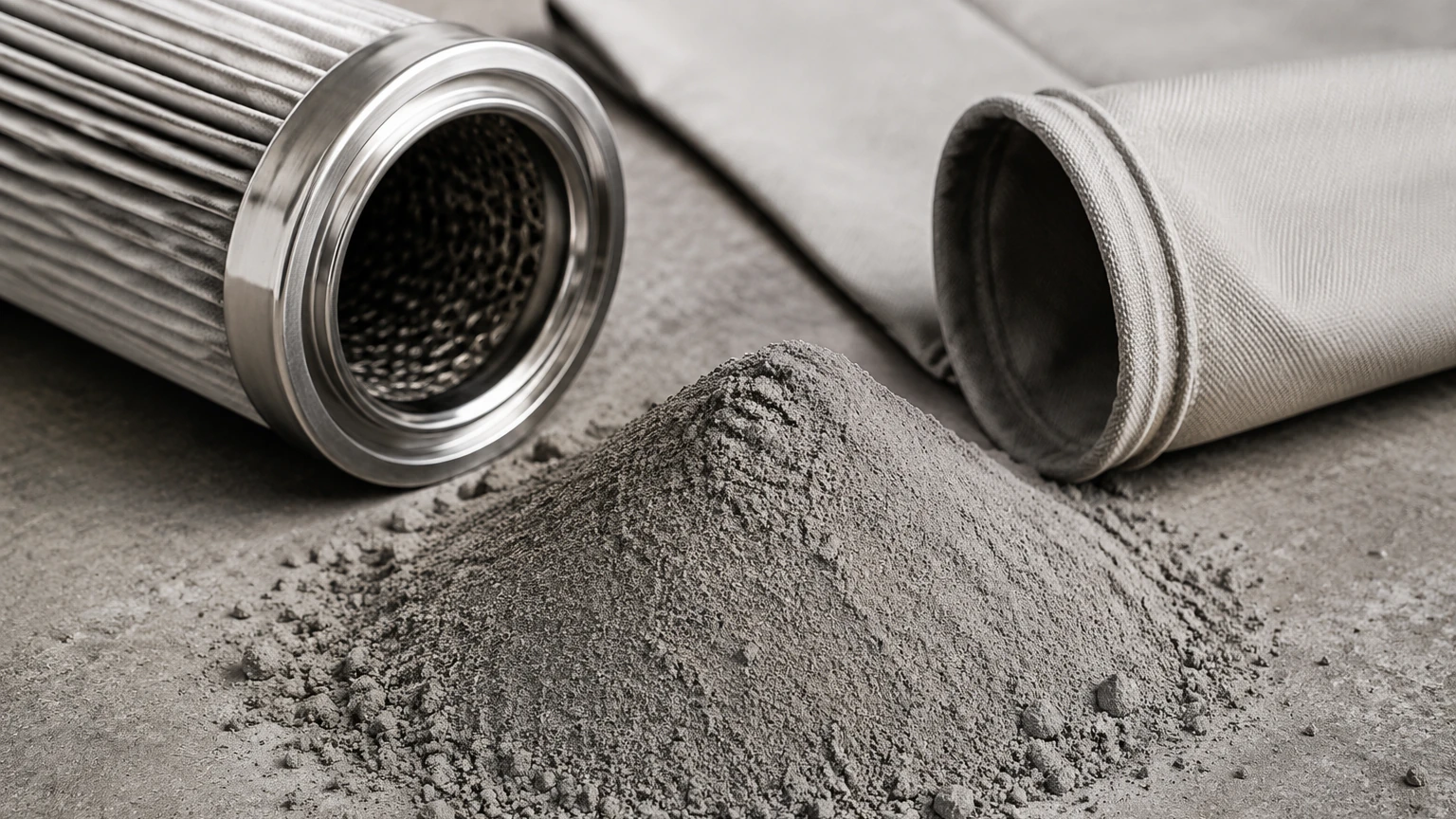
Maintenance and Longevity of Metal Filters
The primary argument for utilizing stainless steel components in a dust collector cement system is the significant extension of the replacement cycle. While the initial investment in metal filtration is higher than fabric bags, the long-term savings are substantial.
1. Reduced Downtime: Fabric bags in abrasive cement environments may need replacement every 6 to 12 months. Stainless steel filters can last years, reducing the frequency of planned and unplanned shutdowns.
2. Cleanability: Unlike fabric, which can trap particles within its fibers (depth loading), metal mesh facilitates surface filtration. This makes it much easier to clean through back-pulsing or even ultrasonic cleaning during major maintenance intervals.
3. Mechanical Resilience: Metal filters are resistant to "popping" or tearing caused by pressure surges or mechanical handling during installation, which are common causes of failure in traditional baghouses.
Technical Specifications and Performance Standards
When evaluating filters for cement applications, engineers should confirm the following technical parameters:
* Operating Temperature: Ensure the media and the adhesives/welds used in the filter construction can handle the maximum expected kiln exhaust temperatures.
* Burst Strength: The filter must withstand the differential pressure without collapsing, especially during start-up or during heavy dust loading events.
* Filtration Efficiency: Verify that the filter meets local environmental protection agency (EPA) or equivalent standards for particulate matter (PM) emissions, often requiring 99.9% efficiency for fine particulates.
* Chemical Compatibility: Assess the presence of sulfur or chlorides in the gas stream to determine if SS304, SS316L, or a more exotic alloy like Inconel is required.
Conclusion
Effective dust collection in the cement industry is a complex engineering challenge that requires a deep understanding of material science and fluid dynamics. By moving toward high-performance stainless steel filtration solutions, cement producers can achieve higher reliability, lower energy consumption, and better compliance with environmental standards.
As a dedicated manufacturer, Kaifil provides the precision-engineered components necessary to optimize these systems. Whether you are designing a new facility or retrofitting an existing baghouse, our team offers the technical support needed to select the ideal filtration media for your specific application. For more information on our custom manufacturing capabilities and product range, visit our Main Page.
