


Filterbags
In the landscape of industrial liquid filtration, filterbags represent one of the most versatile and cost-effective solutions for removing particulate matter from process streams. While high-precision applications often transition toward permanent stainless steel media, the role of disposable filterbags remains critical in pre-filtration, batch processing, and high-flow industrial environments. For engineers and procurement specialists, selecting the appropriate filterbag involves a complex evaluation of material science, fluid dynamics, and mechanical compatibility to ensure process integrity and operational efficiency.
At Kaifil, we understand that filtration is rarely a standalone process. Whether utilized as a primary separation stage or as a safeguard for downstream precision components like stainless steel filter cartridges, the performance of filterbags is dictated by their engineering specifications. This guide examines the technical parameters of filterbags, providing the factual foundation necessary for informed selection within professional industrial frameworks.
Understanding the Role of Filterbags in Industrial Liquid Filtration
Filterbags operate primarily through a combination of depth filtration and surface filtration, depending on the media construction. They are designed to be housed within a pressure vessel, where the fluid flows from the inside of the bag to the outside, trapping contaminants within the bag itself. This design simplifies the disposal process, as the captured solids are contained within the media, preventing the contamination of the filter housing during change-outs.
In heavy industrial sectors—such as chemical processing, water treatment, and food and beverage production—filterbags are valued for their ability to handle high flow rates with relatively low pressure drops. They serve as an essential first line of defense in multi-stage filtration systems. By removing the bulk of suspended solids, they extend the service life of more expensive secondary filters. For those exploring comprehensive filtration architectures, reviewing the broader range of available technologies on our Main Page can provide insights into how bag systems integrate with precision metal filtration components.
Material Science: Selecting Media for Chemical and Thermal Compatibility
The efficacy of a filterbag is fundamentally tied to its material composition. Industrial environments present diverse challenges, including extreme pH levels, high temperatures, and aggressive solvents. Selecting the wrong material can lead to media migration, chemical degradation, or catastrophic failure of the filtration stage.
Polypropylene (PP)
Polypropylene is the most widely used material for filterbags due to its excellent chemical resistance to a broad spectrum of acids and alkalis. It is naturally hydrophobic and silicone-free, making it ideal for coatings and paint applications. However, its thermal threshold is relatively low, typically limited to operating temperatures below 90°C (194°F).
Polyester (PE)
Polyester offers higher thermal stability than polypropylene, often rated for continuous use up to 150°C (302°F). It provides excellent resistance to most oxidizing agents and organic solvents, though it is susceptible to hydrolysis in the presence of high-temperature steam or strong alkalis.
Nylon Mesh
Nylon is primarily used in monofilament mesh bags for surface filtration. It is highly resistant to solvents and hydrocarbons and is often selected for its precise aperture size. Because it is a non-shedding material, it is frequently employed in applications where fiber migration must be strictly avoided.
Specialized Materials (PTFE and Nomex)
For extreme environments involving high-temperature flue gases or highly corrosive chemicals, specialized materials like PTFE (Teflon) or Aramid (Nomex) are utilized. These materials provide the necessary durability for specialized chemical processing but come at a significantly higher price point.
Technical Specifications: Micron Ratings and Particle Retention Efficiency
One of the most frequent points of confusion in filterbag procurement is the distinction between nominal and absolute micron ratings. Understanding these metrics is vital for meeting the required cleanliness levels of a process.
1. Nominal Micron Rating: This is an arbitrary value indicating the ability of the filterbag to retain a majority of particles at the specified size. Typically, a nominal filter might capture 60% to 80% of particles at its rated micron size. These are best suited for non-critical applications or pre-filtration stages.
2. Absolute Micron Rating: This refers to a high-efficiency rating where the media captures 99% or more of particles at the specified size under controlled laboratory conditions. Achieving absolute filtration with a bag often requires multi-layered melt-blown media, which bridges the gap between standard bags and high-performance cartridges.
Engineers must also consider the "dirt-holding capacity." While a finer micron rating provides cleaner effluent, it also leads to faster blinding of the media, resulting in more frequent change-outs and higher operational costs. A balanced approach involves analyzing the particle size distribution (PSD) of the influent to select a micron rating that optimizes both clarity and throughput.
Engineering the Seal: Preventing Bypass in Filterbag Systems
The most common cause of filtration failure is not the media itself, but the bypass of fluid around the filterbag seal. If the seal between the bag and the housing is compromised, unfiltered fluid will enter the downstream flow, rendering the filtration process ineffective.
Ring and Flange Designs
* Steel/Stainless Steel Rings: These are sewn into the top of the bag and rely on the downward pressure of the housing lid to create a seal. While robust, they can be prone to bypass if the ring is not perfectly seated.
* Plastic Flanges (Sentinel/Snap-Collar): These molded plastic components feature a groove that snaps into the housing's internal rim. They provide a more consistent, pressure-activated seal that minimizes the risk of bypass. These are often preferred in pharmaceutical and food-grade applications where strict containment is mandatory.
Construction Methods
* Sewn Seams: Traditional construction involves sewing the media together. However, the needle holes can potentially allow particles larger than the micron rating to pass through.
* Welded Seams: Modern high-performance filterbags utilize ultrasonic or thermal welding. This eliminates needle holes and ensures that the entire bag surface maintains the integrity of the specified micron rating.
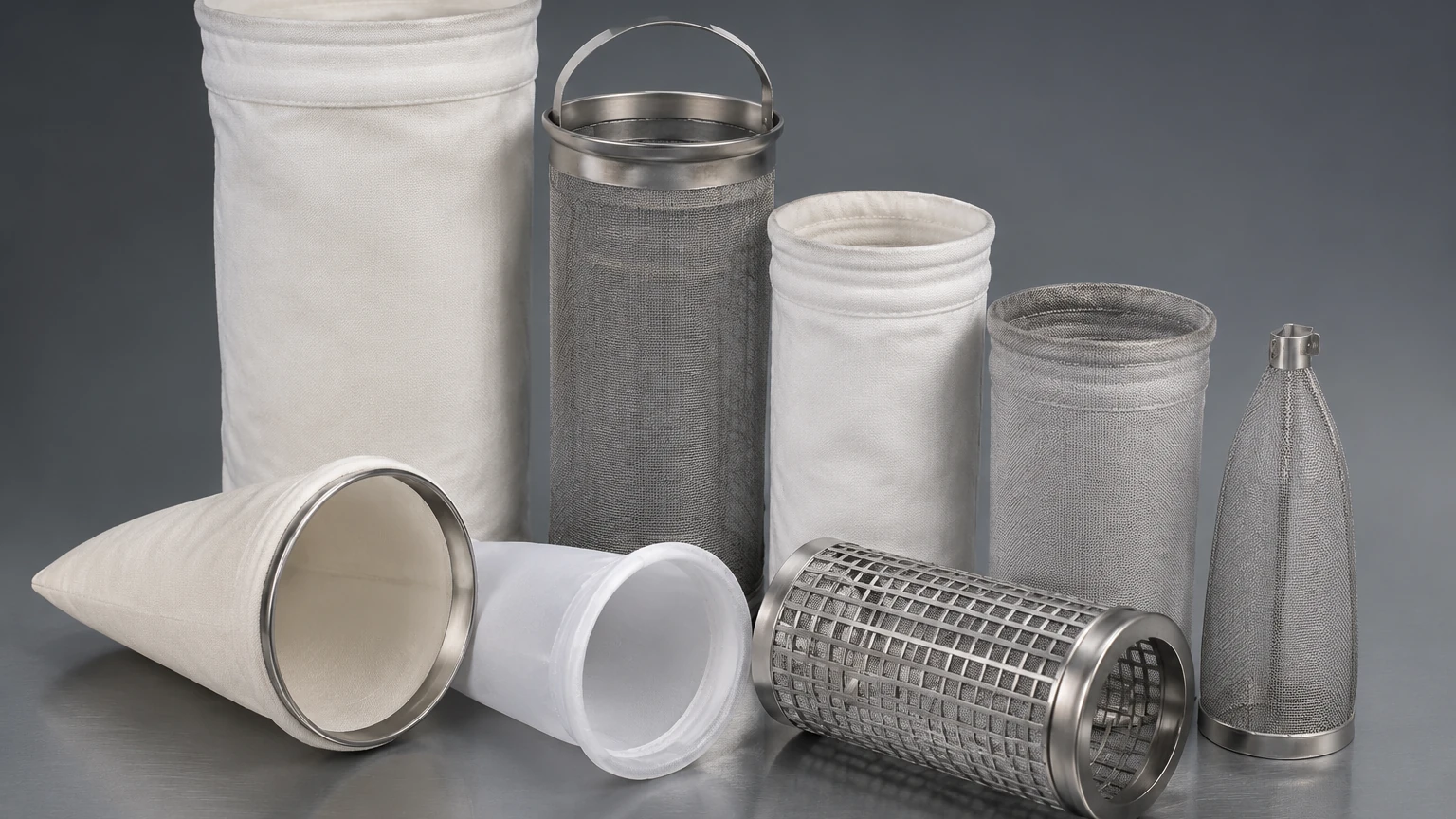
Comparative Analysis: Filterbags vs. Stainless Steel Filter Cartridges
When designing a filtration system, engineers must decide between disposable bags and permanent or semi-permanent stainless steel cartridges. The choice depends on the specific demands of the application.
Filterbags excel in applications with high solids loading where the cost of cleaning permanent media would be prohibitive. They offer a lower initial capital investment and are simple to operate. However, they are limited by their structural strength and cannot be used in high-pressure differential scenarios where a bag might burst.
In contrast, stainless steel filter cartridges—specialties of Kaifil—provide superior mechanical strength, backwash capability, and the ability to withstand extreme temperatures and pressures. In many critical industrial processes, a hybrid approach is used: filterbags remove the bulk contaminants, while stainless steel elements provide the final, high-precision polish. For a detailed look at precision metal options, visit our Main Page.
Operational Management: Replacement Cycles and Maintenance Protocols
To maintain the efficiency of a filtration system, a rigorous maintenance schedule is required. The primary indicator for filterbag replacement is the differential pressure ($ΔP$).
* Initial $ΔP$: The pressure drop across a clean filter. Typically, this should be less than 2 PSI (0.14 bar).
* Terminal $ΔP$: The pressure drop at which the bag is considered fully loaded and must be replaced. For most standard housings, this is between 15 and 25 PSI (1.0 to 1.7 bar).
Exceeding the terminal differential pressure can lead to several risks. First, the increased pressure can force particles through the depth media (particle unloading), contaminating the downstream fluid. Second, it can cause the bag to rupture, leading to a total loss of filtration. Monitoring $ΔP$ via gauges installed on the inlet and outlet of the housing is a fundamental requirement for industrial filtration management.
Customization and OEM Integration for Specialized Applications
Standard off-the-shelf filterbags do not always meet the unique requirements of specialized industrial equipment. Customization is often necessary to address specific dimensions, unique chemical environments, or integrated hardware requirements.
As a manufacturer with extensive OEM experience, Kaifil supports the development of customized filtration components that align with specific housing geometries and performance targets. This includes the integration of specialized rings, reinforced handles for easier removal in deep housings, and multi-layered media configurations designed for specific contaminant profiles. By working closely with our engineering team, global customers can ensure that their filtration solutions are optimized for their specific industrial environment, reducing waste and improving total cost of ownership.
Conclusion
Filterbags are a cornerstone of industrial liquid processing, offering a balance of efficiency, simplicity, and cost-effectiveness. However, their performance is not guaranteed by the media alone; it requires a technical understanding of material compatibility, sealing mechanisms, and the operational limits of the system.
By carefully evaluating the micron requirements, chemical environment, and flow dynamics, engineers can select a filterbag solution that protects downstream equipment and ensures product quality. For those requiring the highest levels of durability and precision, particularly in demanding chemical or hydraulic applications, exploring advanced stainless steel filtration options alongside traditional bag systems is recommended. To learn more about our full range of custom filtration solutions and engineering support, please visit the Kaifil Main Page.
