


How to Filter Sea Water
Seawater filtration is a critical process in numerous industrial applications, ranging from desalination and cooling systems to offshore oil and gas operations and marine ballast water treatment. Unlike freshwater sources, seawater presents a unique set of challenges characterized by high salinity, a diverse range of organic matter, and highly corrosive properties. For engineers and technical procurement teams, understanding how to filter sea water effectively requires a deep dive into material science, mechanical design, and fluid dynamics.
To achieve reliable performance, a filtration system must balance the removal of suspended solids with the need for long-term durability in a harsh environment. This guide explores the technical considerations, material requirements, and multi-stage processes involved in industrial seawater filtration.
The Engineering Challenges of Seawater Environments
Before determining the specific hardware required, it is essential to analyze the environment. Seawater is not a static medium; its composition varies based on depth, distance from the shore, and local biological activity. Three primary factors dictate the design of a filtration system:
1. Corrosion and Pitting: The high chloride content in seawater is notoriously aggressive toward standard metals. Traditional carbon steel or even low-grade stainless steels can suffer from rapid pitting and crevice corrosion.
2. Biofouling: Seawater is rich in microorganisms, algae, and larvae. Without proper filtration and material selection, these organisms can colonize filter surfaces, leading to "bio-growth" that increases pressure drops and restricts flow.
3. Suspended Solids and Turbidity: Seawater contains varying levels of sand, silt, and organic debris. The concentration of these solids often spikes during storms or seasonal changes, requiring a system capable of handling fluctuating loads.
Material Selection: Beyond Standard Stainless Steel
When considering how to filter sea water, material selection is perhaps the most critical decision. While 304 stainless steel is common in food and beverage applications, it is generally unsuitable for permanent seawater immersion due to its susceptibility to chloride-induced corrosion.
316L Stainless Steel
For many coastal applications or systems with intermittent exposure, 316L stainless steel is the baseline. The addition of molybdenum provides better resistance to pitting than 304. However, in warm seawater or stagnant conditions, even 316L may face challenges.
Duplex and Super Duplex Steels
In high-pressure environments, such as those found in Reverse Osmosis (RO) pre-filtration, Duplex stainless steels (like 2205) or Super Duplex (like 2507) are preferred. These alloys offer a higher Pitting Resistance Equivalent Number (PREN), ensuring that the filter cartridges and housings can withstand years of exposure without structural failure.
Specialty Coatings and Non-Metallic Options
In some instances, metal filter elements are reinforced with specialized coatings, or engineers may opt for titanium components for extreme longevity, though the cost-to-performance ratio must be carefully evaluated.
The Multi-Stage Filtration Process
Effective seawater filtration is rarely achieved in a single step. Instead, a graduated approach is used to protect sensitive downstream equipment, such as high-pressure pumps or RO membranes.
Stage 1: Macro-Filtration (Intake Screens)
The process begins at the intake. Large-scale screens or wedge wire filters are used to prevent the entry of fish, seaweed, and large debris. These filters usually have a high micron rating (typically 1mm to 5mm) and are designed for high-volume flow with minimal resistance.
Stage 2: Coarse Filtration (Pre-Treatment)
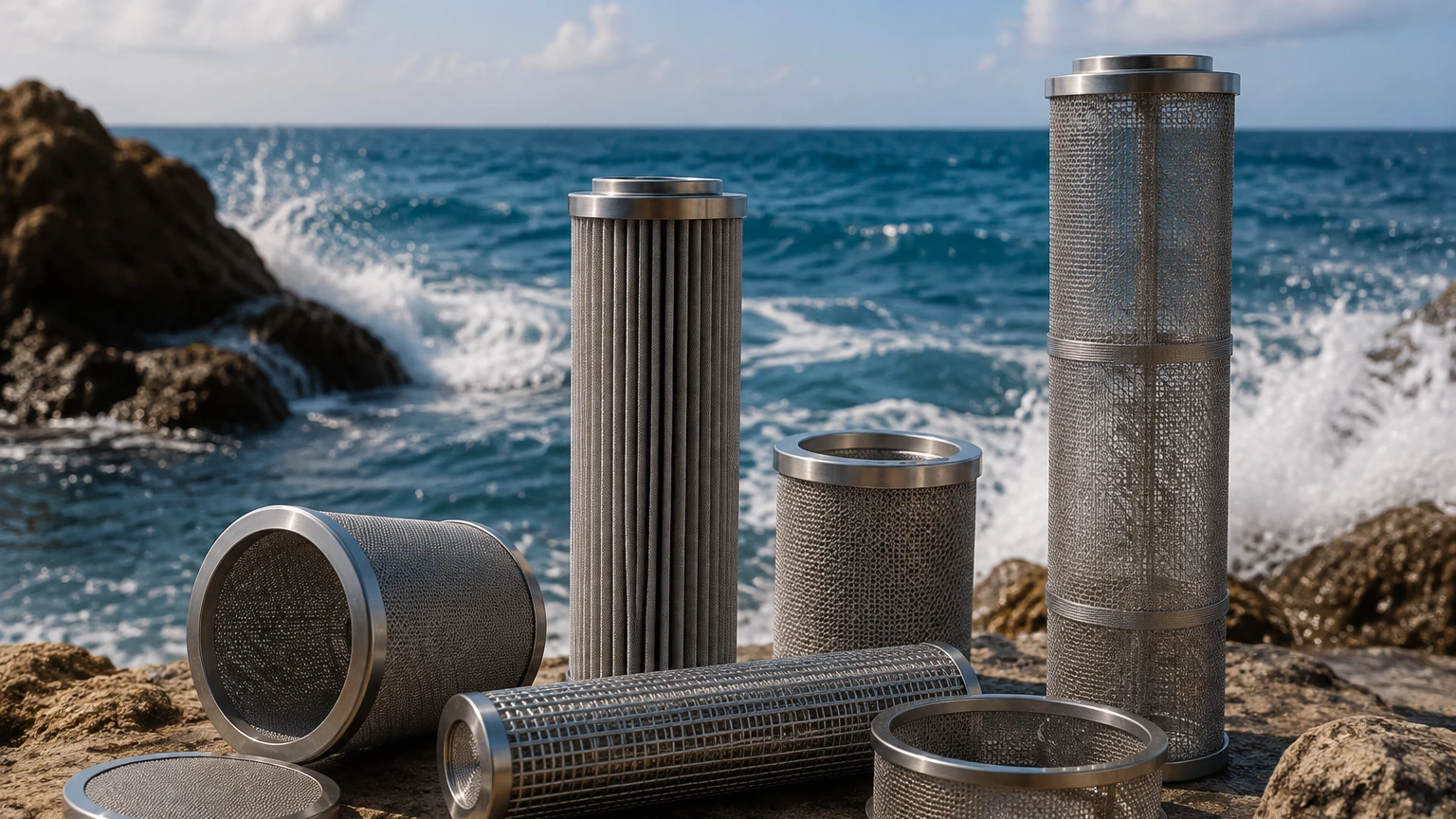
Once the water enters the facility, coarse filtration removes smaller particles that could clog secondary systems. Stainless steel wire mesh filters are frequently used here. These elements are durable and can be cleaned via backwashing. Typical ratings for this stage range from 100 to 500 microns.
Stage 3: Fine Filtration
This is where the "heavy lifting" of particle removal occurs. Fine filtration targets silt and smaller organic matter. Sintered metal mesh or multi-layer wire mesh cartridges are ideal for this stage because they provide a stable pore structure that does not deform under pressure. For those researching how to filter sea water for technical applications, this stage often targets ratings between 5 and 50 microns.
Stage 4: Ultra-Fine or Membrane Protection
In desalination plants, the final stage before the RO membrane involves ultra-fine filtration. This ensures that any remaining microscopic particles are captured, preventing membrane fouling. High-precision metal filter components are often used as a final safety barrier due to their ability to maintain integrity under high differential pressures.
Technical Comparison of Filter Media
Choosing the right media type is essential for optimizing the total cost of ownership (TCO). For more information on specific component designs, you can visit the Main Page to review technical specifications.
| Media Type | Advantages | Typical Application |
| :— | :— | :— |
| Woven Wire Mesh | High open area, easy to clean, precise pore size. | Coarse to fine pre-filtration. |
| Sintered Metal | High mechanical strength, excellent depth filtration. | High-pressure RO pre-treatment. |
| Wedge Wire | Non-clogging surface, extremely robust. | Intake screens and heavy debris removal. |
| Perforated Metal | Structural support for finer mesh layers. | Filter housing internals and strainers. |
Engineering Considerations for System Integration
When designing a system to filter seawater, engineers must look beyond the micron rating. Several operational parameters will dictate the success of the installation.
Flux and Flow Velocity
High flow velocities can accelerate erosion-corrosion on filter surfaces. Conversely, velocities that are too low may encourage the settling of solids and biological growth. Engineers must calculate the optimal flux (flow per unit area) to ensure the filter operates within its efficient range.
Differential Pressure (Delta P)
Monitoring the pressure drop across the filter is the primary method for determining when a cleaning cycle is required. In seawater applications, the "clean" pressure drop should be kept low to maximize the available run time before the "terminal" pressure drop is reached. Metal filters are advantageous here because they can withstand much higher differential pressures than polymer-based disposables without collapsing.
Backwashing and Cleaning Protocols
Because seawater filtration often involves high volumes of organic material, the ability to clean the filter in-situ is a significant advantage. Automated backwashing systems use a portion of the filtered water (or air) to flush particles off the mesh surface. The mechanical rigidity of stainless steel mesh allows for aggressive backwashing without damaging the media.
Addressing Biofouling and Scaling
Even with the best mechanical filtration, biological growth can be an issue. To mitigate this, many industrial systems incorporate secondary treatments:
* Chlorination/Dechlorination: Injecting chlorine at the intake to kill microorganisms, followed by removal before the water reaches sensitive membranes.
* UV Sterilization: Using ultraviolet light to disrupt the DNA of bacteria and algae.
* Copper-Nickel Alloys: Using CuNi components for specific intake parts, as copper has natural bio-inhibitory properties.
Customization and OEM Solutions
No two seawater filtration projects are identical. A system designed for a North Sea oil rig will differ significantly from one designed for a Mediterranean desalination plant. Customization allows for the optimization of:
* End-Cap Configurations: Ensuring a perfect seal within existing housings (DOE, 222, 226, etc.).
* Layering: Combining different mesh counts to create a custom depth-filtration profile.
* Reinforcement: Adding internal cores or external cages to handle extreme pressure spikes.
For purchasing teams, working with a manufacturer that understands these nuances is vital. Reliable filtration prevents downstream downtime, which in industrial seawater applications can cost thousands of dollars per hour in lost production or equipment repair.
Conclusion: Selecting the Right Solution
Understanding how to filter sea water is a balance of choosing the right materials and the right filtration hierarchy. By utilizing high-grade stainless steel and precision-engineered wire mesh, industrial operators can achieve a system that is both effective and durable. The transition from coarse intake screening to fine cartridge filtration ensures that every component is protected, and the use of cleanable metal media provides a sustainable, long-term solution compared to disposable alternatives.
For engineers and procurement specialists looking to implement or upgrade their filtration systems, focusing on the specific chemical and physical properties of their local seawater source is the first step toward a successful design. For further technical resources and product options, visiting the Main Page will provide the necessary data to begin the selection process.
