


Stainless Steel Hydrocyclone
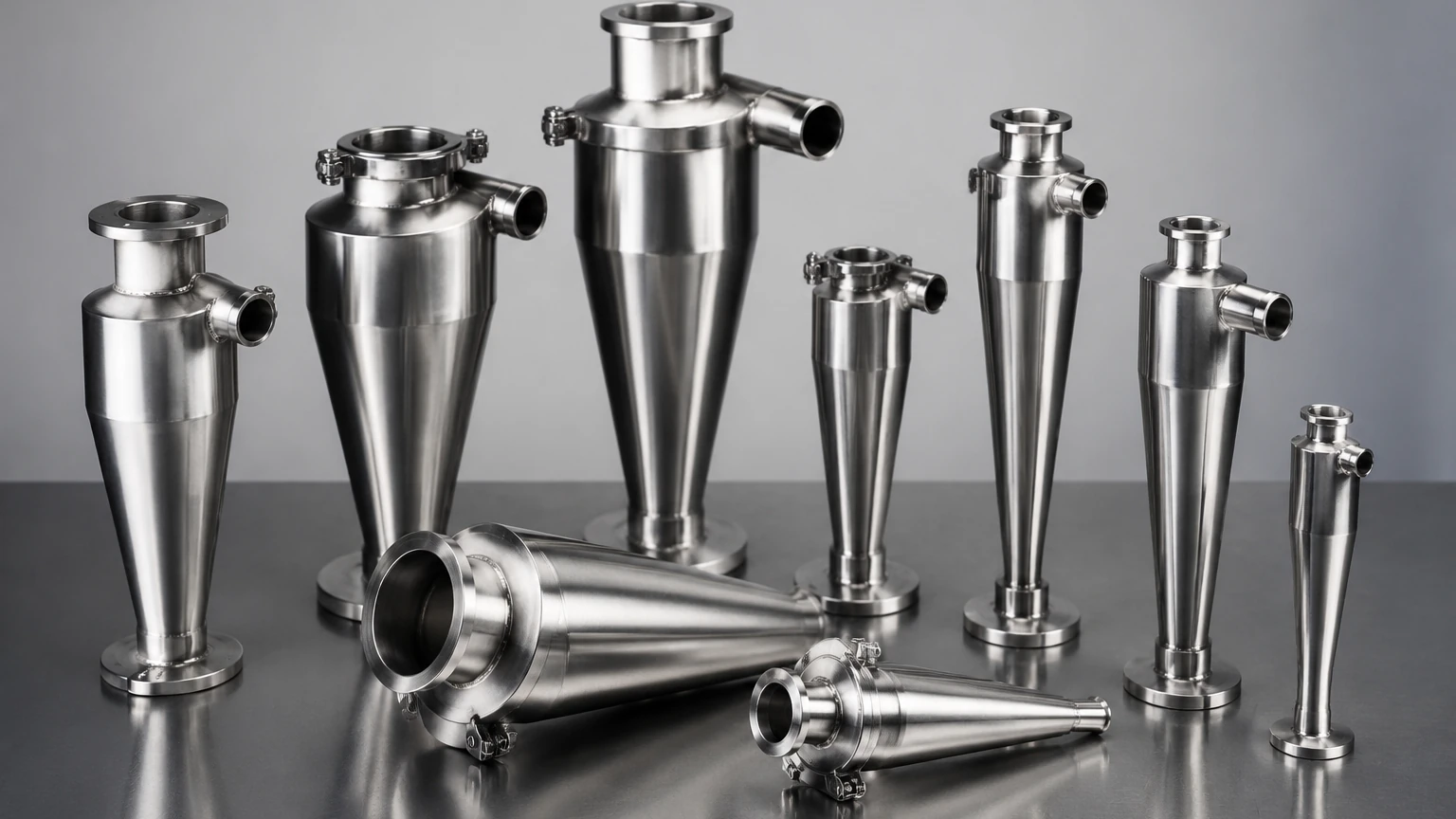
In the landscape of industrial liquid-solid separation, the stainless steel hydrocyclone stands as a critical component for processes requiring high durability, corrosion resistance, and precise particle classification. Unlike mechanical filters that rely on physical barriers, a hydrocyclone utilizes centrifugal force to separate phases of different densities. When constructed from high-grade stainless steel, these units offer the structural integrity needed to withstand high pressures and abrasive slurries, making them indispensable in chemical processing, food production, and pharmaceutical manufacturing.
For engineers and procurement specialists, selecting a stainless steel hydrocyclone involves more than just matching pipe sizes. It requires a deep understanding of fluid dynamics, material science, and the specific requirements of the downstream process. As a manufacturer specializing in custom filtration solutions, Kaifil provides the technical expertise necessary to integrate these components into complex industrial systems. For more information on our full range of filtration capabilities, you can visit our Main Page.
Introduction to Stainless Steel Hydrocyclones in Industrial Filtration
A hydrocyclone is a static device that applies centrifugal force to a flowing liquid mixture to promote the separation of heavy and light components. The "stainless steel hydrocyclone" variant is specifically engineered for environments where carbon steel or plastic alternatives would fail due to chemical attack, thermal degradation, or mechanical stress.
The basic geometry consists of a cylindrical section joined to a conical section. The feed enters tangentially under pressure, creating a powerful vortex. This motion generates centrifugal forces hundreds of times stronger than gravity, driving denser particles toward the outer wall and downward toward the apex (underflow), while the lighter liquid or finer particles are drawn toward the center and upward through the vortex finder (overflow).
In B2B industrial applications, the move toward stainless steel is often driven by the need for longevity and hygiene. In the food and beverage industry, for example, the non-porous surface of stainless steel prevents bacterial growth and allows for rigorous Clean-in-Place (CIP) protocols. In mining or chemical sectors, the alloy's resistance to pitting and erosion ensures that the internal geometry—and thus the separation efficiency—remains constant over years of operation.
Material Selection: Why Stainless Steel is Essential for High-Performance Separation
The choice of material for a hydrocyclone is governed by the chemical composition of the fluid, the abrasiveness of the solids, and the operating temperature. Stainless steel is the gold standard for several reasons:
Corrosion and Chemical Resistance
Industrial fluids often contain acids, alkalis, or chlorides that can rapidly degrade standard metals. Using SS304 or SS316L ensures that the hydrocyclone remains structurally sound. SS316L, with its molybdenum content, is particularly effective against chloride-induced pitting, which is common in water treatment and marine applications.
Thermal Stability
Many industrial processes operate at elevated temperatures where polymers would soften or lose dimensional stability. Stainless steel maintains its mechanical properties across a wide temperature range, ensuring that the critical internal dimensions of the hydrocyclone do not warp under thermal load.
Surface Integrity and Hygiene
For the pharmaceutical and food industries, surface finish is paramount. Stainless steel hydrocyclones can be electropolished to achieve a low Ra (roughness average) value. This smooth surface minimizes particle adhesion and ensures that the equipment can be fully sterilized, meeting strict regulatory standards.
The Mechanics of Centrifugal Separation
Understanding the internal physics of a stainless steel hydrocyclone is vital for optimizing its performance. The separation process occurs in a matter of seconds, driven by the pressure energy of the feed pump being converted into rotational kinetic energy.
The Double Vortex Phenomenon
Inside the hydrocyclone, two distinct vortices are formed. The primary vortex moves downward along the walls of the cone, carrying the heavier solids. As the cone narrows toward the apex, a secondary, upward-moving vortex forms in the center. This secondary vortex carries the clarified liquid (or finer particles) out through the vortex finder. The efficiency of this separation is determined by the balance between centrifugal force (pushing particles out) and drag force (pulling particles into the center).
The Cut Point ($d_{50}$)
The performance of a hydrocyclone is often defined by its "cut point" or $d_{50}$. This is the particle size at which 50% of the particles are recovered in the underflow and 50% in the overflow. Engineering a stainless steel hydrocyclone involves precisely calculating the cone angle, the diameter of the vortex finder, and the apex orifice to achieve the desired $d_{50}$ for a specific application.
Engineering Design Variables and Performance Optimization
To achieve optimal results, several design variables must be carefully calibrated during the manufacturing process. At Kaifil, we emphasize that a "one-size-fits-all" approach rarely works for industrial filtration.
1. Inlet Geometry: The design of the inlet (tangential, involute, or helical) significantly impacts the turbulence levels within the unit. An involute entry reduces the turbulence at the feed point, which can improve separation efficiency and reduce wear on the internal walls.
2. Cone Angle: A narrower cone angle (typically 10° to 20°) is generally used for fine separations, as it increases the residence time of the particles in the centrifugal field. Wider angles are used for coarser separations or high-solids loading.
3. Vortex Finder Diameter: This component controls the volume of the overflow. If the vortex finder is too large, separation efficiency drops; if it is too small, the pressure drop across the unit increases significantly.
4. Apex Orifice (Spigot): The apex is the most critical wear point. In a stainless steel hydrocyclone, the apex can be designed as a replaceable component to allow for adjustments in the underflow concentration and to simplify maintenance.
Strategic Applications Across Industrial Sectors
The versatility of the stainless steel hydrocyclone allows it to serve multiple roles across various industries. Its ability to handle high flow rates with a small footprint makes it a preferred choice for large-scale operations.
Chemical and Petrochemical Processing
In these sectors, hydrocyclones are used to remove catalysts from liquid streams or to separate water from hydrocarbons. The ability of stainless steel to withstand aggressive solvents and high pressures is non-negotiable here.
Food and Beverage Production
Hydrocyclones are used for starch classification, juice clarification, and the removal of sand or grit from wash water. The sanitary design of a stainless steel unit ensures compliance with FDA and other global food safety standards.
Pulp and Paper Industry
Removing "contraries" (sand, glass, staples) from pulp slurry is a classic hydrocyclone application. The high-velocity environment requires the abrasion resistance that only high-grade stainless steel or specialized liners can provide.
Water Treatment and Desalination
As a pre-treatment step, hydrocyclones remove heavy suspended solids before the water reaches sensitive membrane systems or fine wire mesh filters. This protects downstream equipment from premature clogging and physical damage.
Integration with Downstream Filtration Systems
A stainless steel hydrocyclone is rarely used in isolation. In a well-engineered filtration circuit, it often serves as the primary separation stage. By removing the bulk of the heavy solids (typically >10-40 microns), the hydrocyclone significantly reduces the load on secondary filters.
For instance, in a closed-loop cooling system, a hydrocyclone might remove large scale and debris, while a subsequent stainless steel wire mesh filter or cartridge filter removes the finer particulates. This staged approach extends the life of the more expensive fine filter elements and reduces the frequency of manual cleaning or backwashing.
Integrating these components requires a holistic view of the system's flow dynamics. Engineers must ensure that the pressure remaining after the hydrocyclone stage is sufficient to drive the fluid through the secondary filters, or alternatively, incorporate booster pumps where necessary. To explore how these components work together in a complete filtration strategy, visit our Main Page.
Maintenance, Durability, and Total Cost of Ownership
While a stainless steel hydrocyclone has no moving parts, it is not maintenance-free. The high velocities inside the unit mean that the internal surfaces are subject to constant impingement by particles.
Wear Patterns
The most significant wear typically occurs at the apex and the lower section of the cone. Regular inspection of these areas is essential. One of the advantages of a custom-manufactured stainless steel unit is the ability to reinforce these high-wear zones with thicker material or specialized coatings.
Replacement Cycles
Compared to plastic hydrocyclones, which may need frequent replacement due to environmental stress cracking or rapid erosion, a stainless steel unit offers a much longer service life. When calculating the total cost of ownership (TCO), engineers should look beyond the initial purchase price and consider the costs associated with downtime, replacement labor, and the loss of separation efficiency that occurs as a unit wears out.
Troubleshooting Performance Drops
A drop in separation efficiency is often caused by a change in the feed pressure or a blockage in the apex. Because stainless steel is rigid, it allows for precise monitoring of pressure gauges at the inlet and outlets, providing clear data for diagnostic purposes.
Technical Specifications and Selection Criteria for Procurement
When requesting a quote or designing a system involving a stainless steel hydrocyclone, procurement teams should be prepared to provide the following technical data to the manufacturer:
* Fluid Characteristics: Viscosity, density, and chemical composition at operating temperature.
* Solids Characteristics: Particle size distribution (PSD), solid density, and concentration (percentage by weight or volume).
* Flow Rate Requirements: Minimum, normal, and maximum flow rates.
* Separation Goals: The desired cut point ($d_{50}$) or the maximum allowable solid concentration in the overflow.
* Connection Standards: Flange types (ANSI, DIN, JIS) or sanitary tri-clamp fittings.
By providing this detailed information, you allow the engineering team at Kaifil to design a solution that is perfectly matched to your process requirements. Our experience in custom stainless steel fabrication ensures that every hydrocyclone we produce meets the highest standards of precision and durability.
In conclusion, the stainless steel hydrocyclone is a powerhouse of industrial separation. Its combination of centrifugal efficiency and material toughness makes it an essential tool for modern manufacturing. Whether you are looking to protect downstream equipment, recover valuable catalysts, or ensure the purity of a final product, a properly engineered hydrocyclone is a sound investment in process stability and efficiency. For a comprehensive look at how Kaifil can support your industrial filtration needs with custom stainless steel components, please refer to our Main Page.
