


Cip Cleaning Steps
In industrial processing environments—particularly those involving food, beverage, pharmaceuticals, and chemical synthesis—maintaining a sterile and contaminant-free production line is a non-negotiable requirement. Clean-In-Place (CIP) technology has revolutionized these industries by allowing for the thorough cleaning of the interior surfaces of pipes, vessels, and filtration systems without the need for disassembly. For engineers managing complex filtration arrays, understanding the precise cip cleaning steps is essential to ensuring both product safety and the longevity of the filtration hardware.
As a specialized manufacturer of stainless steel filtration solutions, Kaifil recognizes that the efficacy of a CIP cycle is heavily dependent on the design and material integrity of the filter components. High-performance stainless steel mesh and sintered cartridges must be engineered to withstand the thermal and chemical stresses inherent in these cleaning protocols. This guide provides a technical deep dive into the standard sequence of CIP operations, the engineering principles that govern their success, and the specific considerations for maintaining industrial filters.
Understanding the Fundamentals of CIP Technology
Before detailing the individual cip cleaning steps, it is important to define the objective of the process. CIP is an automated method of cleaning that utilizes a combination of chemistry, heat, and mechanical force (turbulent flow) to remove soil. "Soil" in this context refers to any unwanted matter, including mineral scales, organic proteins, fats, or microbial biofilms.
For filtration systems, the CIP process is more complex than simple pipe cleaning. Filters are designed to trap particles, which means the "soil" is often embedded within the depth of the media or tightly wedged in the apertures of a wire mesh. Consequently, the CIP cycle must be robust enough to dislodge these particles while remaining gentle enough to avoid deforming the precision-engineered filter surface. By visiting our Main Page, engineers can explore the various structural designs of stainless steel filters that are specifically optimized for automated cleaning cycles.
The Standard Sequence of Cip Cleaning Steps
A typical CIP cycle is a multi-stage process. While the specific durations and chemical concentrations vary depending on the industry and the nature of the product being processed, the following six steps represent the industry standard for a comprehensive clean.
1. Pre-Rinse
The initial step in the sequence is the pre-rinse. This involves circulating treated water (often recovered from the final rinse of a previous cycle) through the system to remove the bulk of the loose soil. In filtration applications, this step is critical for flushing out the majority of the "cake" or accumulated debris on the filter surface.
From an engineering perspective, the pre-rinse should continue until the effluent discharge runs clear or until turbidity sensors indicate that the majority of the solids have been evacuated. Effective pre-rinsing reduces the chemical load required in subsequent steps, thereby lowering operational costs and reducing the environmental impact of the wastewater.
2. Caustic Wash (Alkaline Cleaning)
The caustic wash is the primary cleaning phase for removing organic soils such as fats, proteins, and carbohydrates. Typically, a solution of Sodium Hydroxide (NaOH) at concentrations ranging from 0.5% to 2.0% is used. The solution is heated—often between 65°C and 85°C—to increase the solubility of the organic matter and accelerate the chemical reaction (saponification of fats).
During this step, the alkaline solution breaks down the molecular bonds of the soil, allowing it to be suspended in the fluid and carried away. For stainless steel filters, it is imperative that the material is of a high grade (such as 316L) to resist potential pitting or corrosion if the caustic concentration or temperature exceeds recommended limits.
3. Intermediate Rinse
Following the caustic wash, an intermediate rinse is performed using fresh water. The goal is to flush out any remaining alkaline cleaning agents and the organic debris they have loosened. This step prevents the neutralization of the acid wash that follows, ensuring that each chemical phase operates at its peak efficiency. Monitoring the pH of the discharge during this phase is a common method for determining when the intermediate rinse is complete.
4. Acid Wash
The acid wash is specifically designed to target inorganic soils, such as mineral scales (calcium or magnesium deposits) and "beer stone" or "milk stone" in the beverage and dairy industries. Common acids used include phosphoric or nitric acid.
Beyond cleaning, the acid wash plays a vital role in the maintenance of stainless steel filtration components. It acts as a passivation agent, helping to restore the protective chromium oxide layer on the surface of the steel. This is particularly important for sintered metal filters and fine wire mesh, where the high surface area makes the component more susceptible to environmental degradation if the passive layer is compromised.
5. Final Rinse
The final rinse uses high-quality water—often deionized or reverse osmosis (RO) water in pharmaceutical applications—to remove all traces of the acid solution and any remaining ions. This step ensures that the system is chemically neutral and free of cleaning residues before the next production batch begins. In many regulated industries, the conductivity of the final rinse water is measured to verify that the system is truly clean.
6. Sanitization or Sterilization
The final of the cip cleaning steps is sanitization. This can be achieved through chemical sanitizers (such as peracetic acid or chlorine dioxide) or thermal methods (Steam-In-Place or hot water). The objective is to reduce the microbial load to an acceptable safety level or, in the case of sterilization, to eliminate all viable microorganisms. Stainless steel filters are ideal for this stage because they can withstand the high pressures and temperatures associated with saturated steam (typically 121°C to 134°C).
Engineering Parameters: The TACT Principle
To optimize the cip cleaning steps, engineers rely on the TACT principle, which balances four interdependent variables:
* Time: The duration that the cleaning solution is in contact with the soil. Longer times can sometimes compensate for lower temperatures or concentrations.
* Action: The mechanical force applied. In CIP, this is achieved through turbulent flow. For effective cleaning in pipes and filter housings, a Reynolds number of at least 3,000 is required, though most industrial standards aim for a flow velocity of 1.5 to 2.1 meters per second.
* Concentration: The strength of the chemical cleaning agents. Higher concentrations can remove tougher soils but increase the risk of material damage and higher chemical costs.
* Temperature: Thermal energy speeds up chemical reactions and helps melt fats. However, excessive heat can "bake" certain proteins onto the filter surface, making them harder to remove.
Filtration-Specific Considerations in CIP Cycles
While the general cip cleaning steps apply to the entire processing line, filtration units present unique challenges. Filters are, by design, restrictions in the flow path. During a CIP cycle, the pressure drop (differential pressure) across the filter must be monitored closely.
Backwashing vs. Forward Flow
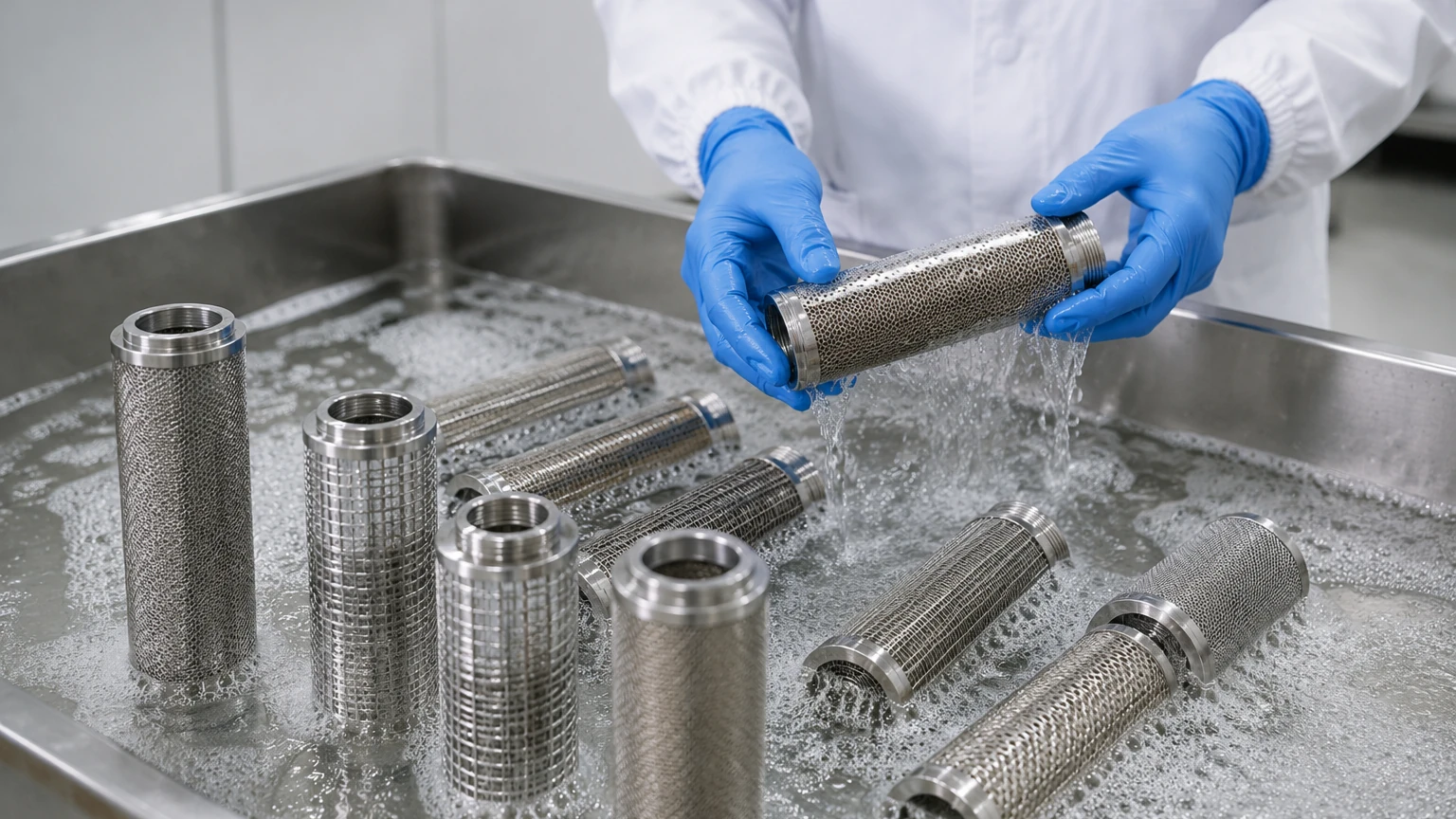
In many automated systems, the CIP cycle includes a backwashing phase. This involves reversing the flow of the cleaning fluid through the filter media. Backwashing is highly effective for dislodging particles trapped in the pores of a sintered metal cartridge or the openings of a plain square weave mesh.
However, the filter must be structurally designed to handle reverse pressure. Standard filter cartridges are often designed for outside-in flow; if the internal support core is not robust, a high-pressure backwash can cause the media to collapse or burst. Kaifil’s custom filtration solutions incorporate reinforced internal structures to ensure that the filter can withstand the mechanical stresses of repeated backwashing during CIP.
Dead Legs and Shadow Zones
A significant risk in CIP is the presence of "shadow zones"—areas where the cleaning fluid does not reach due to the geometry of the filter housing or the pleats of the filter media. If the flow is laminar rather than turbulent, the cleaning agents may bypass the soil. Engineers must ensure that the filter housing design eliminates "dead legs" (stagnant areas) and that the filter media is positioned to receive full exposure to the cleaning flow.
Evaluating Filter Compatibility for CIP Processes
When selecting filtration components for a system that utilizes CIP, several technical criteria must be evaluated:
1. Material Grade: 316L stainless steel is the preferred standard due to its superior resistance to the chemicals used in the acid and caustic washes. For highly aggressive environments involving high chloride concentrations, exotic alloys like Hastelloy may be required.
2. Surface Finish: The smoothness of the filter hardware (measured as Ra) affects how easily soil can be removed. A lower Ra value (e.g., <0.8 μm) indicates a polished surface that resists soil adhesion and biofilm formation.
3. Thermal Expansion: CIP cycles involve rapid temperature swings (e.g., from 20°C ambient to 85°C caustic wash). The filter and its housing must be able to accommodate thermal expansion without losing seal integrity or causing mechanical fatigue in welds.
4. Seal Compatibility: The O-rings and gaskets (typically EPDM, Viton, or PTFE) must be compatible with both the process fluid and the CIP chemicals at elevated temperatures.
Common Risks and Troubleshooting
Failure to properly execute the cip cleaning steps can lead to several industrial issues:
* Cross-Contamination: Residual soil from a previous batch can contaminate the next run, leading to product recalls or batch failure.
* Biofilm Accumulation: If the sanitization step is inadequate, bacteria can form biofilms within the filter mesh. Biofilms are highly resistant to standard cleaning and may require specialized enzymatic cleaners to remove.
* Filter Blinding: If the caustic wash is skipped or insufficient, organic fats can solidify within the filter pores, leading to a permanent increase in differential pressure and reduced flow rates.
* Chemical Pitting: Leaving acid or caustic solutions in the system for longer than the recommended time, or failing to rinse properly, can lead to localized corrosion of the stainless steel.
Conclusion
Mastering the cip cleaning steps is a fundamental requirement for any engineer operating in high-purity industrial sectors. By carefully balancing the TACT parameters and ensuring that the sequence of rinsing and chemical washing is strictly followed, facilities can maintain peak operational efficiency and ensure the highest levels of product hygiene.
At Kaifil, we understand that the filter is often the most critical point in the CIP circuit. Our stainless steel wire mesh filters and sintered cartridges are engineered to meet the rigorous demands of automated cleaning, providing the durability and precision required for years of service. For technical specifications on our CIP-compatible filtration products or to discuss a custom design for your specific application, please refer to our Main Page. By integrating high-quality hardware with a scientifically sound cleaning protocol, manufacturers can achieve the ideal balance of performance, safety, and cost-effectiveness.
