


Syrup Filter Press
In the industrial production of sweeteners, medicinal syrups, and beverage bases, the syrup filter press serves as a critical unit operation for achieving the required clarity, purity, and shelf stability. For engineers and procurement professionals, selecting the right filtration system involves more than just matching a flow rate; it requires a deep understanding of fluid dynamics, material science, and the specific rheological properties of high-viscosity liquids.
Syrup filtration is inherently challenging due to the high sugar concentration, which increases viscosity and alters the pressure-drop characteristics across the filter media. Whether the application involves clarifying raw cane sugar melt, refining corn syrup, or producing pharmaceutical-grade liquid carriers, the efficiency of the syrup filter press directly impacts the final product's quality and the overall cost of production. This guide examines the technical considerations, material requirements, and operational parameters essential for optimizing syrup filtration processes.
Understanding the Role of a Syrup Filter Press in Industrial Processing
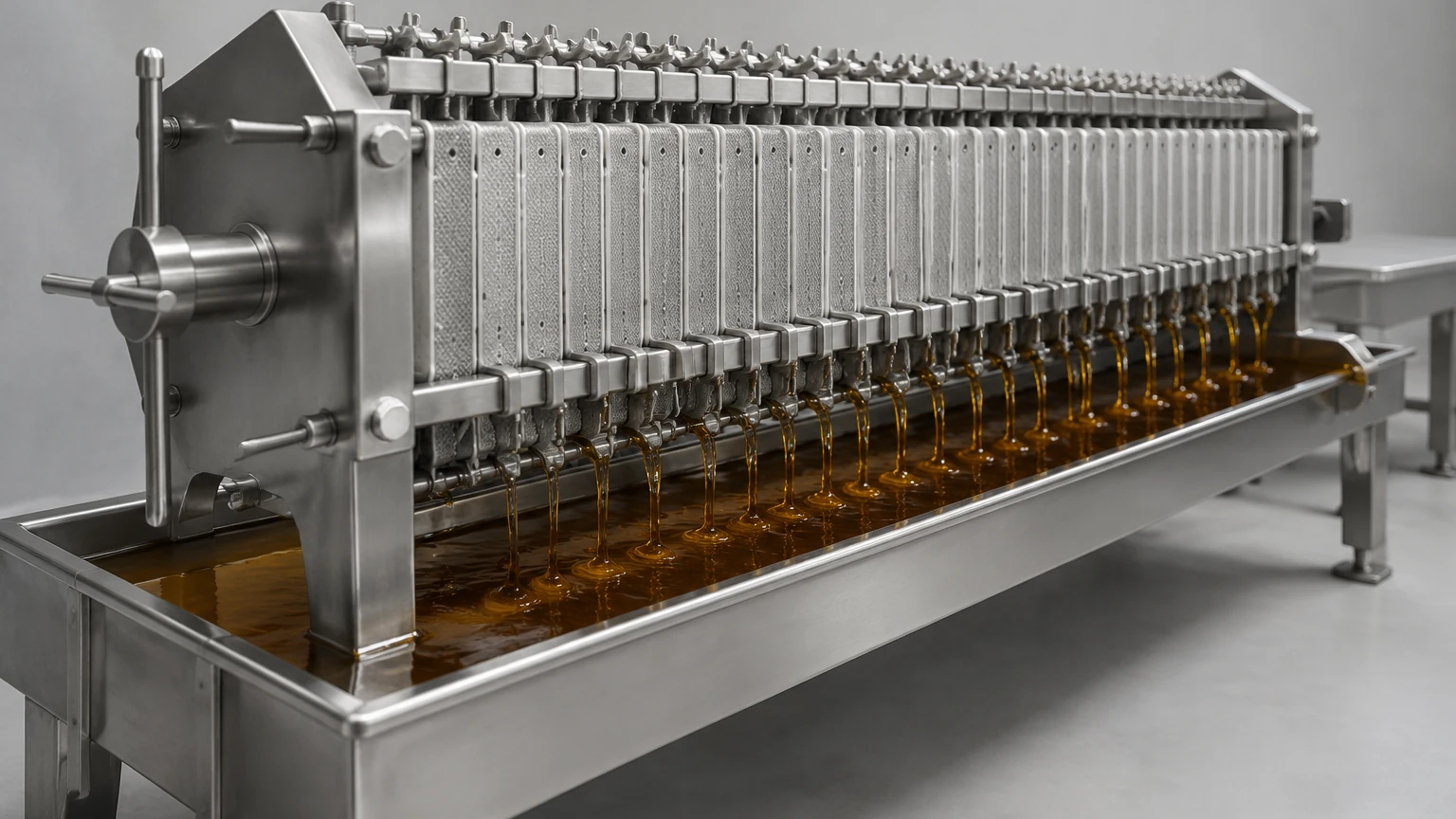
A syrup filter press is a pressure filtration device designed to separate solids from liquids using a series of filter plates and frames or recessed plates. In the context of syrup production, the primary goal is usually the removal of suspended solids, carbon particles (from decolorization stages), and organic impurities that can cause turbidity or "haze" in the finished product.
Unlike centrifugal separators or gravity-fed systems, the filter press utilizes mechanical pressure to force the viscous syrup through a filter medium. This allows for the capture of extremely fine particles, often down to the sub-micron level, depending on the media used. The process typically involves three distinct phases: the filling phase, where the chambers are filled with raw syrup; the filtration phase, where the "filter cake" builds up on the media and acts as an additional filtration layer; and the discharge phase, where the solids are removed.
For industrial operators, the choice of a filter press is often dictated by the need for high solids handling capacity and the ability to achieve a very dry filter cake, which minimizes product loss. In the syrup industry, where the liquid phase is the valuable product, reducing the amount of syrup trapped in the waste cake is a primary driver for equipment ROI.
Engineering Challenges: Handling High Viscosity and Temperature
The most significant technical hurdle in syrup filtration is viscosity. As sugar concentration (Brix) increases, the resistance to flow through the filter media increases exponentially. This relationship is governed by Darcy’s Law, which states that the flow rate is inversely proportional to the viscosity of the fluid.
To maintain an economical flow rate, industrial syrup filtration is almost always performed at elevated temperatures. Heating the syrup reduces its viscosity, allowing it to pass through the filter mesh or cloth with less resistance. However, this introduces further engineering requirements:
1. Thermal Expansion: The filter press components, particularly the plates and the sealing gaskets, must be rated for continuous operation at temperatures often exceeding 80°C (176°F).
2. Pressure Management: Because viscous fluids require higher feed pressures to initiate flow, the structural integrity of the filter plates and the precision of the wire mesh filters are paramount. Sudden pressure spikes can lead to "bleed-through," where solids are forced through the media, contaminating the filtrate.
3. Pump Selection: Positive displacement pumps are typically paired with syrup filter presses to provide a consistent flow regardless of the increasing pressure as the filter cake thickens.
Engineers must balance the temperature to ensure it is high enough to facilitate flow but low enough to prevent the caramelization or degradation of the sugar molecules, which would negatively affect the color and flavor profile of the syrup.
Material Selection and Sanitary Standards for Syrup Filtration
In the food, beverage, and pharmaceutical industries, material compatibility is not just a matter of durability but also of regulatory compliance. The syrup filter press must be constructed from materials that are non-reactive, non-corrosive, and easy to sanitize.
Stainless steel is the industry standard for these applications. Specifically, SS304 and SS316L are preferred for their resistance to the organic acids sometimes found in fruit-based syrups and their ability to withstand rigorous Cleaning-in-Place (CIP) cycles.
* SS304: Suitable for standard sugar syrups and general food-grade applications where corrosion risk is moderate.
* SS316L: Required for pharmaceutical applications or syrups with high acidity or chloride content. The "L" (low carbon) designation is crucial for components that are welded, as it prevents intergranular corrosion.
Beyond the metal housing and plates, the internal filtration components—such as the wire mesh or sintered metal filters—must be manufactured to precise tolerances. For those evaluating technical specifications, visiting the Main Page of a specialist manufacturer like Kaifil provides insight into the variety of custom stainless steel filtration solutions available, ranging from multi-layered sintered mesh to precision-perforated plates that support the filter media.
Comparing Filter Media: Wire Mesh vs. Traditional Cloth
The choice of filter media is perhaps the most critical decision in the setup of a syrup filter press. While traditional textile filter cloths are common, many modern industrial processes are shifting toward stainless steel wire mesh filters for several technical reasons:
Durability and Longevity
Textile cloths are prone to tearing, stretching, and blinding (clogging). In high-pressure syrup applications, the abrasive nature of some impurities can wear down fibers quickly. Stainless steel wire mesh, conversely, offers superior mechanical strength and can withstand repeated pressure cycles without deforming.
Cleaning Efficiency
Syrup is inherently "sticky." Cleaning organic residues from textile fibers can be difficult and often requires aggressive chemicals that can degrade the cloth. Metal filters are much more compatible with high-temperature CIP processes and ultrasonic cleaning, ensuring that the media can be returned to a near-original state of permeability.
Filtration Precision
Wire mesh allows for a highly controlled pore size. In applications where a specific micron rating is required to remove yeast, mold spores, or fine carbon dust, precision-woven wire mesh provides a consistent barrier that does not "unload" particles when pressure fluctuates.
Operational Parameters: Pressure, Flow Rate, and Filtration Accuracy
When specifying a syrup filter press, engineers must define the operational envelope. This includes the maximum allowable pressure drop ($ΔP$) and the target filtration accuracy (micron rating).
1. Micron Rating: For raw syrup clarification, a rating of 20 to 50 microns may be sufficient. However, for "polished" syrups used in clear beverages or injectable medicines, the requirement may drop to 1–5 microns. Achieving these lower levels often requires a multi-stage approach or the use of filter aids like diatomaceous earth (DE).
2. Flux Rate: This is the volume of syrup filtered per unit of filter area per hour (LMH – Liters per Square Meter per Hour). For viscous syrups, flux rates are significantly lower than for water. Increasing the surface area by adding more plates to the press is the standard method for increasing total throughput.
3. Cake Capacity: The volume of the chambers in the filter press must be sized to accommodate the expected load of solids between cleaning cycles. If the syrup has a high impurity content, a larger chamber volume is necessary to prevent frequent downtime for cake discharge.
Maintenance and Longevity: Optimizing the Replacement Cycle
The total cost of ownership (TCO) of a syrup filter press is heavily influenced by maintenance requirements. A well-engineered system should minimize the frequency of manual intervention.
Key maintenance considerations include:
* Seal Integrity: Gaskets and O-rings must be inspected regularly. In syrup applications, dried sugar can act as an abrasive, wearing down seals and leading to external leaks.
* Media Blinding: If the flow rate drops significantly despite high pressure, the filter media may be "blinded." This occurs when fine particles become lodged within the pores of the mesh or cloth. For stainless steel filters, backwashing or chemical soaking is usually effective in restoring performance.
* Plate Alignment: Over time, the mechanical stress of closing the press can lead to plate misalignment. Ensuring the hydraulic closing system is calibrated prevents bypass, where unfiltered syrup leaks around the edge of the media.
By selecting high-quality, custom-manufactured components, facilities can extend the interval between major overhauls. Customization allows for the integration of reinforced edges on filter elements or specialized mesh weaves that are specifically designed to release the filter cake more easily, reducing the physical labor required during the cleaning cycle.
Customization Options for Specialized Syrup Applications
Every syrup production line has unique requirements based on the source material and the end-use of the product. Customization is often necessary to address specific challenges:
* Jacketed Plates: For syrups that must be kept at a precise temperature to prevent crystallization, steam-jacketed or hot-water-jacketed plates can be used to maintain heat throughout the filtration chamber.
* Automated Cake Discharge: In high-volume environments, manual scraping of plates is inefficient. Automatic shakers or belt-driven discharge systems can significantly reduce cycle times.
* Multi-Stage Filtration: Some systems incorporate different grades of wire mesh within a single press, allowing for coarse and fine filtration in a single pass, though this requires careful hydraulic balancing.
Manufacturers like Kaifil specialize in these types of customized filtration components, providing the engineering support needed to adapt a standard filter press design to the specific needs of a syrup production facility. From material selection to the final filtration accuracy, these bespoke solutions ensure that the equipment performs reliably under demanding industrial conditions.
Conclusion: Making an Informed Selection
Investing in a syrup filter press is a significant capital expenditure that requires a balance of engineering precision and operational practicality. By focusing on the rheological properties of the syrup, the required sanitary standards, and the long-term durability of the filter media, purchasing teams can select a system that provides consistent product quality and low operational costs.
Before finalizing a specification, it is essential to confirm the chemical compatibility of all wetted parts, the maximum pressure ratings of the filter elements, and the ease with which the system can be integrated into existing CIP protocols. For technical professionals seeking reliable components and expert guidance on industrial filtration, Review product options and application support to ensure your filtration system is built to meet the rigorous demands of modern syrup processing.
