


Porous Metal Filter
In industrial process engineering, the selection of filtration media is a critical decision that impacts product purity, equipment longevity, and operational safety. Among the various technologies available, the porous metal filter stands out as a robust solution for demanding environments where high temperatures, high pressures, and corrosive chemicals are present. Unlike polymer-based or paper filters, porous metal components offer structural integrity and the ability to be cleaned and reused multiple times, significantly reducing the total cost of ownership in the long term.
As a professional manufacturer, Kaifil specializes in custom stainless steel filtration solutions, providing precision-engineered components that meet the rigorous standards of global industrial sectors. This guide explores the technical fundamentals, material considerations, and engineering selection criteria for porous metal filters to assist technical professionals in optimizing their filtration systems.
Engineering Fundamentals of Porous Metal Media
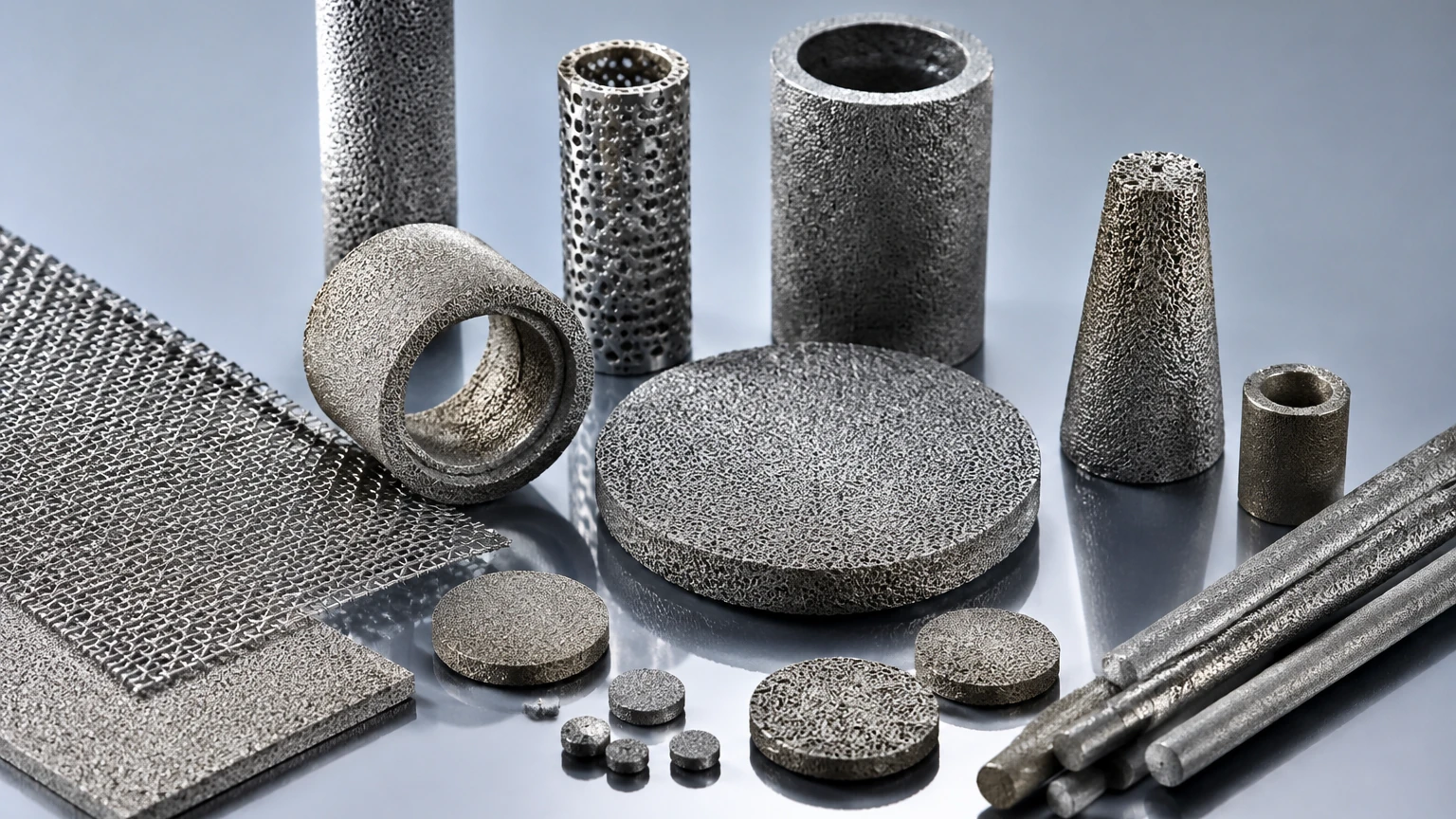
A porous metal filter is an engineered material characterized by a controlled distribution of pores within a metallic matrix. These filters are typically fabricated from metal powders or layers of wire mesh that are bonded together through a process known as sintering. The resulting structure is a rigid, self-supporting medium that provides precise filtration accuracy.
Pore Size and Distribution
The primary metric for any filter is its micron rating. In porous metal media, this is determined by the size of the metal particles or the weave of the wire mesh used during fabrication. Engineers must distinguish between nominal and absolute filtration ratings:
* Nominal Rating: Represents an approximate value where a majority of particles of a certain size are retained. This is often used for less critical applications.
* Absolute Rating: Refers to the diameter of the largest hard spherical particle that will pass through the filter under specified test conditions. For critical pharmaceutical or chemical processes, absolute ratings are essential for guaranteed performance.
Porosity and Permeability
Porosity refers to the percentage of void space within the filter volume, while permeability measures the ability of a fluid to flow through that void space. High porosity usually leads to lower pressure drops and higher flow rates, but it must be balanced against the mechanical strength required for the application. A well-designed porous metal filter optimizes the tortuous path—the winding route a fluid takes through the media—to maximize particle entrapment while minimizing resistance to flow.
Manufacturing Processes: Sintering and Construction
The performance of a porous metal filter is largely a product of its manufacturing method. Sintering is the core technology used by Kaifil to ensure durability and precision.
The Sintering Process
Sintering involves heating metal powders or wire mesh layers to a temperature just below their melting point in a controlled atmosphere. This causes the metal atoms to diffuse across the boundaries of the particles, creating solid-state bonds at the contact points. The result is a unified structure that retains the shape of the mold or the alignment of the mesh while maintaining the interconnected porosity required for filtration.
Sintered Metal Powder vs. Sintered Wire Mesh
There are two primary forms of porous metal media:
1. Sintered Metal Powder: Created by compressing and sintering fine metal powders. This method produces a deep filtration medium with a highly tortuous path, ideal for fine particle retention and gas sparging.
2. Sintered Wire Mesh: Fabricated by laminating multiple layers of stainless steel wire mesh. This construction offers excellent mechanical strength and is easier to clean via backwashing. It is frequently used in high-flow hydraulic systems and polymer melt filtration.
Material Selection and Chemical Compatibility
The choice of alloy is the most significant factor in determining the filter's resistance to corrosion and temperature. Stainless steel is the industry standard due to its versatility and cost-effectiveness.
Stainless Steel Alloys (316L and 304L)
Type 316L stainless steel is the most common material for porous metal filters because of its superior corrosion resistance, particularly against chlorides. The "L" denotes low carbon content, which prevents carbide precipitation during the sintering process, ensuring the filter remains resistant to intergranular corrosion. For less aggressive environments, 304L may be used to reduce costs without sacrificing structural integrity.
High-Performance Alloys
In cases where standard stainless steel is insufficient—such as in highly acidic or high-temperature oxidative environments—specialty alloys are employed:
* Hastelloy®: Offers exceptional resistance to strong acids and oxidizing agents.
* Inconel®: Suitable for extremely high-temperature applications, maintaining strength and oxidation resistance up to 600°C (1112°F) or higher depending on the specific grade.
* Monel®: Frequently used in hydrofluoric acid service and marine environments due to its resistance to seawater corrosion.
Performance Evaluation and Testing
To ensure a porous metal filter meets the requirements of an industrial application, several performance metrics must be evaluated during the engineering phase.
Pressure Drop (ΔP)
The pressure drop across a filter is a function of fluid viscosity, flow rate, and the filter's permeability. Engineers use Darcy’s Law to estimate the initial pressure drop. Monitoring the increase in ΔP over time is critical for determining the cleaning or replacement cycle. A filter that reaches its terminal pressure drop too quickly may be undersized or have an inappropriate micron rating for the particle load.
Bubble Point Testing
This is a non-destructive test used to verify the integrity and maximum pore size of a filter. The filter is submerged in a liquid, and air pressure is gradually increased. The pressure at which the first continuous stream of bubbles appears (the bubble point) is mathematically related to the largest pore size, providing a reliable quality control metric.
Dirt-Holding Capacity
This refers to the total mass of contaminants a filter can retain before the pressure drop reaches a predefined limit. Porous metal filters, especially those with deep powder structures, often exhibit high dirt-holding capacities, which extends the interval between maintenance cycles.
Applications Across Industrial Sectors
Porous metal filters are utilized across a broad spectrum of industries where reliability is non-negotiable. Kaifil provides customized designs to meet these specific sectoral needs.
Chemical and Petrochemical Processing
In chemical manufacturing, filters are used for catalyst recovery, where expensive catalyst particles must be captured from a high-temperature product stream. The ability of stainless steel filters to withstand aggressive solvents and high thermal loads makes them ideal for this application. They are also used in gas filtration to protect downstream compressors from particulate damage.
Food and Beverage Industry
Filtration in the food industry requires materials that are non-toxic and easy to sterilize. Porous metal filters are used for steam filtration (culinary steam), carbonation (sparging CO2 into beverages), and the removal of impurities from edible oils. Their ability to withstand Clean-in-Place (CIP) procedures using caustic chemicals is a major advantage.
Pharmaceutical and Biotechnology
Precision is paramount in pharmaceutical production. Sintered metal filters are employed in sterile air filtration, solvent purification, and the recovery of active pharmaceutical ingredients (APIs). The smooth surface finish and lack of fiber migration (unlike felt or paper filters) prevent product contamination.
Hydraulic and Power Generation
High-pressure hydraulic systems require filters that can withstand significant mechanical stress and pressure surges. Sintered wire mesh elements provide the necessary strength to protect sensitive valves and pumps from wear-inducing particles. In power plants, these filters are used in condensate polishing and fuel gas filtration.
Maintenance, Cleaning, and Service Life
One of the primary benefits of a porous metal filter is its cleanability. Proper maintenance can extend the service life of a stainless steel filter to several years, depending on the application.
Cleaning Methods
* Backwashing/Backpulsing: Reversing the flow of fluid through the filter to dislodge accumulated particles. This is often done in-situ and is highly effective for surface-loading filters like sintered mesh.
* Ultrasonic Cleaning: Using high-frequency sound waves in a cleaning solution to create cavitation bubbles that remove fine particles from deep within the porous structure.
* Chemical Cleaning: Soaking the filter in solvents, acids, or caustic solutions to dissolve organic or inorganic deposits. This must be done with careful consideration of the filter's material compatibility.
* Thermal Cleaning (Burn-off): Heating the filter to high temperatures in a controlled furnace to oxidize organic contaminants. This is common in polymer processing applications.
Determining Replacement Cycles
While cleanable, porous metal filters will eventually reach a point where the permanent pressure drop (the ΔP after cleaning) becomes too high. This occurs when sub-micron particles become deeply embedded or when the cleaning process cannot fully restore the original permeability. Regular monitoring of the clean pressure drop is the best way to predict the end of the filter's functional life.
Key Considerations for Technical Procurement
When sourcing a porous metal filter, purchasing teams and engineers should collaborate to define the exact specifications to avoid premature failure or inefficient performance. Before finalizing a design, consider the following:
1. Operating Conditions: What are the maximum and minimum operating temperatures and pressures? Are there significant pressure spikes?
2. Fluid Characteristics: What is the viscosity of the fluid at operating temperature? Is the fluid corrosive to 316L stainless steel?
3. Contaminant Profile: What is the particle size distribution of the solids to be removed? Are the particles deformable or rigid?
4. Flow Requirements: What is the required flow rate, and what is the maximum allowable initial pressure drop?
5. Housing Compatibility: Does the filter element need to fit into an existing housing? What type of end caps (e.g., DOE, 222, 226) and gasket materials (e.g., Viton, EPDM, PTFE) are required?
Kaifil works closely with global customers to develop high-performance filter products that meet these specific application requirements. By focusing on material selection, filtration accuracy, and customized designs, we deliver dependable filtration components for the most demanding industrial environments.
For more information on our full range of stainless steel filter cartridges and custom wire mesh solutions, please visit our Main Page to review product options and application support. Understanding the nuances of porous metal technology ensures that your facility achieves efficient, durable, and cost-effective filtration performance.
