


Drum Filter Aquaculture
In the modern landscape of Recirculating Aquaculture Systems (RAS) and intensive pond farming, the management of solid waste is the primary determinant of system stability and biological health. Drum filter aquaculture technology has emerged as the industry standard for mechanical filtration, providing a continuous, automated method for removing Total Suspended Solids (TSS) before they can break down into dissolved nutrients like ammonia and nitrites.
For engineers and facility managers, selecting the right filtration components is not merely about water clarity; it is about protecting the biological filter, optimizing oxygen levels, and ensuring the longevity of the mechanical infrastructure. As a specialized manufacturer of stainless steel filtration solutions, Kaifil provides the technical precision required to maintain these demanding environments. Understanding the engineering nuances of drum filters—from mesh selection to hydraulic loading—is essential for achieving a high-performance aquaculture operation.
The Role of Drum Filters in Modern Aquaculture
Mechanical filtration is the first line of defense in any aquaculture system. In high-density environments, fish produce significant amounts of organic waste, including feces and uneaten feed. If left in the water column, these solids undergo microbial decomposition, which consumes dissolved oxygen and releases toxic nitrogenous compounds.
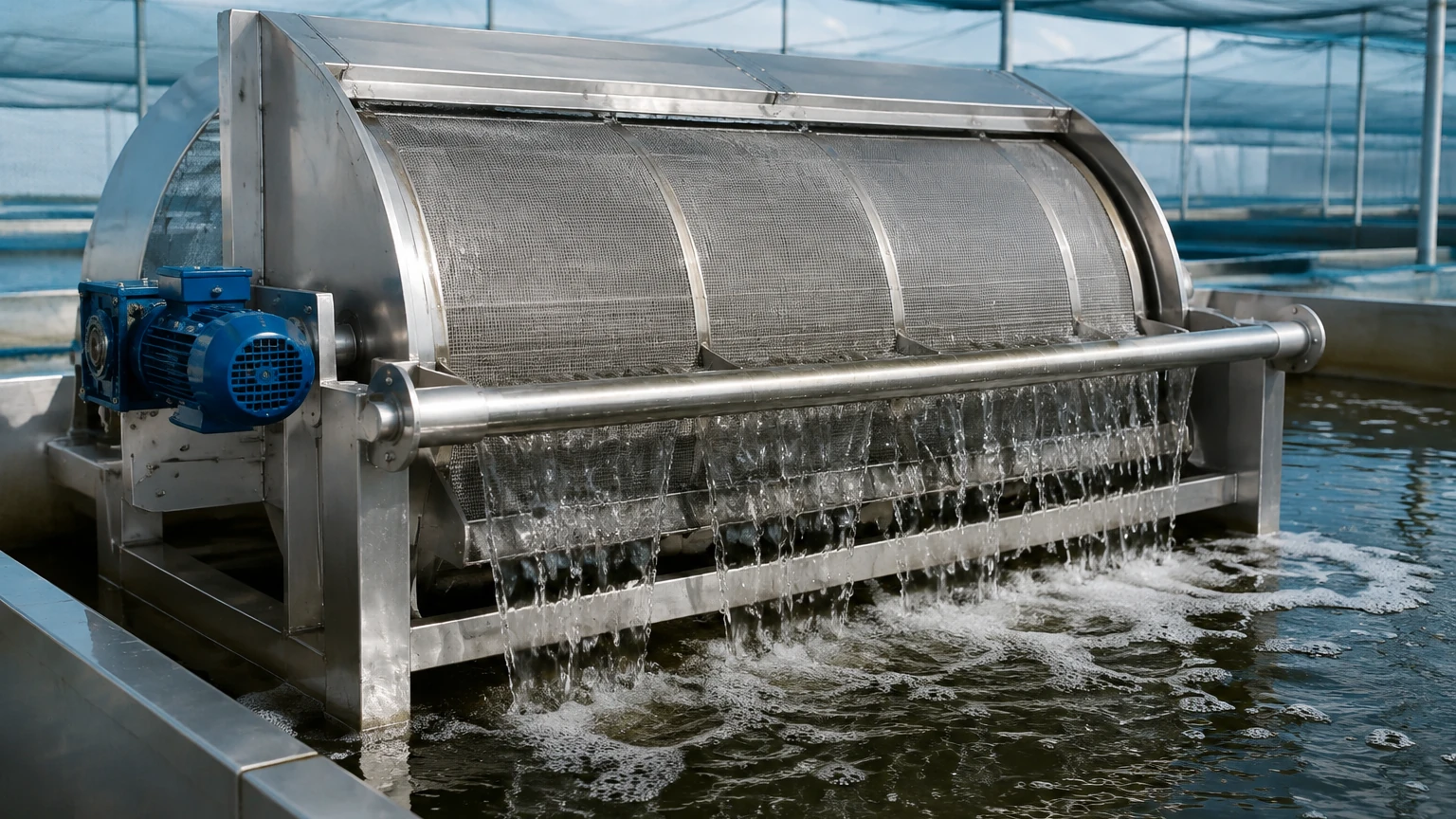
Drum filters are designed to intercept these particles immediately. Unlike sand filters or bead filters, which may require periodic backwashing that interrupts flow, a drum filter operates on a continuous or demand-driven cycle. By utilizing a rotating drum covered in a fine filtration medium—typically stainless steel wire mesh—the system can separate solids from large volumes of water with minimal head loss. This efficiency is why drum filters are the preferred choice for large-scale RAS facilities where water reuse rates often exceed 90%.
Technical Principles of Rotary Drum Filtration
The operation of a drum filter is a balance of gravity, hydraulics, and mechanical timing. The process generally follows a specific sequence:
1. Inflow: Untreated water enters the interior of the rotating drum through an inlet pipe.
2. Separation: As the water attempts to pass through the drum's peripheral mesh to the exterior tank, solid particles larger than the mesh opening are trapped on the inner surface of the screen.
3. Accumulation and Resistance: Over time, the trapped solids create a "filter cake," which actually improves filtration fineness but increases resistance to flow. This causes the water level inside the drum to rise.
4. Activation: Once a predetermined water level (or time interval) is reached, a sensor triggers the drum to rotate and activates the high-pressure backwash system.
5. Backwashing: Nozzles located outside the drum spray pressurized water through the mesh, dislodging the solids into a collection trough for external disposal.
This self-cleaning mechanism allows the system to handle high solids loading without manual intervention, making it a critical component for 24/7 industrial aquaculture operations.
Engineering Considerations: Wire Mesh vs. Synthetic Media
The most critical component of any drum filter is the filtration medium. While some entry-level systems use polyester or nylon fabrics, industrial-grade aquaculture applications almost exclusively demand stainless steel wire mesh.
Durability and Structural Integrity
Stainless steel mesh offers superior dimensional stability. Unlike synthetic fibers, which can stretch or sag under the pressure of backwashing or heavy solids loading, stainless steel maintains its aperture size. This ensures consistent filtration performance over thousands of rotation cycles. For professional-grade systems, AISI 316L stainless steel is the standard due to its exceptional resistance to corrosion in both freshwater and marine (saltwater) environments.
Cleaning Efficiency
Stainless steel surfaces are smoother at a microscopic level than synthetic fibers. This reduces the "stickiness" of organic biofilms and proteins, allowing the backwash system to clear the mesh more effectively with less water consumption. In the context of drum filter aquaculture, efficient cleaning translates to lower energy costs for the backwash pump and reduced water loss from the system.
Precision and Customization
Engineers must select a mesh that balances particle removal with hydraulic throughput. Kaifil specializes in producing precision metal filter components that meet these exact specifications. Whether the application requires a robust weave for primary filtration or a fine micron-rated mesh for polishing, the choice of material directly impacts the system's Total Cost of Ownership (TCO). To explore specific material grades and mesh configurations, technical teams can consult the Main Page for detailed product specifications and application support.
Determining Filtration Accuracy and Micron Ratings
Selecting the correct micron rating is a trade-off between water quality and operational frequency. In aquaculture, common mesh sizes range from 30 microns to 100 microns.
* 30–40 Microns: Often used in hatcheries or systems with very high water quality requirements. While it removes the smallest particles, it requires more frequent backwashing and has a lower hydraulic capacity per square meter of mesh.
* 60–80 Microns: The "sweet spot" for most grow-out RAS facilities. This range effectively removes the bulk of fish feces and uneaten feed before they break down, maintaining a balance between water clarity and pump efficiency.
* 100+ Microns: Typically used as a pre-filter or in systems where solids are large and the primary goal is protecting downstream pumps and heat exchangers.
When designing a system, engineers must calculate the "effective filtration area." This is the total surface area of the drum minus the area covered by the structural frame. If the mesh is too fine for the flow rate, the drum will rotate almost constantly, leading to premature wear on the motor, bearings, and the mesh itself.
Performance Metrics and System Integration
To optimize drum filter aquaculture performance, several hydraulic parameters must be monitored:
Hydraulic Loading Rate (HLR)
This refers to the volume of water passing through a unit area of the filter mesh per hour (m³/m²/h). Exceeding the recommended HLR leads to excessive head loss and can force small, soft organic particles through the mesh, a phenomenon known as "extrusion."
Backwash Pressure and Volume
Effective cleaning requires the backwash nozzles to operate at pressures typically between 4 and 8 bar. If the pressure is too low, the mesh will gradually blind (clog) with biofilm. If it is too high, it can cause mechanical fatigue in the wire mesh. Integrating a variable frequency drive (VFD) on the backwash pump can help fine-tune this process based on the actual solids loading in the system.
Integration with Biofiltration
The drum filter's primary job is to reduce the BOD (Biological Oxygen Demand) load on the biofilter. By removing solids quickly, the nitrifying bacteria in the biofilter can work more efficiently, as they do not have to compete with heterotrophic bacteria that thrive on solid organic waste.
Maintenance, Service Life, and Total Cost of Ownership
While drum filters are automated, they are not "maintenance-free." The industrial environment of an aquaculture farm—characterized by high humidity and potential salinity—is harsh on mechanical components.
1. Mesh Inspection: The wire mesh should be inspected monthly for signs of mechanical damage or localized blinding. High-quality stainless steel mesh from a reliable manufacturer like Kaifil is designed to resist these issues, but physical debris (like a loose bolt or a stone) can still cause tears.
2. Seal Integrity: The seals between the rotating drum and the stationary tank are critical. If these seals fail, untreated water will bypass the filter, allowing solids to enter the biofilter and fish tanks.
3. Lubrication and Drive Train: Motors and drive chains require regular lubrication. Many modern industrial drum filters now use direct-drive systems or ceramic bearings to minimize these maintenance requirements.
Investing in high-quality replacement components is essential for reducing long-term costs. Low-quality mesh may have a lower upfront price but can lead to increased downtime and higher labor costs due to frequent replacements.
Customization and OEM Requirements for Industrial Systems
Every aquaculture project has unique constraints, from the species being farmed (e.g., salmon vs. shrimp) to the physical footprint of the facility. Standard off-the-shelf filters may not always meet the hydraulic or structural requirements of a custom-engineered RAS.
As a professional manufacturer, Kaifil provides OEM and customized filtration solutions. This includes:
* Custom Mesh Sizing: Tailoring the weave and wire diameter to specific flow and particle size requirements.
* Material Selection: Offering different grades of stainless steel or specialized coatings for highly corrosive environments.
* Component Precision: Ensuring that replacement filter panels or cylindrical cartridges fit perfectly within existing drum architectures to prevent bypass.
For engineering firms and purchasing teams, partnering with a manufacturer that understands the technical rigors of industrial filtration is vital. By focusing on durability and precise filtration performance, Kaifil helps global customers achieve reliable, cost-effective results in the most demanding aquaculture environments.
Conclusion
Drum filter aquaculture represents the intersection of mechanical engineering and biological management. By effectively removing solid waste at the source, these systems enable the high-density, sustainable production of aquatic species. However, the success of the system depends heavily on the quality of its filtration components. From selecting the appropriate micron rating to ensuring the structural integrity of the stainless steel mesh, every detail matters.
For those seeking to optimize their filtration systems or develop new aquaculture infrastructure, selecting a partner with deep expertise in metal filtration is a strategic advantage. For more information on custom stainless steel filtration components and industrial-grade solutions, please visit the Main Page to review product options and application support.
