


Engineering Guide to SS 304 Woven Wire Mesh in Industrial Filtration
In the landscape of industrial separation and filtration, ss 304 woven wire mesh serves as a fundamental component due to its versatility, mechanical strength, and cost-effectiveness. For engineers and procurement professionals, selecting the right mesh involves more than just identifying a material; it requires a deep understanding of weave geometries, fluid dynamics, and environmental compatibility. As a specialized manufacturer, Kaifil provides precision-engineered filtration solutions that leverage these technical nuances to meet the rigorous demands of chemical processing, food production, and hydraulic systems.
This guide examines the technical specifications of Type 304 stainless steel mesh, comparing weave structures and providing actionable criteria for selecting the optimal filtration media for industrial applications.
Technical Properties of Type 304 Stainless Steel
Stainless steel 304, often referred to as 18/8 stainless steel due to its composition of approximately 18% chromium and 8% nickel, is the most common grade used in the production of Woven Wire Mesh. Its popularity in industrial filtration is rooted in its balanced physical and chemical properties.
Corrosion Resistance and Chemical Compatibility
Type 304 provides excellent resistance to a wide range of atmospheric environments and many corrosive media. The chromium content forms a passive layer of chromium oxide on the surface, which protects the underlying metal from oxidation. However, engineers must note that 304 is susceptible to pitting and crevice corrosion in warm chloride environments. In applications involving high concentrations of salt or marine environments, upgrading to SS 316L is often recommended. For standard industrial water treatment, food processing, and general chemical filtration, SS 304 remains the industry standard.
Thermal and Mechanical Stability
SS 304 maintains its integrity across a broad temperature spectrum. It offers good oxidation resistance in intermittent service up to 870°C and in continuous service to 925°C. From a mechanical standpoint, the material provides high tensile strength and ease of fabrication, allowing the mesh to be pleated, welded, or formed into complex filter cartridges without compromising the structural regularity of the weave.
Understanding Weave Structures in Woven Wire Mesh
The performance of a filter is largely determined by how the wires are interlaced. Different weave patterns provide varying levels of filtration accuracy, flow capacity, and mechanical rigidity. When specifying ss 304 woven wire mesh, understanding these patterns is critical for achieving the desired micron rating.
Plain Weave
The most straightforward construction, where each warp wire (running the length of the roll) passes alternately over and under each weft wire (running across the width). This results in square or rectangular openings. Plain weave is ideal for general sieving and high-flow applications where the pressure drop must be kept to a minimum.
Twill Weave
In a twill weave, each warp and weft wire passes alternately over two and under two successive wires. This reduces the stress on the individual wires during the weaving process, allowing for the use of heavier wires in a given mesh count. Twill weaves are typically used when a higher mesh count is required than what is possible with a plain weave, providing greater durability for fine filtration tasks.
Dutch Weave (Plain and Twill)
Dutch weaves utilize different wire diameters for the warp and weft. Typically, the warp wires are heavier, while the weft wires are smaller and driven closely together. This creates a "tortuous path" for the fluid, resulting in a much finer filtration capability (down to 5-10 microns) compared to square mesh.
- Plain Dutch Weave: Offers high strength and is easy to clean through backwashing.
- Twill Dutch Weave: Allows for the finest filtration levels and a higher density of wires, though it presents a higher resistance to flow.
Key Specification Parameters for Engineers
When evaluating ss 304 woven wire mesh for a project, several quantitative factors must be confirmed to ensure the component meets the system's operational requirements.
Mesh Count vs. Aperture Size
Mesh count refers to the number of openings per linear inch. While this is a common industry shorthand, the more critical value for filtration is the aperture size (the clear distance between two adjacent wires). The aperture determines the largest particle that can pass through the mesh. It is calculated using the formula:
*Aperture = (1 / Mesh Count) – Wire Diameter*
Percentage of Open Area
The open area is the ratio of the total area of the holes to the total area of the mesh. A higher open area results in a lower pressure drop and higher flow rates but may reduce the mechanical strength of the mesh. Engineers must balance the need for throughput with the structural requirements of the filter housing and the expected differential pressure across the media.
Wire Diameter and Tolerance
The thickness of the wire affects both the aperture size and the overall weight and strength of the mesh. Precise tolerances are essential, especially in high-accuracy pharmaceutical or laboratory applications, where even a slight deviation in wire diameter can significantly alter the filtration cutoff point.
Industrial Applications and Performance Expectations
Ss 304 woven wire mesh is utilized across diverse sectors, each with specific performance benchmarks.
Chemical and Petrochemical Processing
In these environments, the mesh is used for catalyst recovery, gas-liquid separation, and the filtration of polymers. The ability of SS 304 to withstand high pressures while maintaining precise pore sizes is vital for protecting downstream equipment like pumps and valves from particulate damage.
Food and Beverage Industry
Stainless steel is the preferred material for food contact due to its non-reactive nature and ease of sterilization. Woven mesh is used in juice straining, sugar processing, and flour milling. SS 304 ensures that no metallic contaminants are introduced into the product stream while providing a surface that can be cleaned using CIP (Clean-In-Place) protocols.
Hydraulic and Lubrication Systems
Precision metal filters are used to remove contaminants from hydraulic fluids and lubricating oils. These applications often require Dutch weave patterns to capture fine metallic wear particles, preventing system failure and extending the life of high-value machinery.
Selection Criteria and Risk Mitigation
To avoid premature filter failure or system inefficiency, purchasing teams and engineers should address the following considerations before finalizing a specification:
1. Differential Pressure (ΔP): What is the maximum allowable pressure drop across the clean filter? If the mesh is too fine or the open area too low, the system may require excessive energy to maintain flow.
2. Cleaning and Reusability: Unlike disposable paper or polymer filters, SS 304 mesh is often cleanable. Consider whether the application allows for ultrasonic cleaning, backpulsing, or chemical soaking. The weave type (e.g., plain vs. twill) will impact how easily particles are released from the mesh.
3. Mechanical Loading: Will the mesh be subjected to high-velocity fluid impingement or vibration? In such cases, a heavier wire diameter or a support layer (sintered or perforated metal) may be necessary to prevent mesh deformation or fatigue cracking.
4. Material Certification: Always request a Mill Test Report (MTR) to verify the chemical composition of the alloy. Low-quality "304" stainless steel with insufficient nickel or chromium content will fail prematurely in corrosive environments.
Customization and OEM Solutions
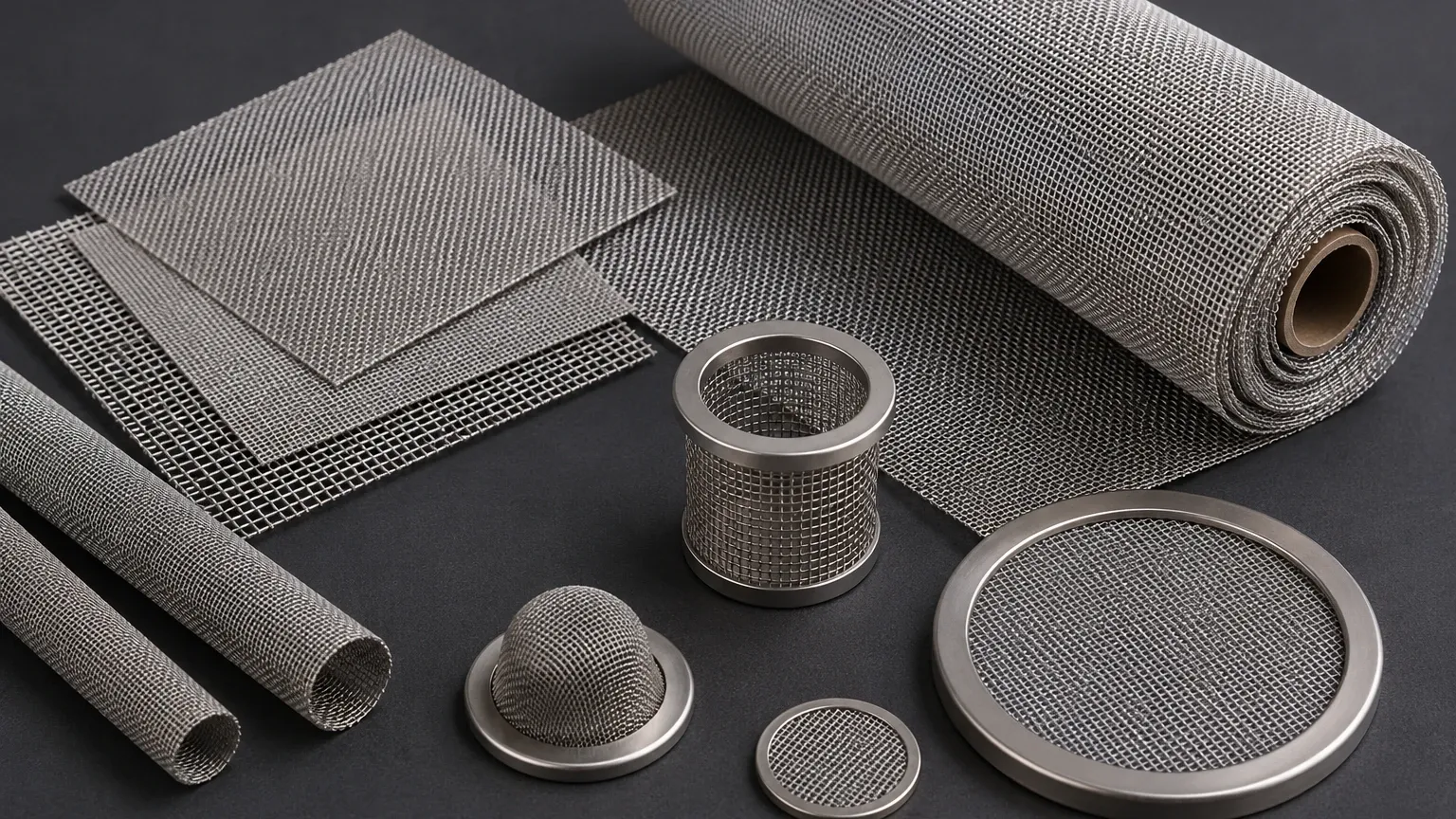
Standard off-the-shelf mesh rolls are often insufficient for specialized industrial equipment. Kaifil specializes in transforming raw Woven Wire Mesh into finished, application-specific components. This includes:
* Custom Slitting and Cutting: Providing mesh in specific widths or shapes (discs, rectangles) to fit existing filter housings.
* Framing and Edging: Adding U-binders or welded frames to provide structural rigidity and ease of installation.
* Multi-Layer Composites: Sintering multiple layers of mesh together to combine the fine filtration of a Dutch weave with the mechanical strength of a coarse support mesh.
* Cylindrical and Pleated Elements: Fabricating mesh into pleated cartridges to maximize surface area within a compact footprint, thereby extending the time between cleaning cycles.
Conclusion
The selection of ss 304 woven wire mesh is a technical decision that impacts the efficiency, safety, and longevity of industrial processes. By focusing on the specific weave geometry, aperture accuracy, and material integrity, engineers can ensure their filtration systems perform reliably under demanding conditions. Whether for simple straining or high-precision separation, Type 304 stainless steel remains a premier choice for durable, cost-effective, and high-performance filtration media. Working with an experienced manufacturer like Kaifil ensures that these technical variables are expertly managed, from material selection to the final fabricated component.
