


Cartridge Filter Types
In industrial fluid processing, selecting the appropriate filtration media is a critical engineering decision that impacts product purity, equipment longevity, and operational efficiency. Cartridge filters serve as modular, replaceable components designed to remove contaminants from liquids or gases. Understanding the various cartridge filter types is essential for engineers and procurement teams to ensure compatibility with specific industrial environments, ranging from high-temperature chemical processing to hygienic food and beverage production.
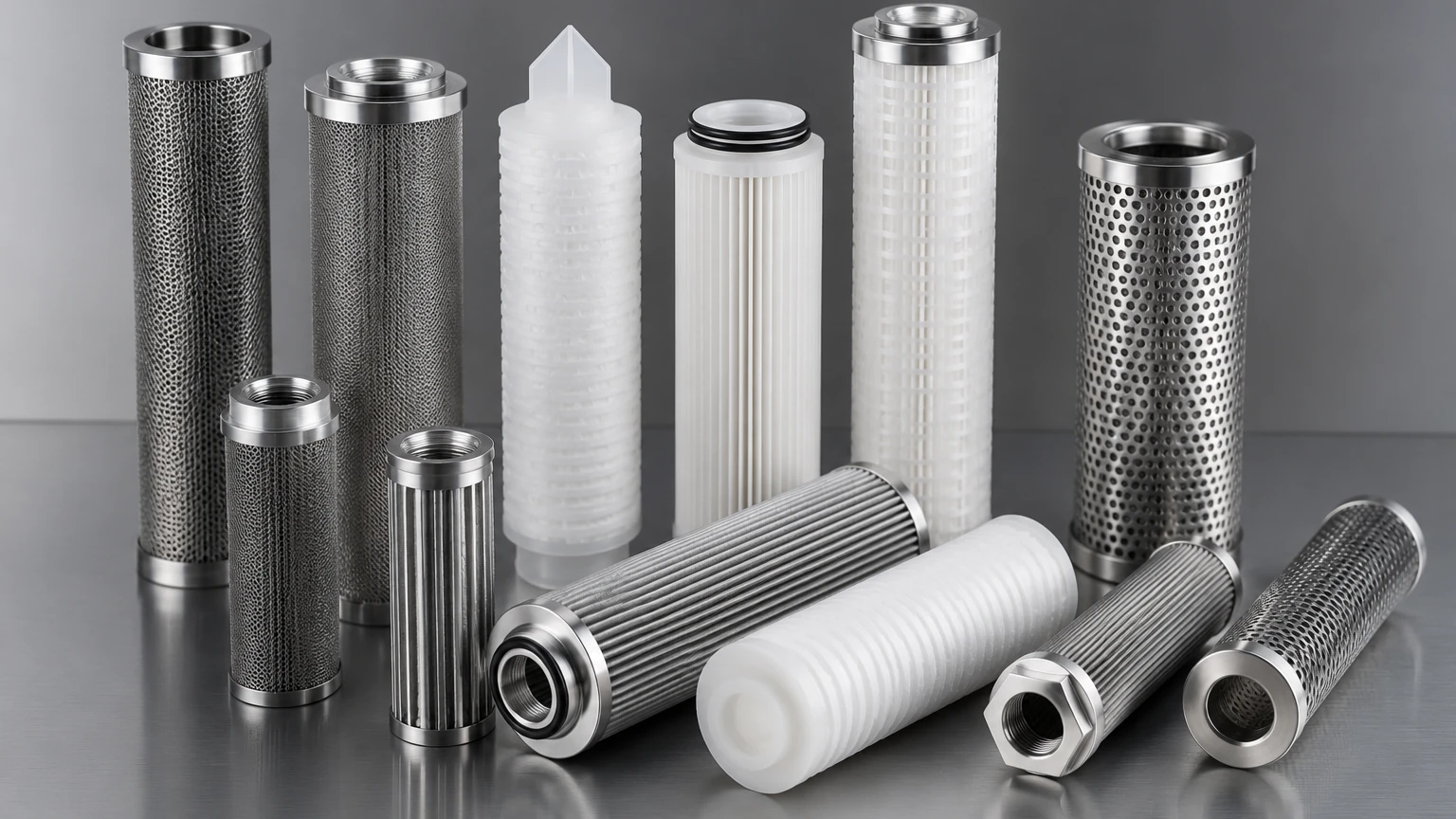
Industrial cartridge filters are generally categorized by their filtration mechanism, material composition, and structural design. Each configuration offers distinct advantages in terms of dirt-holding capacity, pressure drop, and chemical resistance.
Depth Filtration vs. Surface Filtration
The fundamental distinction among cartridge filter types lies in how they capture particles. Most industrial applications utilize either depth or surface filtration mechanisms.
Depth Filter Cartridges
Depth filters capture contaminants throughout the entire thickness of the filter medium. These cartridges are typically constructed from fibrous materials or porous structures. As fluid passes through the tortuous path of the media, particles are trapped within the matrix. Common examples include string-wound cartridges and melt-blown polymer filters. While effective for removing a broad range of particle sizes and offering high dirt-holding capacity, depth filters are generally disposable and may experience media migration under high-pressure conditions.
Surface Filter Cartridges
Surface filters act as a mechanical sieve, capturing particles primarily on the upstream surface of the media. These filters are characterized by a defined pore size, allowing for more precise "absolute" filtration ratings. Stainless steel wire mesh and pleated membranes are the most common surface filtration media. Because the particles accumulate on the surface, these filters often develop a "filter cake" that can further enhance filtration efficiency until the pressure drop necessitates cleaning or replacement.
Metallic Cartridge Filter Types
For demanding industrial environments involving high temperatures, high pressures, or aggressive chemicals, stainless steel cartridge filters are the industry standard. These are engineered for durability and the ability to be cleaned and reused, which significantly reduces the total cost of ownership compared to disposable polymer alternatives.
Sintered Metal Mesh Cartridges
Sintered mesh is produced by layering multiple sheets of stainless steel wire cloth and bonding them together through a vacuum sintering process. This creates a robust, integrated structure that maintains its pore shape even under extreme mechanical stress. These cartridges are ideal for high-viscosity fluids and applications requiring precise micron ratings from 1 to 200 microns. The multi-layer construction provides both a filtration layer and reinforcement layers for structural integrity.
Sintered Metal Fiber Felt
Unlike woven mesh, metal fiber felt is composed of non-woven stainless steel fibers that are sintered into a porous depth medium. This structure provides exceptionally high porosity (up to 80%), which translates to a lower initial pressure drop and a higher dirt-holding capacity than standard mesh. It is frequently used in polymer melt filtration and hydraulic oil systems where fine filtration and long service life are paramount.
Wedge Wire Cartridges
Wedge wire filters are constructed by wrapping a V-shaped profile wire around longitudinal support rods. The resulting slot-shaped openings are resistant to clogging and provide a high-strength surface for heavy-duty applications. These are commonly used in water treatment and pulp and paper industries where backwashing or mechanical scraping is required for cleaning.
Structural Variations: Pleated vs. Cylindrical
The physical geometry of a filter cartridge dictates its flow characteristics and service life. Engineers must choose between pleated and cylindrical designs based on the available space and the required flow rate.
Pleated Filter Cartridges
Pleating the filter media significantly increases the effective surface area within the same footprint of a standard cylindrical cartridge. For example, a pleated stainless steel cartridge can offer several times the filtration area of a plain cylindrical version. This increased area results in:
* Lower Flux Rates: Slower velocity through the media improves filtration efficiency.
* Extended Service Life: More surface area allows for more contaminant buildup before the terminal pressure drop is reached.
* Reduced Pressure Drop: Lower resistance to flow improves system energy efficiency.
Cylindrical (Plain) Cartridges
Cylindrical cartridges consist of a simple sleeve of filter media. While they offer less surface area than pleated designs, they are easier to clean thoroughly, making them suitable for applications where the filtered solids are sticky or where ultrasonic cleaning is frequently employed. They are also generally more cost-effective for low-flow applications where high surface area is not a technical requirement.
Engineering Considerations for Selection
When evaluating cartridge filter types, technical professionals must look beyond the initial purchase price and consider the engineering specifications that define performance.
Micron Ratings: Absolute vs. Nominal
* Nominal Rating: An approximate value indicating that the filter will retain a majority of particles at that size (e.g., 90% or 95%). This is often used for depth filters.
* Absolute Rating: The diameter of the largest hard spherical particle that will pass through the filter under specified test conditions. For critical applications in the pharmaceutical or chemical sectors, absolute-rated stainless steel mesh is often required to ensure process consistency.
Chemical and Thermal Compatibility
The choice of material—typically 304, 316, or 316L stainless steel—must be matched to the process fluid. 316L is preferred for its superior resistance to pitting and corrosion in chloride-rich or acidic environments. Furthermore, the selection of sealing materials (O-rings and gaskets) such as Viton, EPDM, or PTFE must account for the operating temperature and chemical nature of the fluid to prevent bypass or seal failure.
End-Cap Configurations
To ensure a proper fit within the filter housing, various end-cap styles are available. Common configurations include:
* DOE (Double Open End): Requires flat gaskets on both ends.
* SOE (Single Open End): Often features a 222 or 226 O-ring configuration with a fin or flat top to ensure a leak-proof seal in high-purity housings.
Maintenance and Reuse Cycles
One of the primary advantages of metallic cartridge filter types is their cleanability. In many industrial processes, the ability to regenerate a filter through backflushing, chemical cleaning, or ultrasonic baths provides a significant economic advantage.
Engineers should establish a replacement or cleaning cycle based on the "terminal pressure drop"—the point at which the pressure differential across the filter indicates that the media is fully loaded. For stainless steel filters, this threshold is often higher than for polymer filters, which may collapse or bypass under high differential pressure. Regular maintenance not only protects downstream equipment like pumps and spray nozzles but also ensures that the filtration system operates at peak energy efficiency.
Customization and OEM Solutions
Standard off-the-shelf filters may not meet the specific requirements of specialized industrial machinery. Customization options allow for the adjustment of length, diameter, micron rating, and reinforcement structures to handle unique flow patterns or extreme pressures. For purchasing teams and engineers, partnering with a manufacturer that provides tailored engineering support is vital for optimizing filtration performance.
For more information on specialized stainless steel filtration components and custom manufacturing capabilities, you can visit the Main Page to explore technical specifications and application support for industrial filtration systems.
Summary of Selection Criteria
To finalize the selection of cartridge filter types, engineers should confirm the following data points:
1. Fluid Characteristics: Viscosity, temperature, and chemical composition.
2. Contaminant Profile: Particle size distribution and concentration.
3. Operational Parameters: Flow rate (GPM/LPM) and maximum allowable pressure drop.
4. Housing Compatibility: Dimensions and seal requirements.
5. Regulatory Compliance: Requirements for FDA, 3A, or other industry-specific certifications.
By systematically evaluating these factors, industrial professionals can select the most durable and efficient cartridge filter types for their specific application, ensuring reliable performance in demanding environments.
