


4000 Cfm Dust Collector
In industrial environments, air quality and particulate control are critical for both operational safety and product purity. A 4000 CFM dust collector represents a mid-to-high capacity filtration system designed to handle significant volumes of contaminated air. CFM, or Cubic Feet per Minute, measures the volume of air the system can move and filter in sixty seconds. For engineers and facility managers, selecting a system with a 4000 CFM rating requires a deep understanding of airflow dynamics, static pressure, and the specific filtration media required to capture particulates effectively without excessive energy consumption.
At this capacity, the system is typically utilized for centralized dust collection serving multiple workstations or large-scale industrial machinery such as CNC routers, chemical blenders, or pharmaceutical tablet presses. The effectiveness of a 4000 CFM dust collector is not solely dependent on the fan's power but on the synergy between the ductwork design, the filter housing, and the precision of the internal filtration components.
Engineering Considerations for Airflow and Static Pressure
When specifying a 4000 CFM dust collector, the first technical hurdle is calculating the Total Static Pressure (TSP) of the system. Static pressure is the resistance to airflow caused by ductwork, elbows, hoods, and the filter media itself. If the static pressure is underestimated, the actual airflow at the capture point will drop significantly below the rated 4000 CFM, leading to poor dust extraction and potential regulatory non-compliance.
Duct Velocity and Transport
To maintain a 4000 CFM flow rate, the ductwork must be sized to ensure a specific transport velocity. For standard industrial dust, a velocity of 3,500 to 4,500 feet per minute (FPM) is generally required to keep particles suspended in the air stream. If the velocity drops too low, dust will settle in the ducts, creating fire hazards and reducing system efficiency. Conversely, excessively high velocities increase friction losses and noise, requiring more horsepower from the blower motor.
Pressure Drop Across Filter Media
The filter media is the primary source of resistance in the system. As dust builds up on the surface of the filter, the pressure drop increases. A well-engineered system utilizes high-performance Main Page components that offer a low initial pressure drop and high permeability. Monitoring the differential pressure across the filters is essential for determining cleaning cycles and replacement schedules.
The Role of Stainless Steel Filtration in High-Demand Applications
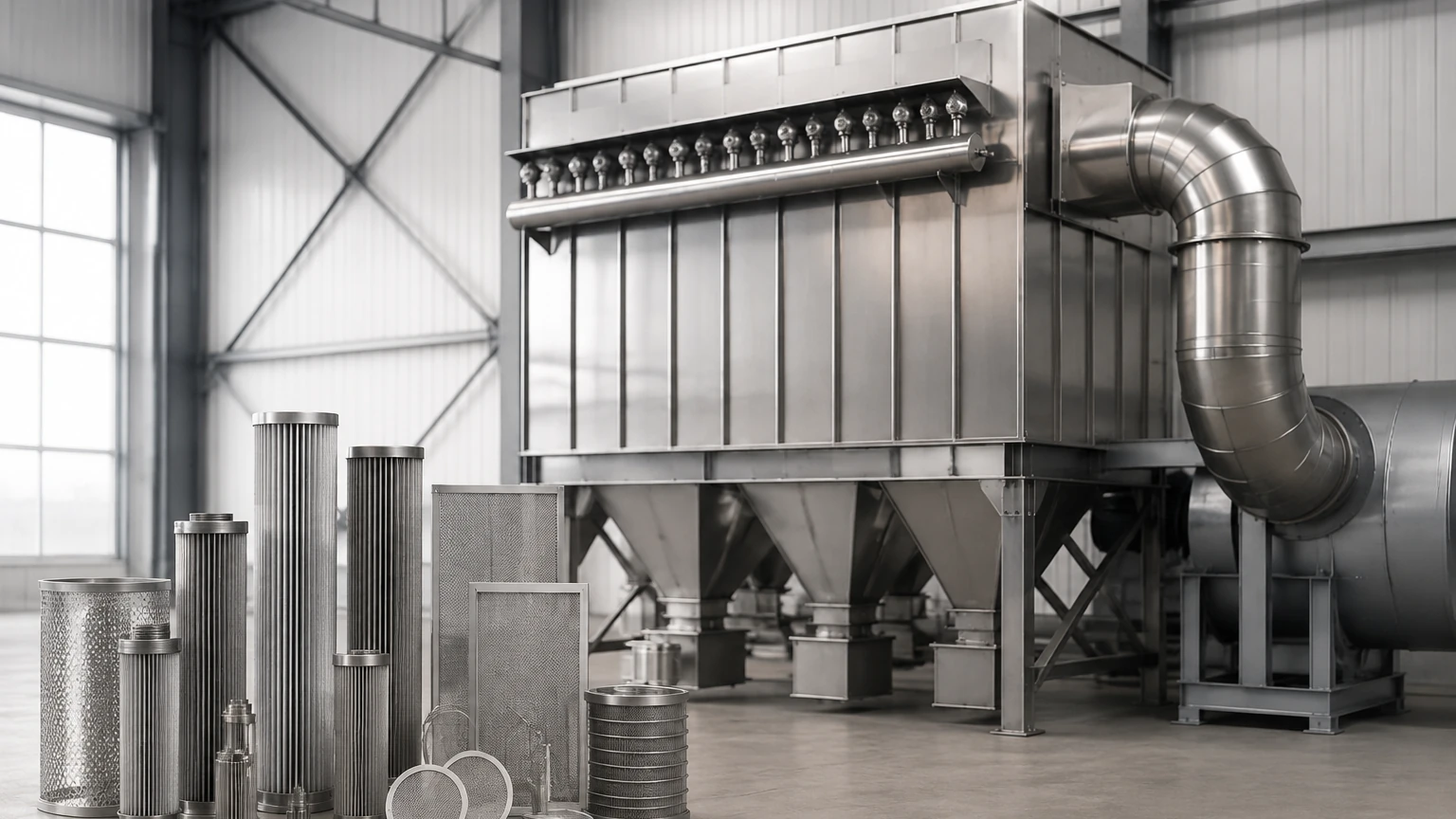
While many standard dust collectors use polyester or cellulose bags, certain industrial applications demand the durability and chemical resistance of stainless steel. In sectors like chemical processing, food and beverage, and pharmaceuticals, the particulates being captured may be corrosive, abrasive, or subject to high temperatures that would degrade synthetic fibers.
Advantages of Stainless Steel Wire Mesh and Cartridges
Stainless steel filter cartridges and wire mesh components provide several technical advantages for a 4000 CFM dust collector:
1. Thermal Stability: Stainless steel can operate in environments exceeding 500°F (260°C), where standard fabric filters would melt or ignite.
2. Chemical Compatibility: For processes involving solvents or acidic vapors, 304 or 316L stainless steel offers superior corrosion resistance, ensuring the structural integrity of the filter element.
3. Washability and Reuse: Unlike disposable bags, stainless steel filters can often be cleaned through ultrasonic baths or back-flushing, reducing the long-term cost of consumables.
4. Precision Micron Ratings: Custom-manufactured wire mesh allows for precise control over filtration accuracy, ensuring that even sub-micron particles are captured in high-purity applications.
Selection Criteria: Air-to-Cloth Ratio and Filtration Efficiency
A critical metric in the design of a 4000 CFM dust collector is the air-to-cloth (A/C) ratio, also known as the filtration velocity. This is the ratio of the air volume (4000 CFM) to the total surface area of the filter media.
Calculating the Required Surface Area
If a system is designed with an A/C ratio of 2:1, it would require 2,000 square feet of filter media to handle 4000 CFM. A lower A/C ratio generally leads to longer filter life and better efficiency because the air passes through the media at a slower speed, allowing for better particle capture and easier cleaning. In heavy dust load applications, such as metal grinding or powder handling, a lower A/C ratio is mandatory to prevent "blinding" or clogging of the filters.
Efficiency Ratings
Filtration efficiency is often measured by MERV (Minimum Efficiency Reporting Value) ratings or by specific micron retention levels. For a 4000 CFM dust collector used in pharmaceutical or food grade environments, HEPA-level filtration or high-precision stainless steel mesh may be required to meet stringent air quality standards. Engineers must balance the need for high efficiency with the resulting increase in static pressure.
Customization for Specific Industrial Applications
No two industrial processes are identical, and a standard 4000 CFM dust collector often requires customization to meet specific site requirements. This is where the expertise of a specialized manufacturer becomes invaluable. Customization options often focus on the material of construction and the geometry of the filter elements.
Pharmaceutical and Food Processing
In these industries, hygiene is paramount. Filters must be constructed from FDA-compliant materials and designed to eliminate "dead zones" where bacteria could grow. Stainless steel filter cartridges with smooth surface finishes (Ra values) are often used to facilitate complete cleaning and sterilization (CIP/SIP processes).
Chemical and Petrochemical
In environments where explosive dust (ATEX/DSEAR) is a concern, the filtration system must be grounded and may require anti-static media. Stainless steel components are naturally conductive, which helps in dissipating static charges that can accumulate during the movement of dry powders through the 4000 CFM air stream.
Maintenance and Total Cost of Ownership (TCO)
When evaluating a 4000 CFM dust collector, the initial purchase price is only one component of the Total Cost of Ownership. Maintenance, energy consumption, and filter replacement costs often exceed the original investment over the life of the system.
Pulse-Jet Cleaning Systems
Most modern 4000 CFM collectors utilize pulse-jet cleaning, where a burst of compressed air is blown through the filter in the reverse direction to dislodge the dust cake. The effectiveness of this system depends on the rigidity of the filter media. Stainless steel cartridges provide a stable structure that responds well to pulse-cleaning, ensuring more of the dust is removed compared to flexible bags that may retain particles in their fibers.
Replacement Cycles
The durability of the filtration media directly impacts downtime. In harsh environments, synthetic filters may need replacement every few months. In contrast, precision-engineered metal filters can last for years if maintained correctly. This longevity significantly reduces the labor costs associated with filter changes and the disposal costs of contaminated filter media.
Information Confirmation for Purchasing Teams
Before finalizing a specification for a 4000 CFM dust collector or its replacement components, technical professionals should confirm several key data points with their suppliers:
* Particle Characterization: What is the average particle size (microns), shape, and density? Is the dust hygroscopic (moisture-absorbing) or abrasive?
* Operating Temperature: What are the continuous and peak operating temperatures of the air stream?
* Chemical Environment: Are there any gases or vapors present that could react with the filter media or the housing?
* Regulatory Requirements: Does the system need to meet specific OSHA, EPA, or local environmental standards for emissions?
* Space Constraints: Does the facility have the footprint to accommodate the necessary filter surface area to maintain a low air-to-cloth ratio?
By addressing these factors, engineers can ensure that their 4000 CFM dust collector operates at peak efficiency, providing a safe working environment and protecting downstream equipment from contamination. For those seeking specialized filtration components tailored to these demanding specifications, exploring the technical capabilities of a dedicated manufacturer is the most reliable path forward. You can find more information on customized stainless steel filtration by visiting the Main Page to review product options and application support.
