


Oil Dehydrator
In the landscape of industrial maintenance and fluid management, the oil dehydrator stands as a critical piece of equipment designed to preserve the integrity of lubricating and hydraulic oils. Water contamination is one of the most pervasive and destructive issues in industrial systems, leading to accelerated component wear, chemical breakdown of additives, and catastrophic equipment failure. For engineers and maintenance professionals, understanding the technical nuances of oil dehydration—ranging from the physics of water-in-oil states to the precision filtration components required for efficient removal—is essential for optimizing system reliability.
Industrial oils are the lifeblood of machinery in sectors such as power generation, pulp and paper, mining, and metal processing. When these fluids become contaminated with water, the resulting damage is often irreversible. An effective oil dehydrator not only removes water but also maintains the oil's dielectric strength and lubricity, extending the service life of both the fluid and the mechanical components it protects.
The Critical Role of the Oil Dehydrator in Industrial Maintenance
Water enters industrial systems through various pathways, including seal leakage, reservoir breathing due to thermal expansion, and condensation from ambient humidity. Once present, water triggers several deleterious processes. It promotes oxidation, which increases the oil's acidity and viscosity, leading to the formation of sludge and varnish. Furthermore, water can cause hydrogen embrittlement in high-strength steels and lead to cavitation in pumps and valves.
An oil dehydrator is engineered to address these challenges by removing water down to levels well below the oil's saturation point. Unlike simple particulate filtration, dehydration requires a change in the physical state of the water or the use of specialized media to separate it from the oil base. By integrating an oil dehydrator into a kidney-loop or offline filtration system, facilities can move from reactive maintenance to a proactive reliability strategy. For detailed technical specifications on the filtration components that support these systems, engineers often refer to the Main Page of specialized manufacturers to ensure material compatibility and performance standards.
Understanding the Three States of Water in Lubricating Oils
To select the appropriate oil dehydrator technology, it is necessary to understand how water exists within the oil. Water contamination typically presents in three distinct forms:
1. Dissolved Water: At this stage, water molecules are chemically dispersed throughout the oil, much like humidity in the air. The oil remains clear. The amount of dissolved water an oil can hold depends on its base stock, additive package, and temperature (the saturation point).
2. Emulsified Water: When the concentration of water exceeds the saturation point and is subjected to high shear (such as in a pump), it forms an emulsion. This gives the oil a cloudy or milky appearance and is particularly difficult to remove because the water droplets are microscopic and chemically bound to the oil's additives.
3. Free Water: This is water that has completely separated from the oil and typically settles at the bottom of a reservoir due to its higher specific gravity. While free water is the easiest to remove via drainage, its presence indicates that the oil is fully saturated and that emulsified water is likely present.
An industrial oil dehydrator must be capable of addressing at least two, and ideally all three, of these states to be considered effective for high-performance applications.
Vacuum Dehydration: The Engineering Behind Flash Distillation
Vacuum dehydration is widely regarded as the most versatile and effective method for removing all forms of water, including dissolved water. This process operates on the principle of Henry’s Law and the relationship between pressure and the boiling point of liquids.
In a vacuum oil dehydrator, the contaminated oil is introduced into a vacuum chamber. By reducing the internal pressure (typically to 25–28 inches of Hg), the boiling point of water is lowered significantly—often to as low as 100°F to 120°F (38°C to 49°C). This allows the water to flash into steam at temperatures that do not degrade the oil or its additives. The oil is usually spread over a large surface area using specialized internal dispersal elements to maximize the evaporation rate.
One of the primary advantages of vacuum dehydration is its ability to remove dissolved gases and air along with the water. However, the efficiency of this process relies heavily on the quality of the internal components, such as the stainless steel mesh or dispersal media that facilitate the thin-film evaporation process. These components must withstand the vacuum environment and the chemical profile of the treated oil.
Coalescence and Separation: Mechanical Water Removal Strategies
For systems where water contamination is primarily in the free or emulsified state, a coalescing oil dehydrator offers a robust mechanical solution. This technology utilizes specialized filter media to gather small, dispersed water droplets into larger drops that can be easily separated by gravity.
Coalescing systems typically involve two stages. In the first stage, the oil passes through a coalescer element—often a multi-layered structure involving fiberglass or pleated stainless steel wire mesh. As the oil-water mixture flows through the media, the polar nature of the water molecules causes them to attach to the fibers. These tiny droplets collide and merge (coalesce) into larger beads. In the second stage, a separator element, usually made of a hydrophobic material like Teflon-coated stainless steel mesh, allows the oil to pass through while repelling the water beads, which then fall into a collection sump.
Coalescing is highly efficient for low-viscosity oils (such as turbine oils) but becomes less effective as oil viscosity increases or when high concentrations of surfactants and detergents are present, as these chemicals can "disarm" the coalescing media.
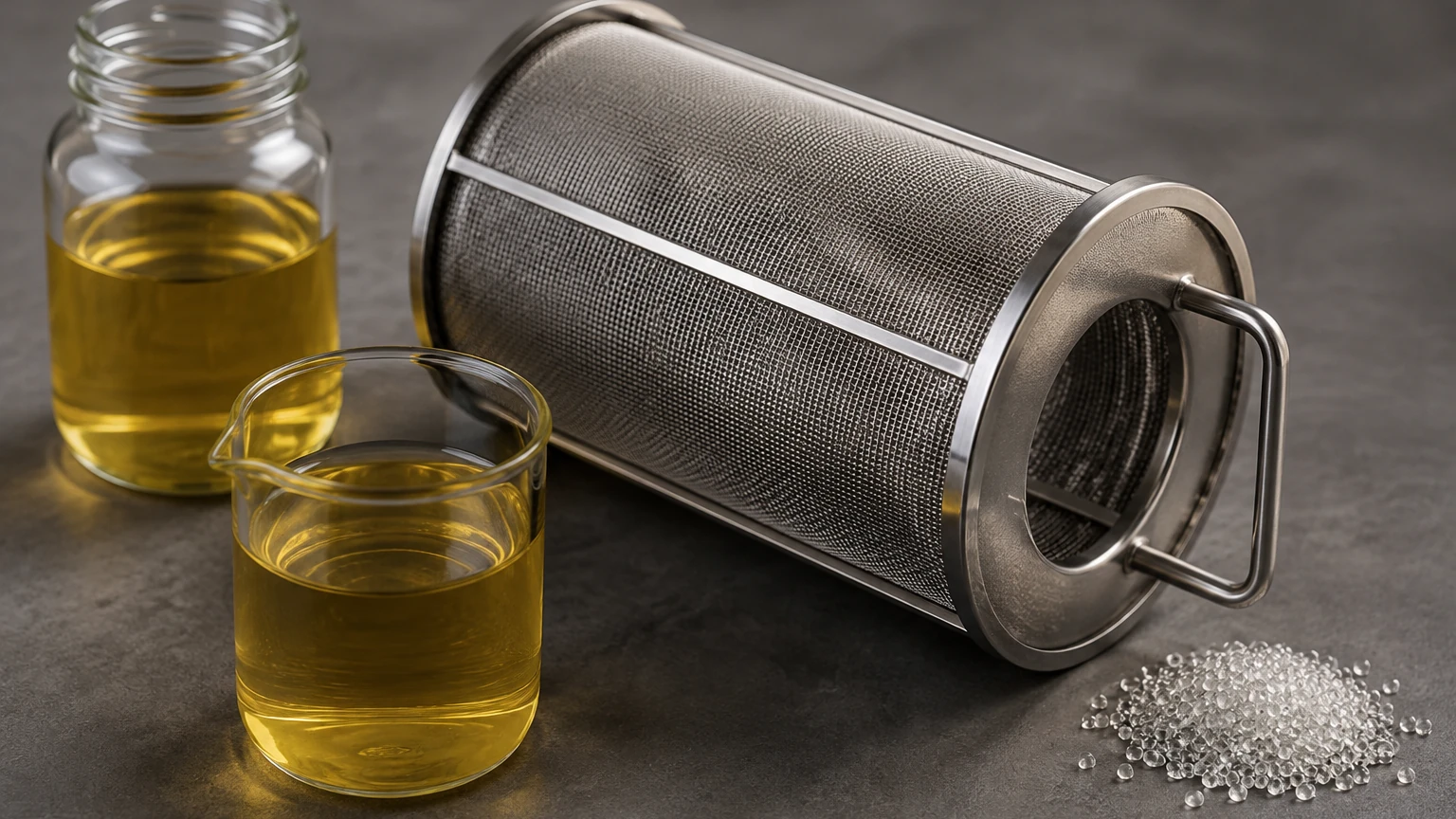
The Importance of High-Precision Stainless Steel Filters in Dehydration Units
Regardless of the dehydration method used, the performance of an oil dehydrator is intrinsically linked to the quality of its filtration components. Stainless steel filter cartridges and wire mesh elements are preferred in industrial dehydration for several engineering reasons:
* Thermal Stability: Dehydration processes often involve heating the oil to optimize water release. Stainless steel components maintain their structural integrity at elevated temperatures where synthetic or paper media might fail.
* Chemical Compatibility: Industrial oils can contain aggressive additive packages or acidic oxidation byproducts. Stainless steel (specifically 304 or 316L grades) provides superior resistance to corrosion and chemical degradation.
* Durability and Reusability: Precision metal filters can withstand high differential pressures and can often be cleaned and reused, providing a lower total cost of ownership compared to disposable elements.
* Precision Micron Ratings: In a vacuum dehydrator, pre-filters and post-filters are essential to protect the vacuum pump and ensure the returned oil meets ISO cleanliness codes. Stainless steel wire mesh allows for exact control over pore size, ensuring consistent filtration performance.
Manufacturers like Kaifil specialize in these custom stainless steel filtration solutions, providing the necessary hardware to ensure that the oil dehydrator operates at peak efficiency even in demanding chemical or high-pressure environments.
Selection Criteria: Matching Dehydrator Components to Fluid Properties
When specifying or purchasing an oil dehydrator, engineers must evaluate several technical parameters to ensure the unit is fit for purpose. These considerations include:
Fluid Viscosity
Viscosity is perhaps the most significant factor in dehydration efficiency. High-viscosity gear oils (ISO VG 320 and above) move more slowly through coalescing media and require more surface area in vacuum chambers to achieve effective thin-film evaporation. The choice of filter mesh weave and pleat density must account for the pressure drop associated with higher viscosities.
Temperature Limits
While heat aids in water removal, excessive heat can cause thermal cracking of the oil. A well-designed oil dehydrator will include heaters with low watt-density to prevent localized overheating. The internal filtration components must be rated for the maximum operating temperature of the system.
Flow Rate and Water Loading
The dehydrator must be sized to handle the expected water ingression rate. If a system has a high continuous ingression of water, a larger vacuum chamber or a multi-stage coalescing system may be required. The flow rate through the stainless steel filter elements must be optimized to prevent media migration or excessive pressure differential.
Material Selection
For applications involving synthetic fluids, phosphate esters, or water-glycols, the materials used in the oil dehydrator—including seals, gaskets, and filter media—must be strictly compatible. 316L stainless steel is often specified for its superior resistance to pitting and crevice corrosion in these environments.
Operational Best Practices and Filter Element Replacement Cycles
To maintain the effectiveness of an oil dehydrator, a rigorous maintenance schedule is required. The primary indicators of performance are the water concentration (measured in ppm) and the differential pressure across the filter elements.
1. Monitoring Differential Pressure: As the filters within the dehydrator capture particulate matter, the pressure drop increases. Stainless steel elements should be cleaned or replaced once they reach the manufacturer's specified limit to prevent bypass or element collapse.
2. Water Concentration Testing: Regular Karl Fischer titration or the use of online moisture sensors is necessary to verify that the oil dehydrator is successfully removing water. If water levels remain high despite continuous operation, it may indicate that the coalescing media is blinded or the vacuum seal has been compromised.
3. Vacuum Pump Maintenance: In vacuum units, the vacuum pump oil itself can become contaminated with the water it is removing. Regular oil changes for the vacuum pump are essential for maintaining the required vacuum depth.
Custom OEM Filtration Solutions for Dehydration Systems
Many industrial applications require bespoke oil dehydrator designs to fit specific spatial constraints or unique fluid chemistries. In these instances, OEM customization becomes a critical factor. Customization can involve the design of specialized stainless steel filter housings, the development of unique wire mesh configurations to handle non-standard viscosities, or the integration of multi-stage filtration assemblies within a single unit.
By working with manufacturers that offer deep expertise in stainless steel filtration, engineering teams can ensure that their oil dehydrator is equipped with components that are precisely matched to their operational needs. This collaborative approach leads to higher water removal efficiency, longer component life, and more reliable industrial processes.
Effective oil dehydration is a cornerstone of modern machinery lubrication. By understanding the technologies available and the critical role of precision metal filtration, industrial operators can significantly reduce the risks associated with water contamination and ensure the long-term health of their critical assets.
