


Cartridge Filter Manufacturers
In the industrial landscape, filtration is not merely a utility but a critical process component that ensures product purity, protects downstream equipment, and maintains system efficiency. Selecting the right cartridge filter manufacturers is a strategic decision for engineers and procurement professionals in sectors such as chemical processing, pharmaceuticals, food and beverage, and hydraulic systems. This guide explores the technical considerations, manufacturing standards, and evaluation criteria necessary to identify a partner capable of delivering high-performance filtration solutions.
Industrial cartridge filters must withstand demanding environments, including high temperatures, corrosive chemicals, and significant pressure differentials. Unlike standard commercial filters, industrial-grade components—particularly those made from stainless steel—are engineered for durability and precision. Understanding the capabilities of a manufacturer is essential for ensuring that the filtration system meets specific operational requirements without premature failure or bypass issues.
The Role of Material Science in Cartridge Manufacturing
One of the primary differentiators among cartridge filter manufacturers is their expertise in material selection. For industrial applications, stainless steel is often the material of choice due to its mechanical strength and chemical resistance. Manufacturers typically work with 304 and 316L stainless steel, though specialized applications may require exotic alloys like Monel or Inconel.
Stainless Steel Wire Mesh
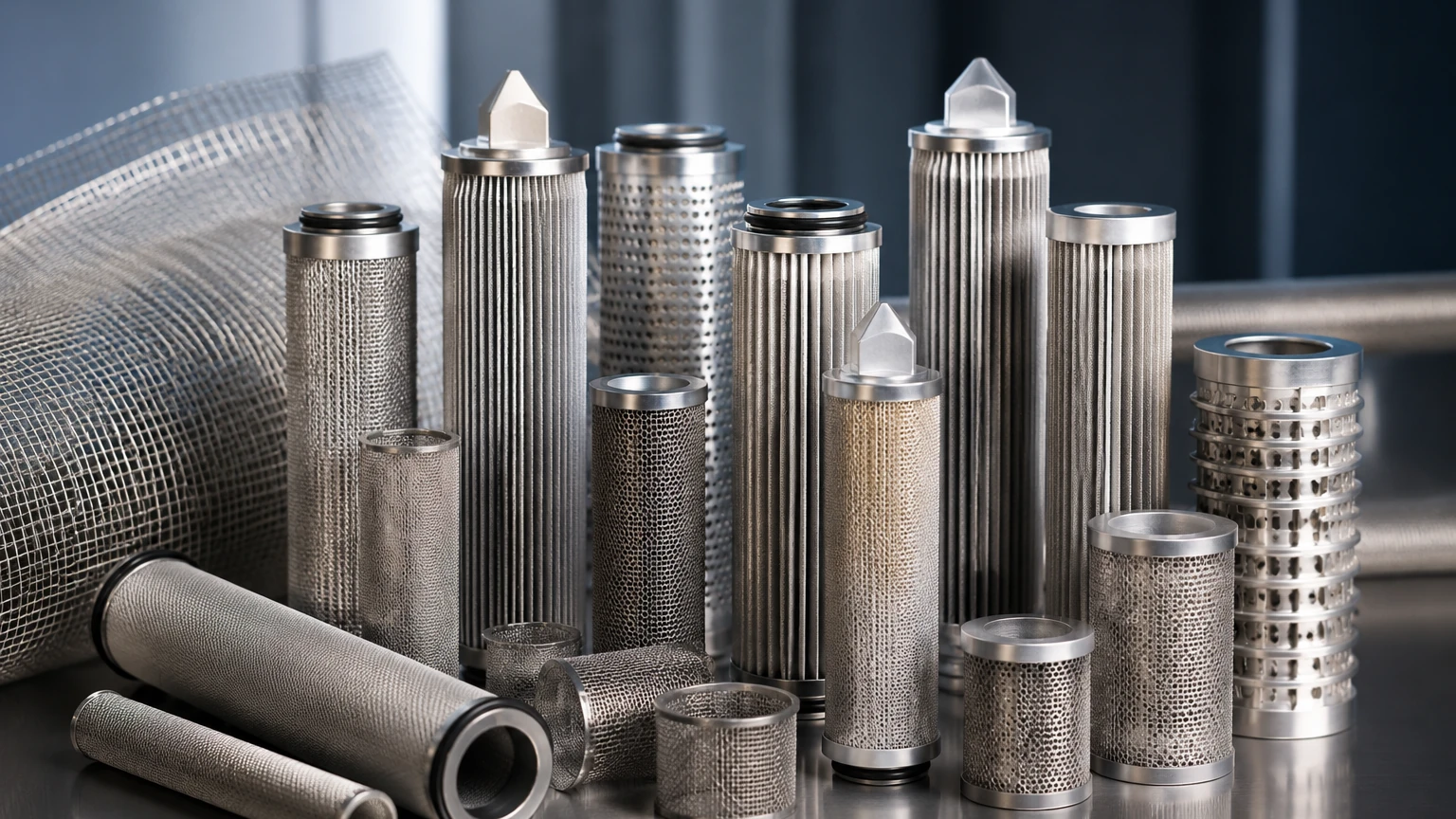
Stainless steel wire mesh filters are valued for their precise pore sizes and cleanability. Manufacturers use different weave patterns—such as plain weave, twill weave, or Dutch weave—to achieve specific filtration characteristics. A plain weave offers straightforward flow, while a Dutch weave provides a denser structure for finer filtration. The choice of weave affects both the micron rating and the mechanical stability of the filter element.
Sintered Metal Media
For applications requiring extreme pressure resistance or ultra-fine filtration, sintered metal media is often employed. This process involves bonding layers of wire mesh or metal powder through heat and pressure without melting the base material. The result is a porous, rigid structure that maintains its integrity under high-stress conditions. Leading manufacturers utilize sintering to create depth filtration media that offers superior dirt-holding capacity compared to single-layer mesh.
Engineering Considerations for Custom Filtration Solutions
Off-the-shelf filtration products rarely meet the nuanced needs of complex industrial systems. Therefore, the ability of cartridge filter manufacturers to provide customized engineering is a key performance indicator. When evaluating a manufacturer, engineers must consider how the following factors are integrated into the design process:
Micron Rating: Absolute vs. Nominal
A critical technical distinction is the difference between nominal and absolute micron ratings. A nominal rating indicates the filter's ability to retain a majority of particles at a certain size, whereas an absolute rating guarantees the retention of virtually all particles (typically 99.9%) at that size. Manufacturers must provide clear data on how these ratings are verified, often through glass bead testing or other standardized methods.
Pressure Drop and Flow Rate
The efficiency of a filtration system is heavily influenced by the initial pressure drop (ΔP). A high initial pressure drop reduces the available service life of the filter and increases energy consumption. Manufacturers must calculate the effective filtration area and optimize the pleat geometry to ensure maximum flow with minimal resistance. For those looking to optimize their current systems, reviewing technical specifications on the Main Page can provide a baseline for performance expectations.
Structural Integrity and End-Cap Configurations
The method by which the filter media is attached to the end caps is a common point of failure. High-quality manufacturers utilize TIG (Tungsten Inert Gas) welding or plasma welding to create a seamless, robust bond. This eliminates the need for adhesives or resins that might degrade in high-temperature or chemically aggressive environments. Furthermore, the selection of end-cap styles—such as DOE (Double Open End), SOE (Single Open End) with 222 or 226 O-rings—must be compatible with the existing filter housing to prevent bypass.
Evaluating Manufacturing Capabilities and Quality Control
Technical expertise must be backed by rigorous quality control protocols. When vetting cartridge filter manufacturers, it is important to look beyond the product catalog and examine the production floor and testing laboratory. A reliable manufacturer should be able to demonstrate the following:
1. Material Traceability: In industries like pharmaceuticals and food processing, material certification is mandatory. Manufacturers should provide Mill Test Reports (MTRs) for the stainless steel used, ensuring it meets ASTM or ISO standards.
2. Testing Procedures: Standard tests include the Bubble Point Test (to verify pore size and integrity), Pressure Decay Testing, and Flow Fatigue Testing. These tests ensure that the cartridge will perform as specified under actual operating conditions.
3. Cleanroom Production: For high-purity applications, the manufacturing environment itself must be controlled. Inquire if the manufacturer has cleanroom facilities for assembly and packaging to prevent contamination before the filter reaches the site.
4. OEM and Prototyping: For equipment manufacturers (OEMs), the ability to produce small-batch prototypes for testing before moving to full-scale production is invaluable. This collaborative approach allows for design iterations that optimize the filter's performance within a specific machine or process.
The Economics of Filtration: Total Cost of Ownership
While the initial purchase price is a factor, the total cost of ownership (TCO) is a more accurate metric for industrial filtration. High-quality stainless steel cartridges from reputable cartridge filter manufacturers often have a higher upfront cost than disposable polymer filters, but they offer significant long-term savings.
Reusability and Cleaning
Stainless steel cartridges are designed to be cleaned and reused. Depending on the contaminant, cleaning methods can include backwashing, ultrasonic cleaning, or chemical baths. A manufacturer that provides detailed cleaning protocols helps the end-user extend the life of the filter, reducing the frequency of replacements and minimizing waste.
Downtime Reduction
Filters that fail prematurely or clog frequently lead to expensive production downtime. By selecting a manufacturer that focuses on high dirt-holding capacity and structural durability, facilities can extend the intervals between maintenance cycles. This reliability is particularly vital in continuous process industries where a single hour of downtime can result in substantial financial loss.
Application-Specific Requirements
Different industries impose unique demands on filtration components. A manufacturer's experience in a specific sector can be a deciding factor in the success of the filtration strategy.
* Chemical Processing: Requires extreme chemical compatibility and the ability to handle high-temperature fluids. Filters must resist corrosion and maintain structural integrity in the presence of solvents, acids, and bases.
* Food and Beverage: Focuses on hygiene and compliance with FDA or EC regulations. The filters must be easy to sanitize and free of any substances that could leach into the product.
* Hydraulic Systems: Demands high pressure resistance and the ability to capture fine metallic particles that could cause wear on pumps and valves. The collapse pressure of the cartridge is a critical specification here.
* Water Treatment: Often involves high flow rates and the removal of both organic and inorganic particulates. Durability against scaling and oxidation is essential.
Conclusion: Selecting a Strategic Manufacturing Partner
Choosing between various cartridge filter manufacturers requires a balance of technical scrutiny and an understanding of long-term operational goals. A manufacturer should serve as a technical resource, offering guidance on material selection, filtration accuracy, and customized designs. By focusing on engineering precision, material quality, and rigorous testing, engineers can ensure that their filtration systems provide dependable performance in even the most demanding industrial environments.
For those responsible for procurement or system design, the focus should remain on finding a partner that understands the intersection of fluid dynamics and material science. A well-engineered filter does more than just trap particles; it optimizes the entire process, protects valuable assets, and contributes to the overall safety and efficiency of the industrial operation. As filtration requirements continue to evolve with new technologies and stricter regulations, the value of a technically proficient manufacturing partner becomes increasingly clear.
