


Woven Wire Fence Twisting Tool: A Technical Guide for Industrial Mesh Installation
In industrial applications, the integrity of a wire mesh installation is as critical as the quality of the material itself. Whether for perimeter security, industrial enclosures, or specialized filtration frames, the method used to secure and tension the mesh determines the longevity and performance of the system. A woven wire fence twisting tool is a fundamental instrument in this process, designed to facilitate the secure fastening of wire ties and the tensioning of mesh panels against structural supports. For engineers and procurement specialists, understanding the mechanics of these tools alongside the specifications of the Woven Wire Mesh being installed is essential for achieving professional-grade results.
Industrial filtration and structural mesh applications require precision. When working with high-grade materials like stainless steel, the physical properties of the wire—such as its tensile strength and work-hardening characteristics—must be considered during the installation phase. This guide explores the technical relationship between specialized twisting tools and the performance of woven wire systems.
Understanding the Mechanics of the Woven Wire Fence Twisting Tool
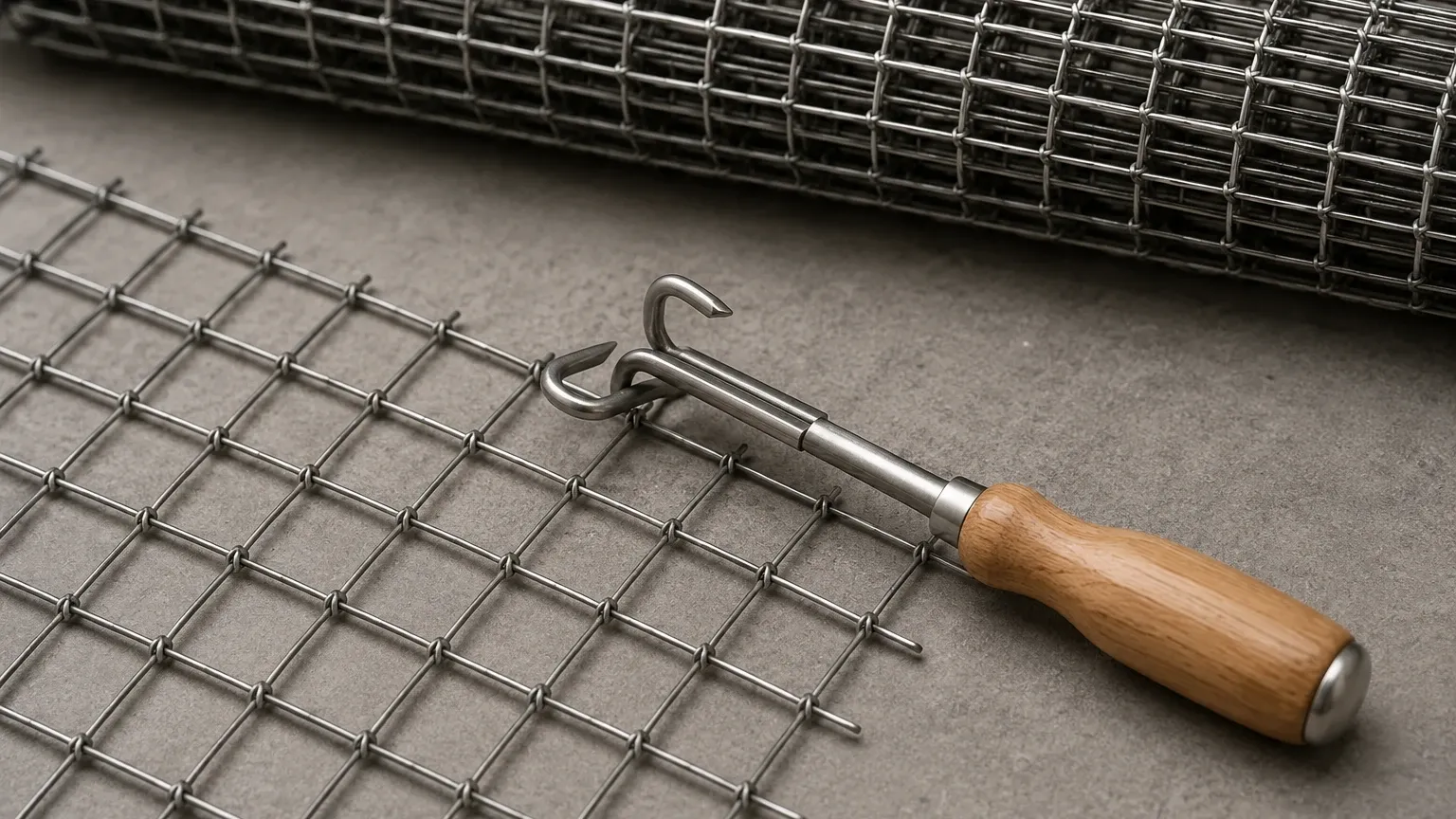
A woven wire fence twisting tool, often referred to in industrial contexts as a wire tie twister or a tensioning tool, serves a specific mechanical purpose: it converts a manual or semi-automatic pulling motion into a high-torque rotational force. This force is used to wrap tie wires around a fence post or frame member and the mesh itself, creating a tight, uniform knot that resists vibration and mechanical stress.
Types of Twisting Tools
1. Manual Hook Twisters: These are simple, handheld tools with a curved hook at the end. They require the operator to manually rotate the tool to twist the wire. While effective for small-scale repairs, they are less efficient for large industrial installations.
2. Automatic Pull-Action Twisters: These tools feature an internal spiral screw mechanism. When the handle is pulled, the hook rotates automatically. This significantly reduces labor time and ensures a consistent number of twists per tie, which is vital for maintaining uniform tension across a large surface area of Plain, twill and dutch woven wire mesh in SS304/316L — rolls, cut mesh and framed panels. Send mesh count or micron target for a technical quote.
3. Pneumatic and Battery-Powered Twisters: For high-volume production environments or extensive perimeter fencing, powered tools provide the highest level of consistency and torque control, minimizing operator fatigue and ensuring that every connection point meets engineering specifications.
Engineering Considerations for Woven Wire Mesh Tensioning
The primary goal of using a twisting tool is to achieve and maintain proper tension. In industrial settings, an improperly tensioned mesh can lead to several failure modes:
* Material Fatigue: If the mesh is too loose, it will vibrate or flutter in high-velocity air or fluid streams (in filtration) or under wind load (in fencing). This constant movement leads to metal fatigue at the contact points, eventually causing the wire to snap.
* Bypass and Leakage: In filtration applications, if a mesh panel is not securely fastened to its frame using precise twisting techniques, gaps can form. This allows unfiltered media to bypass the mesh, compromising the entire process.
* Structural Sagging: Over time, gravity and environmental factors can cause woven wire to sag. Using a high-quality woven wire fence twisting tool ensures that the initial tension is high enough to account for the natural "settling" of the metal over its service life.
When selecting a mesh for these applications, engineers must consider the mesh count and wire diameter. A heavier wire gauge requires more torque to twist securely, necessitating a more robust twisting tool. Conversely, fine filtration mesh requires a delicate touch to avoid crushing the delicate wire structure during the fastening process.
Material Selection: SS304 vs. SS316L in Industrial Environments
The effectiveness of a twisting tool and the longevity of the installation are heavily dependent on the alloy of the Woven Wire Mesh. Stainless steel is the industry standard due to its mechanical strength and resistance to environmental degradation.
Stainless Steel 304 (SS304)
SS304 is the most common grade used in industrial mesh. It offers excellent formability, making it relatively easy to twist and secure. It is suitable for most indoor industrial applications and outdoor environments where salt spray or high chemical exposure is not a primary concern.
Stainless Steel 316L (SS316L)
For more demanding environments, such as chemical processing plants, marine applications, or pharmaceutical cleanrooms, SS316L is preferred. The addition of molybdenum provides superior resistance to pitting and crevice corrosion. From an installation standpoint, SS316L is slightly more resistant to work-hardening than standard 316, which can be an advantage when performing complex twists or ties with a manual tool.
Selection Criteria for Industrial Mesh and Tools
When planning a project that involves woven wire components, procurement teams should evaluate the following criteria to ensure compatibility between the mesh and the installation tools:
1. Wire Gauge Compatibility: Ensure the twisting tool is rated for the diameter of the tie wire being used. Using a tool designed for light-duty wire on heavy-gauge industrial ties will lead to tool failure or incomplete twists.
2. Mesh Opening and Count: The "mesh count" (number of openings per linear inch) dictates how much space is available for fastening. In very fine mesh, traditional twisting tools may be too large, requiring specialized micro-twisters or alternative fastening methods like resistance welding.
3. Environmental Exposure: If the installation is in a corrosive environment, both the mesh and the tie wires must be of the same alloy (e.g., SS316L) to prevent galvanic corrosion. The twisting tool itself should be made of hardened steel to resist wear from the tough stainless steel wire.
4. Tension Requirements: Determine the required Newton-meters of tension for the specific application. For structural fencing, high tension is required; for filtration cartridges, the focus is more on the uniformity of the seal than the absolute tension.
Installation Best Practices with a Twisting Tool
To achieve a professional B2B-grade installation, follow these technical steps:
* Alignment: Before applying the twisting tool, ensure the Woven Wire Mesh is perfectly aligned with the frame or posts. Any misalignment will be "locked in" once the ties are twisted, leading to uneven stress distribution.
* Pre-Tensioning: Use a stretcher bar or tensioning winch to pull the mesh taut across the entire span before applying individual wire ties. The twisting tool should be used to secure the tension, not to create it from scratch.
* Consistent Twist Count: When using a pull-action twister, ensure the same number of rotations is applied to every tie. This ensures that the load is distributed evenly across all fastening points, preventing localized mesh deformation.
* Tail Management: After twisting, the "tail" of the wire tie should be tucked away or trimmed. In filtration applications, these tails can create turbulence; in fencing, they pose a safety hazard.
The Role of Customization in Industrial Filtration
At Kaifil, we recognize that standard off-the-shelf solutions often fall short of the rigorous demands of chemical processing, food and beverage production, and hydraulic systems. Our expertise lies in providing customized Woven Wire Mesh solutions that are engineered for specific mechanical and filtration requirements.
Customization options include:
* Specific Alloy Selection: Beyond SS304 and SS316L, we can provide mesh in specialized alloys for extreme temperature or corrosive environments.
* Edge Treatments: For mesh panels that will be installed using twisting tools or mechanical fasteners, we can provide reinforced edges or framed borders to prevent fraying and improve tension distribution.
* Precision Slitting and Cutting: We provide mesh in exact dimensions, reducing the need for field-cutting and ensuring a perfect fit within your existing frames or enclosures.
Conclusion: Ensuring Long-Term Performance
The combination of high-quality Woven Wire Mesh and the correct application of a woven wire fence twisting tool is the foundation of a durable industrial installation. By focusing on material science, mechanical tension, and proper installation techniques, engineers can significantly extend the service life of their filtration and structural systems.
When evaluating your next project, consider the total cost of ownership. While a cheaper mesh or a substandard twisting tool might reduce initial capital expenditure, the increased maintenance costs and potential for system failure far outweigh the early savings. Investing in precision-engineered stainless steel mesh and professional-grade installation tools ensures a reliable, high-performance solution that meets the stringent standards of modern industry.
For technical assistance in selecting the right mesh count, wire diameter, or alloy for your specific application, contact our engineering team. We provide comprehensive support from material selection through to customized production, ensuring your filtration and structural components perform as intended in the most demanding environments.
