


Woven Wire Fence T Post: Engineering Guide for Industrial Mesh Installations
In industrial environments, the structural integrity of containment and filtration systems is as critical as the performance of the mesh itself. While many engineers focus primarily on the technical specifications of the Woven Wire Mesh, the method of support—often involving a woven wire fence t post system—determines the longevity and stability of the installation. For sectors ranging from chemical processing to large-scale water treatment, understanding how high-performance stainless steel mesh integrates with structural supports is essential for maintaining operational safety and efficiency.
Selecting the right combination of mesh and post requires a deep dive into material science, mechanical tensioning, and environmental resistance. This guide examines the technical considerations for deploying woven wire mesh in industrial fencing and containment applications, focusing on the synergy between the mesh fabric and T-post supports.
Technical Fundamentals of Woven Wire Mesh
Before addressing the support structure, it is vital to define the characteristics of the mesh. In industrial B2B applications, "woven wire mesh" refers to a precision-engineered fabric created by interlacing metallic wires. At Kaifil, we specialize in high-grade alloys that provide the mechanical strength necessary for demanding environments.
Material Selection: SS304 vs. SS316L
The choice of alloy is the first decision point for any engineer.
* Stainless Steel 304: The standard for most industrial applications, offering excellent strength and basic corrosion resistance. It is suitable for general containment where extreme chemical exposure is not a primary concern.
* Stainless Steel 316L: Formulated with molybdenum, this alloy provides superior resistance to chlorides and acidic environments. In coastal industrial sites or chemical processing plants, 316L is the preferred choice to prevent pitting and structural failure over time.
Weave Types and Mechanical Properties
The weave pattern dictates the mesh's flexibility and its ability to withstand lateral pressure when mounted on a woven wire fence t post.
1. Plain Weave: The most common pattern where each warp wire crosses alternately over and under each weft wire. It offers high precision and is easy to tension.
2. Twill Weave: Used for heavier wire diameters in relation to the mesh count. This weave allows for greater durability in high-impact areas.
3. Dutch Weave: Primarily used in filtration, this weave provides a dense, strong structure that can also serve in specialized high-pressure containment scenarios.
The Role of T-Posts in Industrial Mesh Support
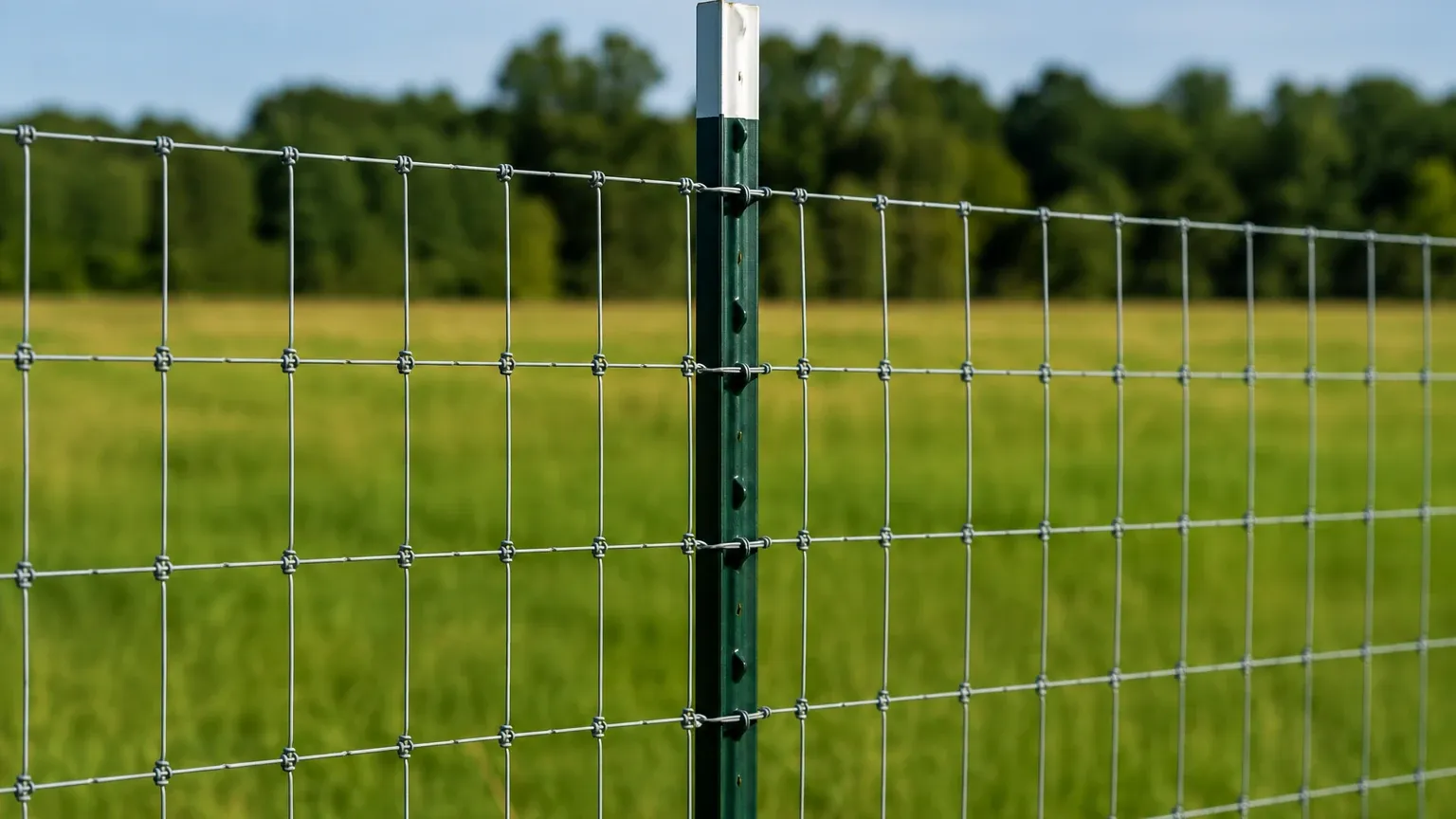
A woven wire fence t post is a structural member shaped like the letter 'T' in cross-section. In industrial settings, these are not merely agricultural stakes; they are engineered supports designed to handle the high tensile loads required to keep stainless steel mesh taut.
Structural Advantages of T-Posts
The "T" profile provides three-way resistance against bending. When installing heavy-duty woven wire mesh, the post must resist the inward pull of the tensioned wire. The studs along the spine of the T-post provide fixed points for wire clips, preventing the mesh from sliding vertically under its own weight or due to external impacts.
Weight and Coating Specifications
For industrial applications, T-posts are typically categorized by their weight per linear foot (e.g., 1.25 lbs/ft or 1.33 lbs/ft). Heavier posts are required for taller mesh heights or areas subject to high wind loads. Furthermore, while the mesh may be stainless steel, the posts are often hot-dipped galvanized or powder-coated to prevent galvanic corrosion at the contact points.
Engineering Considerations for Integration
When designing a system that utilizes a woven wire fence t post with Plain, twill and dutch woven wire mesh in SS304/316L — rolls, cut mesh and framed panels. Send mesh count or micron target for a technical quote., several engineering factors must be calculated to ensure system integrity.
Tensile Strength and Tensioning
Unlike flexible chain-link, high-quality woven wire mesh has a specific modulus of elasticity. If the mesh is over-tensioned, it can deform the T-posts or snap the wire. If under-tensioned, the mesh will sag, leading to fatigue at the attachment points. Engineers must specify the target tension based on the wire diameter and the distance between posts (typically 8 to 12 feet for industrial perimeters).
Aperture Size and Wind Loading
In outdoor industrial installations, the "open area" of the mesh is a critical variable. A fine mesh with a high mesh count acts like a sail. If a fine-micron mesh is attached to a woven wire fence t post without accounting for wind load, the entire structure may fail during a storm. Kaifil provides detailed specifications on open area percentages to help engineers calculate these loads accurately.
Installation Best Practices for Industrial Mesh
To maximize the service life of a woven wire installation, the interface between the mesh and the T-post must be handled with precision.
Attachment Mechanisms
In B2B environments, simple wire ties are often insufficient. Stainless steel specialized clips or "U-bolts" are recommended. These should be made of the same alloy as the mesh to prevent bimetallic corrosion. The clips should be placed every 6 to 12 inches along the T-post to distribute the load evenly.
Corner and End Post Bracing
While T-posts are excellent for line support, they cannot handle the terminal tension of a long run of woven wire mesh. Engineers should design the system with heavy-duty pipe posts or reinforced H-braces at every corner and end point. The woven wire fence t post then serves as the intermediate stabilizer.
Environmental and Chemical Resistance
In sectors like chemical processing or wastewater treatment, the environment is often corrosive. The longevity of the woven wire fence t post system depends on how well the materials withstand these conditions.
* Oxidation Resistance: Stainless steel mesh forms a self-healing chromium oxide layer. If the mesh is scratched during installation on the T-post, this layer should reform, provided the environment isn't too aggressive for the chosen grade.
* Thermal Expansion: In applications involving high-temperature discharge or extreme climates, the difference in thermal expansion coefficients between the stainless mesh and the carbon steel T-posts must be considered to prevent buckling.
Cost Considerations and Total Cost of Ownership (TCO)
From a procurement perspective, the initial cost of stainless steel woven wire mesh and high-grade T-posts is higher than galvanized alternatives. However, the TCO is significantly lower in industrial settings due to:
1. Reduced Maintenance: Stainless steel does not require frequent recoating or rust treatment.
2. Longer Service Life: A properly engineered system can last decades, whereas lower-grade materials may fail in 3–5 years in corrosive environments.
3. Operational Uptime: High-strength mesh reduces the risk of containment breaches that could lead to environmental fines or safety shutdowns.
Critical Questions for Engineers and Purchasing Teams
Before finalizing a specification for a woven wire fence t post and mesh system, technical teams should confirm the following:
* What is the primary function? (e.g., security, debris filtration, bird exclusion, or safety guarding)
* What is the exact chemical environment? (This dictates the SS304 vs. SS316L decision)
* What are the mechanical load requirements? (Impact resistance vs. static tension)
* Is customization required? Kaifil offers custom-cut mesh panels and specific weave patterns to meet unique site dimensions, which can simplify the installation on T-posts.
Conclusion
The integration of high-performance Woven Wire Mesh with a robust woven wire fence t post support system is a foundational requirement for many industrial infrastructure projects. By focusing on material compatibility, mechanical tensioning, and environmental factors, engineers can ensure a durable and cost-effective solution. At Kaifil, we provide the technical expertise and manufacturing precision needed to deliver mesh products that meet these rigorous standards.
For technical specifications, material certifications, or to discuss a custom filtration or containment project, engineers are encouraged to consult with our technical team to ensure the selected mesh and support configuration are optimized for their specific application.
