


Coalescing Filter Manufacturers
In industrial fluid dynamics and gas processing, the separation of liquid aerosols and droplets from a continuous phase is a critical requirement for protecting downstream equipment and ensuring product purity. Coalescing filter manufacturers play a pivotal role in this ecosystem, providing the specialized components necessary to manage multi-phase flows. Unlike standard particulate filters that simply trap solid contaminants, coalescing filters are engineered to facilitate the merging of small droplets into larger ones, which can then be removed by gravity.
For engineers and procurement teams, selecting a manufacturer involves more than comparing price points. It requires a deep understanding of the physics of coalescence, material compatibility, and the structural integrity of the filter media under varying pressure differentials. This guide examines the technical landscape of coalescing filtration and the criteria for evaluating manufacturers in the B2B industrial sector.
The Engineering Principles of Coalescence
To effectively evaluate coalescing filter manufacturers, one must first understand the three-stage process that defines high-performance coalescing: interception, diffusion (Brownian motion), and inertial impaction.
1. Diffusion: This occurs with the smallest sub-micron droplets. These particles move erratically due to molecular collisions, eventually making contact with the filter fibers.
2. Interception: Mid-sized droplets that follow the flow stream come into contact with a fiber as they pass within a distance equal to their radius.
3. Inertial Impaction: Larger, heavier droplets possess enough momentum to deviate from the gas stream lines when the flow changes direction around a fiber, causing them to strike the fiber surface.
Once these droplets are captured by the media—often a graded density matrix of borosilicate glass microfibers or stainless steel wire mesh—they move along the fibers to intersection points. Here, they merge (coalesce) into larger droplets. As these droplets grow, they migrate through the depth of the filter toward the outer surface (in an inside-to-outside flow configuration). Once they reach the outer drainage layer, the droplets become heavy enough to fall into a collection sump, leaving the process stream free of liquid carryover.
Material Selection and Structural Integrity
Reliable coalescing filter manufacturers prioritize material science to ensure longevity in demanding environments. In many industrial applications, such as chemical processing or high-temperature steam filtration, standard polymer-based filters may fail due to chemical degradation or thermal softening. This is where stainless steel filtration solutions become essential.
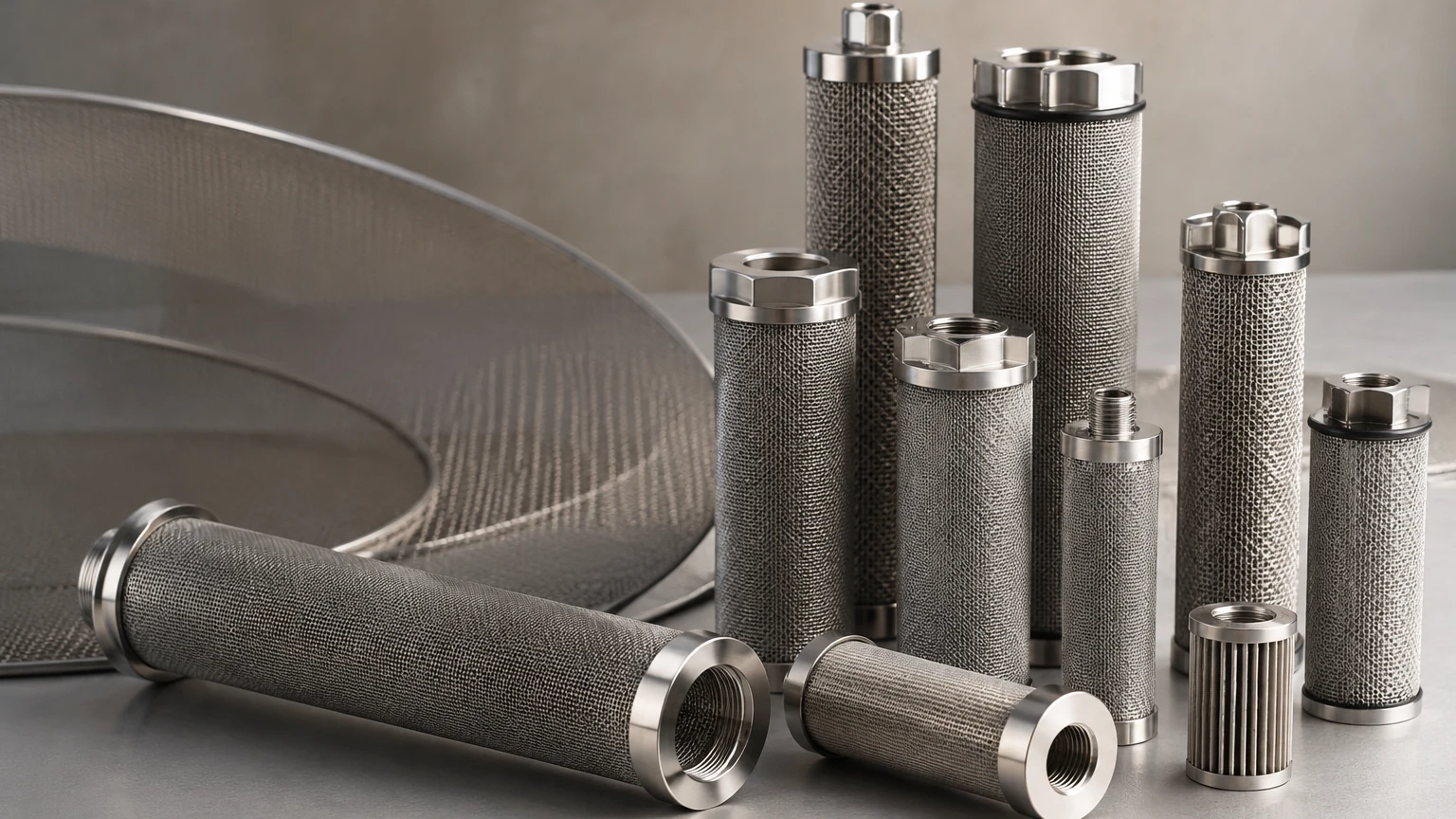
Manufacturers like Kaifil specialize in utilizing stainless steel 304 and 316L for filter support structures and specialized mesh media. The choice of material impacts several operational factors:
* Chemical Compatibility: Stainless steel resists corrosion from aggressive solvents and acidic environments common in the oil and gas or pharmaceutical industries.
* Temperature Resistance: Metal filters maintain their structural integrity at temperatures that would melt or deform synthetic fibers.
* Pressure Differential (ΔP): Coalescing elements must withstand high differential pressures, especially during startup or when the media becomes saturated with high-viscosity liquids. A robust inner and outer support core, often made of perforated metal or expanded stainless steel, prevents element collapse.
When reviewing a manufacturer’s capabilities, engineers should confirm the grade of steel used and the welding or bonding techniques employed to ensure there is no risk of media migration or bypass.
Evaluating Manufacturer Performance Metrics
When sourcing from coalescing filter manufacturers, technical specifications must be scrutinized to ensure they align with the specific application requirements. Generic marketing claims of "99.9% efficiency" are insufficient without context. The following metrics are critical for B2B procurement:
Filtration Rating and Efficiency
Coalescing filters are typically rated by their ability to remove liquid aerosols of a certain size, often down to 0.3 or 0.01 microns. Manufacturers should provide efficiency data based on standardized testing (such as ISO 12500-1 for compressed air). It is important to distinguish between the initial dry pressure drop and the saturated pressure drop, as the latter represents the filter's performance during steady-state operation.
Flow Rate and Velocity
Coalescence is highly dependent on face velocity. If the velocity is too high, the captured droplets may be re-entrained into the gas stream before they can drain. Conversely, if the velocity is too low, the inertial impaction mechanism is weakened. A competent manufacturer will provide flow curves that help engineers size the housing and elements correctly for their specific operating pressure and temperature.
Liquid Loading Capacity
In applications with high liquid concentrations (heavy loading), the filter must be able to drain liquid as fast as it is collected. If the drainage layer is overwhelmed, the filter will "flood," leading to a massive increase in pressure drop and liquid carryover. Manufacturers should be consulted on the maximum liquid loading their elements can handle before performance degrades.
Customization and OEM Capabilities
In many industrial settings, off-the-shelf filtration units do not fit the physical or functional constraints of the system. This is particularly true in the production of specialized machinery, hydraulic power units, or integrated chemical skids. Working with coalescing filter manufacturers that offer OEM and custom design services provides several advantages:
* Bespoke Dimensions: Customizing the length, diameter, and end-cap configuration allows for the retrofitting of existing housings or the design of more compact systems.
* Specialized Media Layers: Depending on whether the goal is liquid-liquid separation (e.g., removing water from fuel) or liquid-gas separation (e.g., removing oil mist from air), the manufacturer can adjust the hydrophobic or hydrophilic properties of the media.
* Integrated Support: Manufacturers with in-house engineering teams can assist in the design phase, performing flow simulations and material stress tests to ensure the filter performs as expected before mass production begins.
For purchasing teams, the ability to consolidate the supply chain by working with a manufacturer that handles both the internal filter elements and the precision metal components is a significant cost and logistics benefit.
Common Risks and Selection Pitfalls
Procuring industrial filters involves navigating risks that can lead to system downtime or expensive equipment repairs. Engineers should be wary of the following when selecting a partner:
* Bypass Risks: If the end caps are not properly bonded to the media, or if the gaskets are of inferior quality, the process fluid will take the path of least resistance, bypassing the filter media entirely. High-quality manufacturers use epoxy bonding or thermal welding to ensure a leak-proof seal.
* Media Migration: In low-quality filters, fibers from the filter media can break off and enter the downstream flow, potentially contaminating the final product or damaging sensitive instruments. This is a common issue with cheap glass fiber elements that lack a proper downstream containment layer.
* Inaccurate Micron Ratings: Without standardized testing, some manufacturers may use "nominal" ratings rather than "absolute" ratings. In critical B2B applications, absolute ratings are necessary to guarantee the protection of downstream components.
To mitigate these risks, it is standard practice to request material certifications (MTRs) and performance test reports during the vetting process.
Total Cost of Ownership (TCO) in Filtration
While the initial purchase price of a filter element is a visible cost, the total cost of ownership is dominated by operational expenses. Coalescing filter manufacturers who focus on engineering high-efficiency, low-pressure-drop elements help reduce the energy consumption of the entire system.
Every bar of pressure drop across a filter in a compressed air system, for example, translates to increased power consumption at the compressor. By selecting elements with optimized pleat geometry and high-porosity media, engineers can achieve the required separation efficiency with minimal energy loss. Furthermore, the durability of the media determines the replacement cycle. Stainless steel elements that can be cleaned or those with high dirt-holding capacity reduce the frequency of maintenance intervals and the associated labor costs.
Conclusion: Choosing a Technical Partner
Selecting from the available pool of coalescing filter manufacturers requires a focus on technical transparency and manufacturing precision. For industries such as food and beverage, pharmaceuticals, and chemical processing, the reliability of the filtration system is non-negotiable.
By focusing on manufacturers that demonstrate expertise in stainless steel fabrication and custom engineering, such as the Main Page of Kaifil’s technical resources, companies can ensure they are receiving components designed for the rigors of industrial use. Whether the requirement is for a standard replacement element or a completely custom OEM filtration solution, the priority should always be on verified performance, material integrity, and the engineering support necessary to optimize the filtration process.
