


Food Manufacturer Dust Collector
In the food processing industry, air quality and particulate control are fundamental to both operational safety and product integrity. A food manufacturer dust collector is not merely a piece of auxiliary equipment; it is a critical component of the facility’s hygiene and safety infrastructure. These systems are designed to capture airborne particulates—ranging from fine flour and sugar dust to spice powders and grain husks—generated during grinding, mixing, conveying, and packaging processes.
For engineers and facility managers, selecting the appropriate filtration technology requires a deep understanding of material characteristics, regulatory compliance, and the technical limitations of different filter media. This article explores the engineering considerations, material requirements, and performance metrics essential for optimizing dust collection in food manufacturing environments.
Technical Challenges in Food Dust Collection
Food manufacturing presents a unique set of challenges that distinguish its dust collection requirements from general industrial applications. The primary concerns involve hygiene, moisture levels, and the inherent volatility of organic dust.
Combustible Dust Hazards
Many organic materials processed in food facilities, such as starch, sugar, and cocoa, are highly combustible. When suspended in the air at specific concentrations within an enclosed space, these particles can lead to devastating explosions. A food manufacturer dust collector must comply with NFPA (National Fire Protection Association) standards, particularly NFPA 652 (Fundamentals of Combustible Dust) and NFPA 61 (Prevention of Fires and Dust Explosions in Agricultural and Food Processing Facilities). Engineering controls often include explosion venting, isolation valves, and the use of grounded, conductive filter media to prevent static discharge.
Hygiene and Cross-Contamination
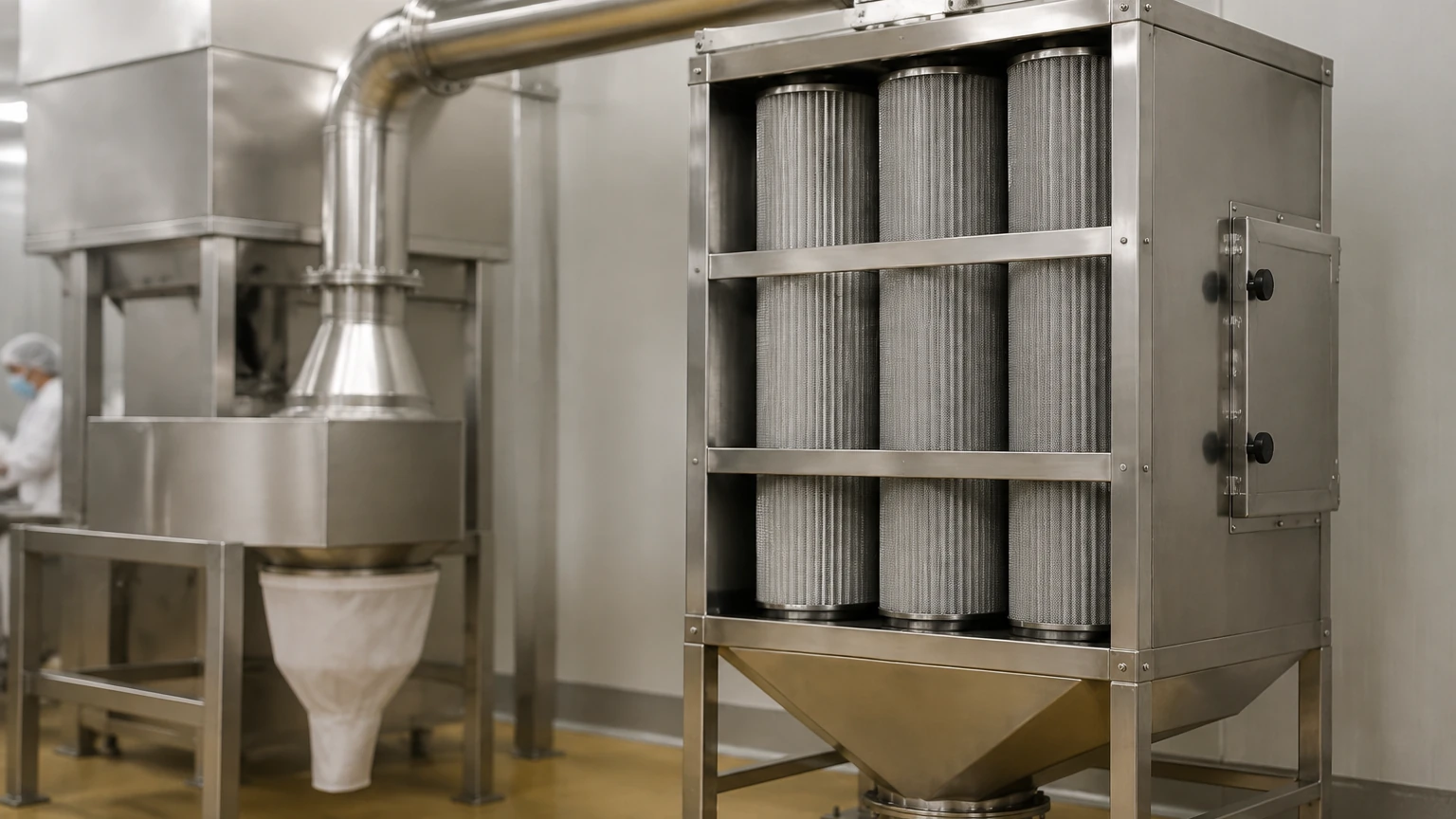
Unlike metalworking or woodworking, food processing requires strict adherence to sanitary standards to prevent microbial growth and cross-contamination. Dust collectors must be designed with "clean-out" capabilities. Dead spaces where dust can accumulate and ferment or harbor bacteria must be eliminated. This often necessitates the use of stainless steel housing and specialized filter cartridges that can withstand rigorous cleaning protocols.
Moisture and Oil Content
Food dust is rarely "dry" in the traditional sense. Ingredients may contain oils, fats, or moisture from steam-heavy processing areas. Standard fabric filters often suffer from "blinding" or "plugging" when exposed to these conditions. Engineers must specify filter media with oleophobic or hydrophobic treatments, or move toward stainless steel wire mesh solutions that offer superior release properties and durability in high-moisture environments.
Selecting Filtration Media for Food Applications
The heart of any food manufacturer dust collector is the filter medium. The choice between synthetic fabrics and metallic mesh depends on the specific temperature, chemical exposure, and particle size distribution of the process.
Stainless Steel Wire Mesh Filters
For demanding applications involving high temperatures or corrosive cleaning agents, stainless steel wire mesh is often the preferred choice. These filters, typically manufactured from 304 or 316L stainless steel, provide several technical advantages:
1. Durability: Unlike polymer-based bags, stainless steel mesh does not tear or degrade under high pressure or thermal cycling.
2. Cleanability: Stainless steel components are compatible with Clean-in-Place (CIP) systems, allowing for sterilization without removing the filter elements.
3. Precision: Advanced weaving techniques allow for precise micron ratings, ensuring consistent capture efficiency for specific particle sizes.
Synthetic and Membrane Media
In dry, ambient temperature applications, needle-felt polyester or ePTFE (expanded polytetrafluoroethylene) membranes are common. ePTFE membranes provide high surface-loading efficiency, meaning particles are captured on the surface rather than embedded within the depth of the media. This facilitates better dust cake release during pulse-jet cleaning cycles. However, these materials have lower mechanical strength and chemical resistance compared to metal alternatives.
Engineering Specifications and System Design
When specifying a dust collection system, engineers must evaluate several key performance indicators (KPIs) to ensure the system meets the facility's throughput and air quality goals.
Air-to-Cloth Ratio
The air-to-cloth (A/C) ratio, also known as the filtration velocity, is the ratio of the air volume entering the collector (CFM) to the total square footage of the filter media. For food dust, which can be light and prone to re-entrainment, a lower A/C ratio is generally recommended. This reduces the velocity of air passing through the media, preventing particles from being forced through the pores and extending the life of the filter.
Pressure Drop and Energy Consumption
Differential pressure (the difference in pressure between the dirty and clean sides of the filter) is a primary indicator of filter health. A high pressure drop indicates that the filters are loaded and require cleaning or replacement. By selecting high-permeability media and optimizing the pulse-jet cleaning frequency, manufacturers can maintain a lower average pressure drop, significantly reducing the energy consumption of the system’s primary fan.
Particle Size Distribution (PSD)
Before selecting a filter, a PSD analysis should be conducted. If the majority of the dust is sub-micron, a high-efficiency membrane or a multi-staged filtration approach may be necessary. For coarser materials, a robust stainless steel wire mesh may provide the best balance of flow rate and capture efficiency. For more detailed technical specifications on various filter types, engineers can refer to the Main Page of specialized manufacturers to compare material properties and flow charts.
Compliance and Material Standards
In the United States and Europe, materials that come into contact with food—or are used in environments where food is processed—must meet specific regulatory criteria.
FDA and EC 1935/2004
Filter media used in a food manufacturer dust collector should be composed of FDA-compliant materials. Stainless steel 316L is widely recognized as the gold standard for food contact due to its corrosion resistance and non-reactive nature. When using synthetic media, it is essential to verify that all resins, binders, and surface treatments are certified for food use.
3-A Sanitary Standards
For applications requiring the highest level of hygiene, equipment designed to 3-A Sanitary Standards ensures that the machinery is easy to clean and inspect. This includes requirements for surface finishes (measured in Ra) and the radius of internal corners to prevent material buildup.
Maintenance and Total Cost of Ownership (TCO)
While the initial purchase price of a dust collector is a significant factor, the Total Cost of Ownership (TCO) is often dominated by maintenance, energy, and downtime.
Replacement Cycles
Disposable fabric filters may have a lower upfront cost but require frequent replacement, leading to high labor costs and production interruptions. In contrast, permanent stainless steel filter elements can last for years with proper maintenance. For a food manufacturer dust collector, the ability to wash and reuse filters can lead to substantial long-term savings.
Monitoring and Diagnostics
Modern dust collection systems often incorporate smart sensors to monitor differential pressure, hopper levels, and compressed air usage. Integrating these sensors into the facility's PLC (Programmable Logic Controller) allows for predictive maintenance, ensuring that filters are cleaned or replaced only when necessary, thereby optimizing the lifespan of the media.
Conclusion: Selecting the Right Partner
Optimizing a food manufacturer dust collector requires a balance between filtration efficiency, regulatory compliance, and operational cost. Engineers must look beyond basic catalog specifications and consider the specific nuances of their production environment—whether that involves the abrasive nature of sugar crystals or the corrosive effects of sanitizing chemicals.
By focusing on high-quality materials like stainless steel and ensuring the system design accounts for combustible dust risks and hygienic requirements, food manufacturers can protect their personnel, their products, and their bottom line. For technical guidance on custom filtration components and material selection, consulting with a manufacturer experienced in industrial-grade metal filtration is a vital step in the procurement process.
