


1×1 Woven Wire Mesh
In the landscape of industrial filtration and material separation, the specification of a mesh is the primary determinant of performance, durability, and cost-efficiency. Among the various configurations available, 1×1 woven wire mesh represents a critical category used in heavy-duty screening, coarse filtration, and structural applications. Understanding the technical nuances of this specific mesh count is essential for engineers and procurement professionals who must balance flow rates with structural integrity.
As a specialized manufacturer, Kaifil provides precision-engineered Woven Wire Mesh solutions designed to meet the rigorous demands of chemical processing, food production, and industrial filtration. This guide explores the engineering considerations, material properties, and application criteria for 1×1 woven wire mesh to assist in informed technical selection.
Understanding the 1×1 Woven Wire Mesh Specification
The term "1×1" in the context of woven wire mesh typically refers to the mesh count—the number of openings per linear inch. A 1×1 mesh indicates one opening per inch in both the warp (lengthwise) and shute (crosswise) directions. Because the mesh count is low, the resulting openings are relatively large, making this specification ideal for coarse separation and high-flow environments.
However, it is important for engineers to distinguish between "mesh count" and "clear opening." While a 1×1 mesh has one opening per inch, the actual size of that opening (the aperture) depends entirely on the wire diameter. For example, if a 1×1 mesh utilizes a 0.250-inch wire, the clear opening will be 0.750 inches. If a thinner 0.135-inch wire is used, the opening increases to 0.865 inches.
When specifying 1×1 woven wire mesh, the relationship between wire diameter and aperture size determines the "Open Area" percentage. This percentage is a vital metric for calculating flow resistance and throughput in hydraulic or pneumatic systems.
Material Selection: SS304 vs. SS316L
Material science is at the core of filtration performance. For most industrial 1×1 woven wire mesh applications, stainless steel is the standard due to its mechanical strength and resistance to environmental degradation. Kaifil primarily utilizes two grades of stainless steel to meet diverse application requirements:
Stainless Steel 304 (SS304)
SS304 is the most common alloy used in industrial screening. It offers excellent corrosion resistance against most oxidizing acids and is highly durable. It is a cost-effective choice for applications in food processing, general manufacturing, and architectural guards where extreme chemical exposure is not a primary concern.
Stainless Steel 316L (SS316L)
For more demanding environments, SS316L is the preferred choice. The addition of molybdenum enhances its resistance to pitting and crevice corrosion, particularly in chloride-rich environments. Engineers should specify SS316L for 1×1 woven wire mesh used in marine applications, chemical processing plants, or pharmaceutical environments where rigorous CIP (Clean-in-Place) protocols involving harsh chemicals are standard.
Engineering Considerations: Wire Diameter and Open Area
Selecting the correct wire diameter for 1×1 woven wire mesh is a balancing act between structural rigidity and filtration efficiency.
1. Structural Integrity: Thicker wires provide higher tensile strength and resistance to mechanical impact. This is crucial in applications like vibrating screens or protective barriers where the mesh is subjected to physical stress.
2. Open Area and Flow Rate: The open area is calculated using the formula: `Open Area % = (Aperture / (Aperture + Wire Diameter))^2 x 100`. A higher open area results in lower pressure drops across the mesh, which is critical for gravity-fed filtration or high-volume air intake systems.
3. Weight Considerations: In large-scale installations, the weight of the mesh can impact the design of the supporting framework. Heavier wire diameters significantly increase the total weight per square foot, necessitating more robust mounting hardware.
By consulting with a technical manufacturer, engineers can optimize these variables to ensure the mesh performs reliably over its intended service life without premature fatigue or failure.
Weave Types and Mechanical Stability
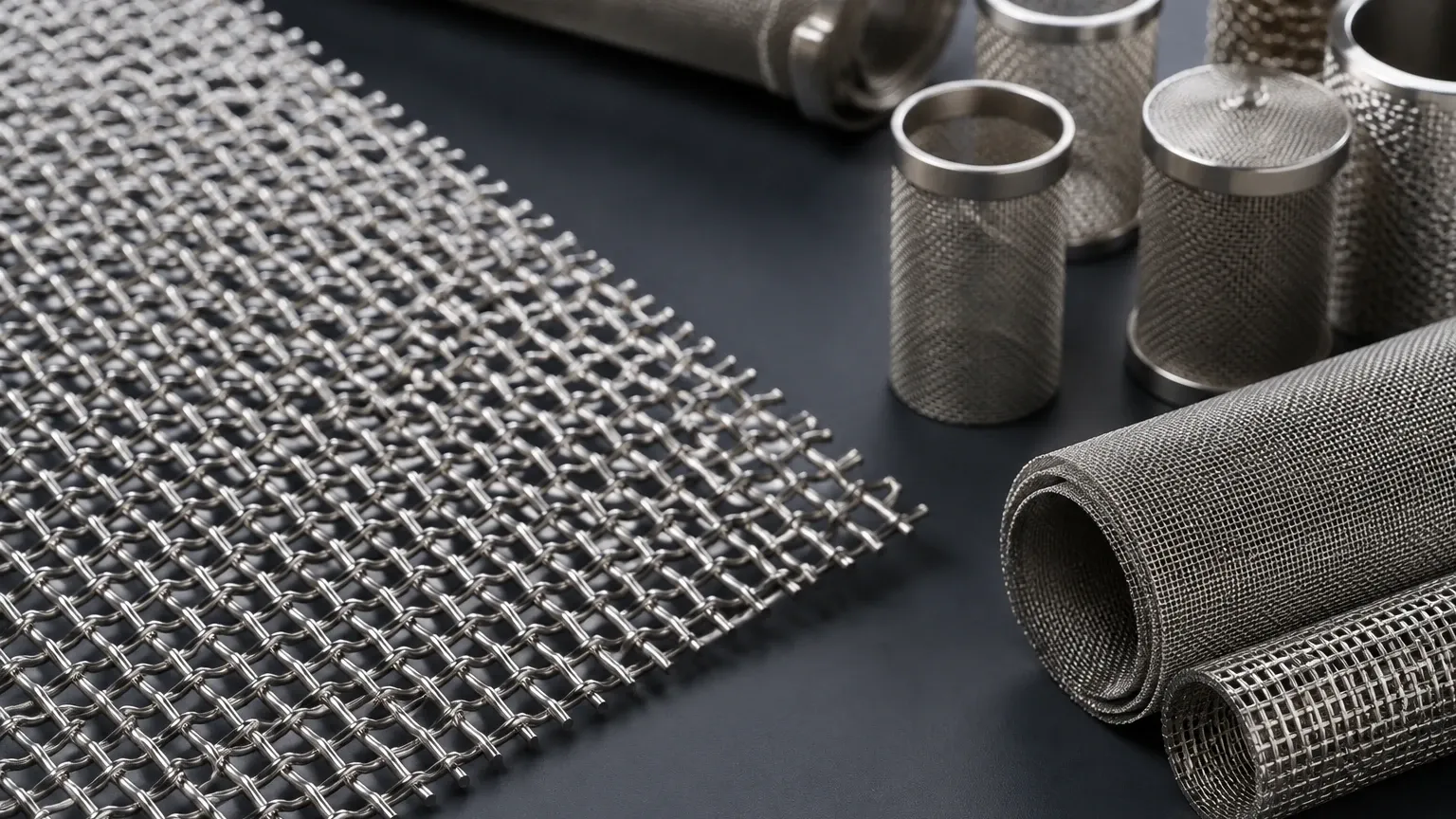
While finer meshes often utilize twill or dutch weaves to achieve high filtration accuracy, 1×1 woven wire mesh almost exclusively employs the Plain Weave or Pre-Crimp styles.
* Plain Weave: In this configuration, each shute wire passes alternately over and under each warp wire. For 1×1 mesh, this provides a stable, consistent aperture.
* Intermediate Crimp (Intercrimp): For larger openings and relatively light wires, an intermediate crimp may be used to provide extra stability and ensure the wires remain locked in place, preventing "mesh migration" or aperture distortion under load.
At Kaifil, we ensure that the weaving tension is precisely controlled to maintain the dimensional accuracy of the 1×1 openings, which is critical for applications requiring exact particle sizing.
Common Applications for 1×1 Woven Wire Mesh
Due to its robust nature and large aperture size, 1×1 woven wire mesh serves several distinct industrial functions:
1. Coarse Pre-Filtration
In water treatment and chemical processing, 1×1 mesh acts as a primary stage of filtration. It captures large debris, such as stones, plastic fragments, or large organic matter, protecting downstream pumps and finer filter cartridges from damage and clogging.
2. Industrial Guards and Safety Enclosures
The strength of stainless steel 1×1 mesh makes it an excellent material for machine guards, window screens in industrial facilities, and safety partitions. It allows for maximum visibility and airflow while providing a formidable physical barrier.
3. Heat Treating and Drying Trays
In the food and beverage industry, 1×1 mesh is often fabricated into trays for drying or heat-treating bulk products. The large open area facilitates uniform airflow and heat distribution, ensuring consistent processing times.
4. Architectural and Decorative Elements
Beyond industrial utility, the clean lines and durability of 1×1 woven wire mesh are increasingly utilized in architectural designs for facades, infill panels for railings, and ceiling textures, where both aesthetics and longevity are required.
Risks and Maintenance in Industrial Environments
Even the most durable 1×1 woven wire mesh is subject to wear and tear. Engineers must be aware of the following risks to optimize replacement cycles:
* Abrasion: In mining or aggregate processing, the constant friction of abrasive materials can thin the wire over time, eventually leading to breakage. Selecting a wire with higher hardness or a larger diameter can mitigate this.
* Vibration Fatigue: If the mesh is not properly tensioned within its frame, constant vibration can lead to work-hardening and eventual cracking at the contact points.
* Blinding/Clogging: While less common with 1×1 mesh than with finer counts, sticky or fibrous materials can still bridge across the openings. Regular inspection and mechanical cleaning are necessary to maintain flow rates.
Technical Confirmation: What to Specify Before Ordering
To ensure the delivery of a product that meets your specific project requirements, the following technical data should be confirmed with the manufacturer:
1. Mesh Count or Aperture: Explicitly state if you require 1 opening per inch (1×1 mesh) or a specific clear opening size (e.g., 0.75 inches).
2. Wire Diameter: Specify the gauge or decimal inch measurement of the wire.
3. Alloy Grade: Confirm SS304, SS316L, or other specialty alloys based on the chemical environment.
4. Edge Treatment: Determine if the mesh should have raw edges, hemmed edges, or be welded into a custom frame.
5. Dimensions and Quantity: Provide the exact length and width of the panels or the total linear footage of the rolls required.
Why Choose Kaifil for Woven Wire Mesh Solutions?
Kaifil specializes in the manufacture of high-performance stainless steel filtration components. Our expertise extends from standard Woven Wire Mesh rolls to fully customized filter cartridges and precision metal components. We understand that in industrial applications, there is no "one size fits all" solution.
Our manufacturing process emphasizes quality control at every stage—from material verification and wire drawing to the final weaving and inspection. By working closely with our global partners, we provide filtration solutions that offer the ideal balance of performance, durability, and total cost of ownership.
Whether you are designing a new filtration system or seeking a reliable OEM partner for replacement mesh components, Kaifil provides the technical support and manufacturing capacity to meet your specifications. For technical quotes on plain, twill, or dutch woven wire mesh in SS304/316L—including rolls, cut mesh, and framed panels—contact our engineering team with your mesh count or micron target today.
