


Stainless Steel Woven Wire 120 Mesh: A Technical Guide for Industrial Filtration
In industrial filtration and separation processes, the selection of the correct mesh count is a critical engineering decision that directly impacts throughput, product purity, and equipment longevity. Stainless steel woven wire 120 mesh represents a versatile medium-fine grade of wire cloth, often serving as the primary filtration layer in liquid-solid separation or as a protective screen for sensitive downstream components.
For engineers and procurement professionals, understanding the technical nuances of 120 mesh—ranging from its geometric properties to its performance under high-pressure conditions—is essential for optimizing system performance. This guide examines the specifications, material considerations, and application-specific selection criteria for Woven Wire Mesh to assist in technical decision-making.
Technical Specifications of 120 Mesh
The term "120 mesh" refers to the number of openings per linear inch (25.4 mm). While the mesh count defines the density of the weave, the performance of the filter is determined by the interplay between the wire diameter, the aperture size, and the resulting open area.
Aperture and Micron Rating
For a standard stainless steel woven wire 120 mesh, the wire diameter typically ranges from 0.08 mm to 0.09 mm (approximately 0.0032 to 0.0035 inches). Based on these dimensions, the aperture size—the clear distance between two adjacent wires—is generally calculated as follows:
* Mesh Count: 120
* Wire Diameter: 0.08 mm
* Aperture (Opening): 0.132 mm (132 Microns)
* Open Area Percentage: Approximately 38% to 42%
A 132-micron aperture makes 120 mesh an ideal candidate for removing fine sands, crystalline precipitates, and larger suspended solids in industrial fluids. However, it is important to note that the "nominal" micron rating can vary slightly based on the specific wire diameter chosen during the manufacturing process. A thicker wire increases the mechanical strength of the mesh but reduces the aperture size and the total open area, which in turn increases the pressure drop across the filter.
The Importance of Open Area
The open area percentage is a critical metric for calculating flow rates and pressure loss. A higher open area allows for a higher volume of fluid to pass through the mesh with less resistance. For 120 mesh, an open area of roughly 40% provides a balanced performance profile, offering sufficient flow capacity for hydraulic and chemical processing applications while maintaining the structural integrity required to withstand differential pressures.
Material Selection: SS304 vs. SS316L
The choice of alloy is as important as the mesh geometry. Stainless steel is the industry standard due to its corrosion resistance and mechanical durability, but the specific grade must be matched to the operating environment.
Type 304 Stainless Steel
Grade 304 is the most common material for woven wire mesh. It offers excellent resistance to atmospheric corrosion and is suitable for most food-grade applications and general industrial use. It is cost-effective and provides high tensile strength. However, in environments containing high concentrations of chlorides or acidic chemicals, 304 can be susceptible to pitting and crevice corrosion.
Type 316L Stainless Steel
For more demanding environments, such as marine applications, chemical processing plants, or pharmaceutical manufacturing, Type 316L is the preferred choice. The addition of molybdenum (2-3%) significantly enhances its resistance to pitting and chloride-induced stress corrosion cracking. The "L" designation stands for "Low Carbon," which improves the mesh's weldability and prevents carbide precipitation during the fabrication of filter cartridges or framed panels.
Weave Types and Mechanical Stability
While 120 mesh is most commonly produced in a Plain Weave, other configurations exist depending on the required mechanical properties.
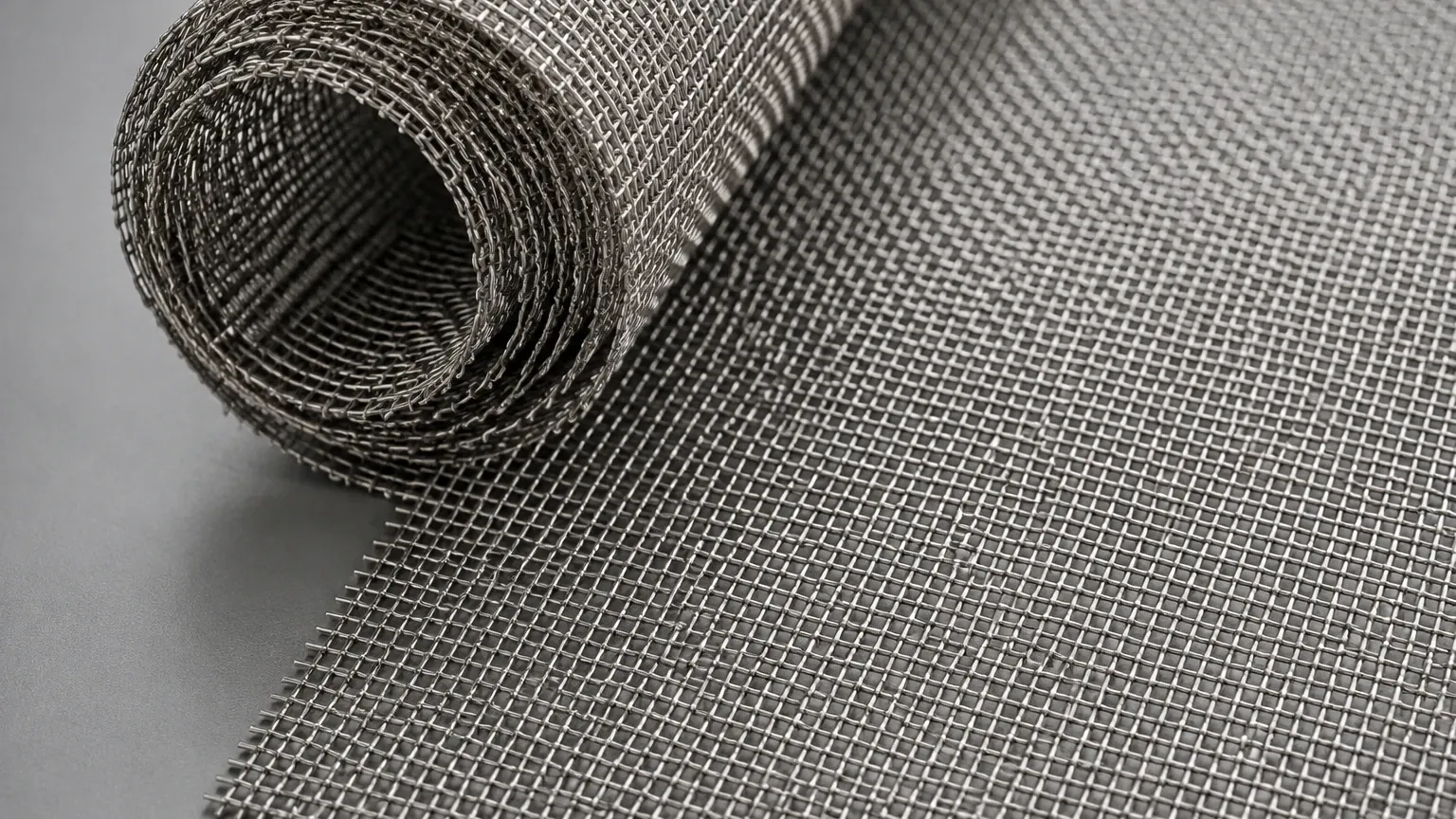
1. Plain Weave: Each warp wire (running lengthwise) passes alternately over and under each weft wire (running crosswise). This is the most stable and common weave for 120 mesh, providing uniform aperture sizes and consistent filtration performance.
2. Twill Weave: Each warp wire passes alternately over and under two weft wires. While less common for 120 mesh than for finer counts (like 325 or 400 mesh), twill weaving allows for the use of thicker wires relative to the mesh count, which can be beneficial in high-pressure applications where increased wire mass is required for durability.
Kaifil specializes in providing Plain, twill and dutch woven wire mesh in SS304/316L — rolls, cut mesh and framed panels. Send mesh count or micron target for a technical quote. to ensure that the weave architecture matches the specific mechanical stresses of the application.
Engineering Considerations for Industrial Applications
When integrating 120 mesh into an industrial system, engineers must evaluate several performance factors beyond simple particle size exclusion.
Pressure Drop and Flow Velocity
As fluid passes through the mesh, a pressure differential (Delta P) is created. For 120 mesh, this pressure drop is influenced by the fluid's viscosity and the velocity of the flow. In high-viscosity applications, such as polymer filtration or heavy oil processing, a 120 mesh screen may require a larger surface area (pleating) to keep the pressure drop within acceptable limits and prevent the mesh from deforming.
Blinding and Clogging
Blinding occurs when particles that are slightly larger than or equal to the aperture size become lodged in the mesh, reducing the effective filtration area. 120 mesh is particularly effective for "surface filtration," where particles are trapped on the upstream side. However, if the slurry contains needle-like or irregular particles, the risk of blinding increases. In such cases, automated backwashing systems or ultrasonic cleaning may be necessary to maintain flow.
Mechanical Loading and Support
On its own, a single layer of 120 mesh is relatively thin (approximately 0.16 mm to 0.18 mm total thickness). In high-pressure systems, it is often used as part of a multi-layer sintered structure or supported by a coarser "backup" mesh (such as 10 mesh or 20 mesh) to prevent the fine 120 mesh from bursting or stretching under load.
Common Industrial Applications
Stainless steel woven wire 120 mesh is utilized across a broad spectrum of industries due to its precise aperture and robust material properties.
* Chemical Processing: Used for the filtration of catalysts, the removal of impurities from liquid chemicals, and as a protective screen for pumps and valves.
* Pharmaceutical Manufacturing: 120 mesh is frequently employed in the production of Active Pharmaceutical Ingredients (APIs) to ensure particle size consistency and to filter out precipitates during solvent recovery.
* Food and Beverage: Utilized in sieving applications for powders, spices, and flours, as well as in the filtration of juices and oils where 316L stainless steel ensures compliance with hygiene standards.
* Hydraulic Systems: Acts as a fine strainer in hydraulic reservoirs to protect sensitive servo-valves and actuators from particulate contamination that could lead to system failure.
* Water Treatment: Used in pre-filtration stages for reverse osmosis (RO) systems or as a final screen in industrial wastewater discharge to meet environmental regulations regarding suspended solids.
Customization and OEM Capabilities
Industrial filtration often requires more than just raw mesh rolls. Customization is key to ensuring the filter fits the specific housing and operational requirements of the machinery. Kaifil provides comprehensive OEM services for stainless steel woven wire 120 mesh, including:
* Cut-to-Size Discs and Strips: Precision laser or die-cutting to exact tolerances for use in laboratory equipment or small-scale industrial filters.
* Framed Panels: Mesh tensioned and welded into stainless steel frames for use in vibrating screens or large-scale intake filters.
* Cylindrical and Pleated Cartridges: 120 mesh can be fabricated into multi-layer cartridges to increase the filtration surface area and extend the service life between cleanings.
* Sintered Mesh Laminates: Bonding 120 mesh with other layers of wire cloth to create a high-strength, porous metal plate that resists migration and deformation.
Maintenance and Total Cost of Ownership (TCO)
While the initial purchase price of stainless steel mesh is a factor, the total cost of ownership is determined by the mesh's durability and cleanability. Unlike disposable synthetic filters, stainless steel 120 mesh is a permanent component that can be cleaned and reused.
Cleaning Methods
* Ultrasonic Cleaning: The most effective method for 120 mesh, using high-frequency sound waves to dislodge fine particles from the apertures without damaging the wires.
* Backwashing: Reversing the flow of fluid to push contaminants off the surface of the mesh.
* Chemical Cleaning: Using mild acids or bases to dissolve organic or mineral scale, provided the chemical is compatible with the stainless steel grade (304 vs 316L).
Replacement Cycles
The replacement cycle for 120 mesh depends on the abrasiveness of the particles and the frequency of the cleaning cycles. In non-abrasive liquid applications, a well-supported 120 mesh screen can last for several years. However, in high-vibration sieving or abrasive slurry applications, regular inspection for wire thinning or "holing" is necessary to prevent bypass.
Conclusion
Stainless steel woven wire 120 mesh is a fundamental component in precision industrial filtration. By providing a 132-micron aperture with a high degree of mechanical and chemical stability, it bridges the gap between coarse straining and ultra-fine separation. When selecting 120 mesh, engineers must prioritize material grade, wire diameter, and the specific weave type to ensure the filter meets the rigorous demands of the application.
For organizations looking to optimize their filtration processes, partnering with a manufacturer that understands the technical complexities of wire cloth is essential. Kaifil provides the engineering expertise and manufacturing precision required to deliver high-performance filtration solutions tailored to specific industrial needs. Whether you require bulk rolls or custom-engineered filter components, selecting the right mesh starts with a clear understanding of your technical requirements and the performance boundaries of the material.
