


Does Home Depot Sell Expanded Metal
When engineers or procurement specialists begin sourcing materials for industrial projects, the search often starts with immediate availability. The question of whether a major retail chain like Home Depot sells expanded metal is common among those looking for quick prototypes or small-scale repairs. While Home Depot and similar big-box retailers do stock a limited selection of expanded metal, there is a significant distinction between retail-grade hardware and the high-precision Perforated & Expanded Metal required for industrial filtration and heavy-duty engineering applications.
Understanding the limitations of retail sourcing versus industrial manufacturing is critical for maintaining the structural integrity and filtration efficiency of professional systems. This article explores the availability of expanded metal in retail environments, the technical specifications required for industrial use, and why specialized manufacturing is often necessary for B2B applications.
Retail Availability and the Search for Metal Mesh
To answer the primary question: yes, Home Depot does sell expanded metal. However, their inventory is typically tailored toward the DIY market, home improvement, and light decorative use. In a standard retail environment, you will generally find small, pre-cut sheets, often in sizes like 12" x 24" or 24" x 36". These are frequently located in the hardware or metal shapes aisle.
The materials available at retail are usually limited to aluminum, plain steel, or galvanized steel. For a maintenance manager needing to patch a small vent or a hobbyist building a radiator cover, these options are sufficient. However, for a chemical processing plant or a pharmaceutical manufacturer, the retail selection fails to meet the stringent requirements for material grade, precise diamond dimensions, and corrosion resistance.
When asking does home depot sell expanded metal, it is important to realize that their products are rarely accompanied by the technical documentation—such as Material Test Reports (MTRs) or precise open-area calculations—that engineers require to ensure a component will withstand high-pressure filtration or corrosive chemical exposure.
Comparing Retail Sourcing with Industrial Manufacturing
For industrial applications, the difference between a retail product and a manufactured component lies in the specifications. Industrial filtration requires a level of precision that mass-market retail products cannot provide.
Material Grades and Chemical Compatibility
Retailers typically offer "weldable steel" or basic aluminum. In contrast, industrial manufacturers like Kaifil specialize in stainless steel alloys, such as 304, 316, and 316L. In sectors like food and beverage or hydraulic oil filtration, using the wrong grade of steel can lead to rapid oxidation, media migration, and system failure. Industrial-grade expanded metal is selected based on its ability to resist specific chemical environments and temperature fluctuations.
Dimensional Accuracy and Tolerances
Retail expanded metal is often produced with wider tolerances. In a filtration assembly, where expanded metal may serve as a support core for a pleated filter cartridge, even a millimeter of deviation in thickness or diamond size can compromise the fit and function of the unit. Industrial manufacturing ensures that the Short Way of Diamond (SWD) and Long Way of Diamond (LWD) are consistent across the entire sheet or roll, ensuring uniform flow distribution.
Customization and Scale
Perhaps the most significant limitation of retail sourcing is the lack of customization. Industrial projects often require specific sheet sizes, custom-rolled cylinders, or expanded metal with specific strand widths to achieve a targeted weight-to-strength ratio. A manufacturer can provide expanded metal in bulk coils or custom-cut shapes that integrate seamlessly into a production line, whereas retail sourcing is limited to what is physically on the shelf.
Technical Properties of Perforated & Expanded Metal
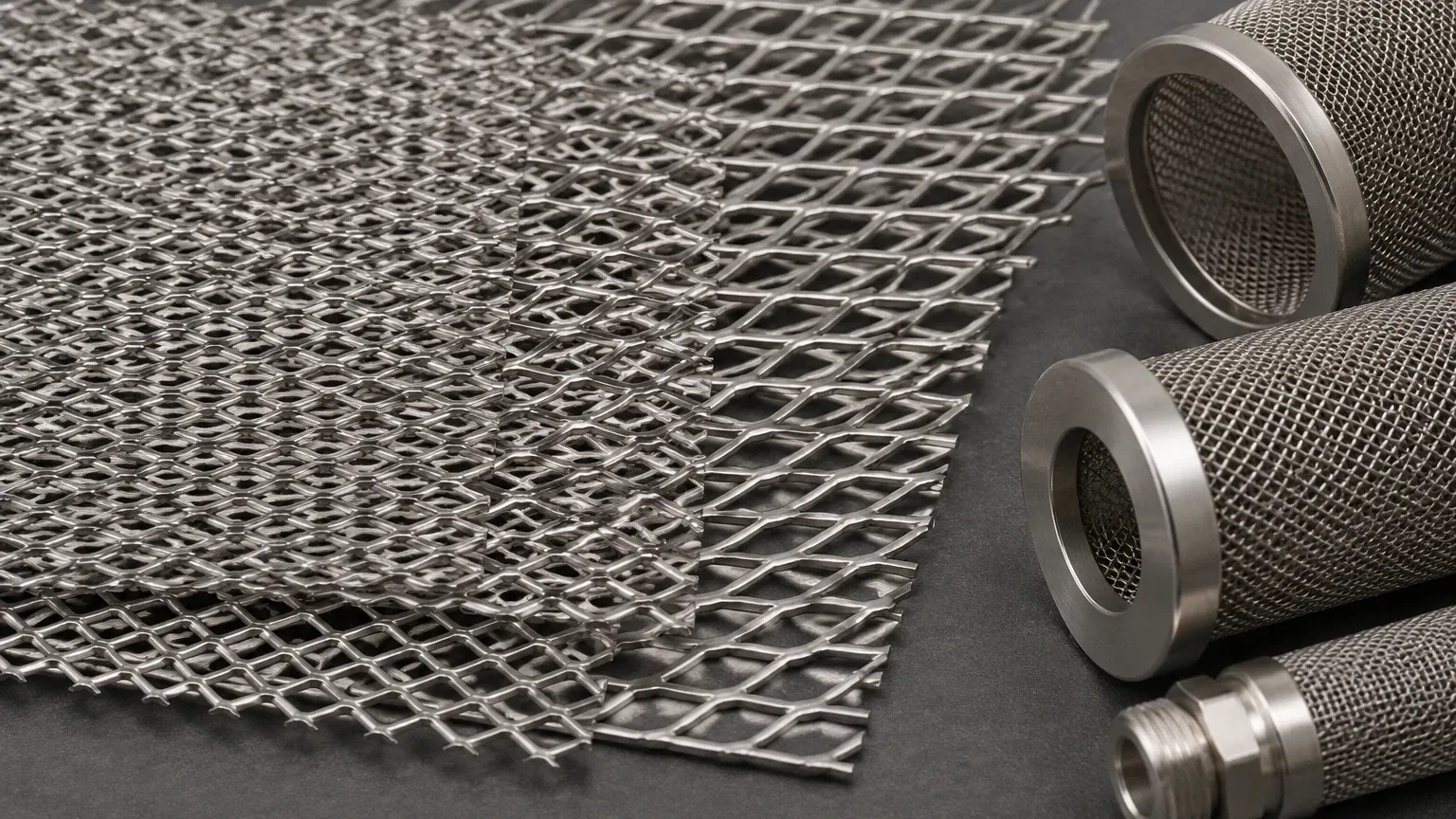
Expanded metal is created through a process of slitting and stretching a solid metal sheet. Unlike perforated metal, which is punched and results in material waste, expanded metal is produced without any scrap, making it a cost-effective and environmentally friendly option for structural support.
There are two primary forms used in industrial settings:
1. Standard (Raised) Expanded Metal: This version has strands that are turned at a sharp angle to the plane of the sheet. It provides maximum strength and a high-grip surface, often used in industrial walkways or as a primary filter stage to break up large debris.
2. Flattened Expanded Metal: After the expanding process, the sheet is passed through a cold-roll reducing mill. This flattens the strands and bonds, creating a smooth, flat surface. Flattened expanded metal is ideal for filtration applications where a smooth interface with filter media (such as wire mesh or synthetic fabric) is required to prevent abrasion.
When selecting Perforated & Expanded Metal, engineers must consider the "open area" percentage. This calculation determines the flow rate and pressure drop across the filter. Retail products rarely provide these calculations, forcing engineers to perform manual measurements that may not be accurate across the entire batch.
Role in Industrial Filtration Systems
In the context of B2B filtration solutions, expanded metal is rarely a standalone product; it is a critical structural component. Its primary roles include:
Support Cores for Filter Cartridges
High-pressure hydraulic systems or steam filtration processes put immense stress on the filter media. Expanded metal is rolled into cylinders and welded to serve as an internal support core. Its rigid structure prevents the filter media from collapsing under the force of the fluid flow. The diamond-shaped openings are specifically engineered to provide maximum support while minimizing resistance to the flow.
Protective Outer Cages
For filters used in harsh environments, an outer cage made of expanded metal protects the delicate inner mesh or pleated paper from mechanical damage during installation, cleaning, or operation. This is particularly important in mobile hydraulic equipment or large-scale water treatment facilities where debris might impact the filter housing.
Pre-Filtration and Strainers
In some heavy-duty applications, expanded metal acts as a coarse strainer, capturing large particulates before the fluid reaches the finer filtration stages. This extends the life of the primary filter elements and reduces the total cost of ownership by preventing premature clogging.
Engineering Considerations for Material Selection
When moving beyond the basic question of does home depot sell expanded metal, engineering teams must evaluate several technical factors to ensure the material is fit for purpose.
* Strand Width and Thickness: These dimensions dictate the mechanical strength of the mesh. In high-vibration environments, thicker strands are necessary to prevent fatigue cracking at the bonds.
* Long Way of Opening (LWO) vs. Short Way of Opening (SWO): The orientation of the diamonds affects how the material handles stress. Engineers must specify the direction of the diamonds relative to the flow or the structural load.
* Surface Finish: For pharmaceutical or food-grade applications, the expanded metal must be free of burrs and sharp edges. Industrial manufacturers use specialized deburring, pickling, or electropolishing processes to ensure the material meets sanitary standards—processes that are not applied to retail-grade hardware.
Customization Options and Engineering Support
One of the primary reasons B2B buyers choose a manufacturer like Kaifil over a retail outlet is the availability of engineering support. When a project requires a unique filtration solution, the manufacturer works closely with the client to determine the optimal material and configuration.
OEM (Original Equipment Manufacturer) services allow for the production of expanded metal components that are ready for immediate integration. This includes:
* Custom Slitting: Providing the exact width needed for automated filter assembly lines.
* Precision Welding: Joining expanded metal into seamless tubes or cones using TIG, MIG, or spot welding techniques.
* Material Certification: Providing full traceability for the alloys used, which is a mandatory requirement in many regulated industries.
By sourcing directly from a manufacturer, companies can ensure that every component of their filtration system—from the Perforated & Expanded Metal support to the fine wire mesh—is designed to work in harmony.
Cost-Benefit Analysis: Total Cost of Ownership
While the unit price of a small sheet of expanded metal at a retail store might seem low, the total cost of ownership for an industrial project can be significantly higher if retail materials are used.
Factors that increase the cost of retail sourcing for B2B applications include:
1. Labor Costs: Manually cutting and finishing retail sheets to fit industrial equipment is time-consuming and prone to error.
2. Replacement Frequency: Lower-grade materials (like galvanized steel) will fail much sooner than 316L stainless steel in a corrosive environment, leading to increased downtime and maintenance costs.
3. System Risk: If a retail-grade support core fails, it can release metal fragments into the downstream system, potentially damaging expensive pumps, valves, or sensitive equipment.
In contrast, investing in purpose-built industrial expanded metal ensures longevity, compliance with safety standards, and optimized system performance. For purchasing teams, the reliability of a consistent supply chain and the ability to order in bulk far outweigh the convenience of a local retail purchase.
Conclusion: Making the Right Procurement Choice
While the answer to does home depot sell expanded metal is affirmative, the utility of those products is strictly limited to non-critical, small-scale applications. For engineers and technical professionals tasked with designing or maintaining industrial filtration systems, the requirements for material purity, dimensional precision, and structural integrity necessitate a professional manufacturing partner.
By focusing on high-quality Perforated & Expanded Metal, industries can achieve the durability and performance required for demanding applications in chemical processing, water treatment, and beyond. When precision and reliability are the primary objectives, sourcing from a specialized manufacturer like Kaifil provides the technical expertise and customization options that retail stores simply cannot match.
