


Dimensions of Expanded Metal
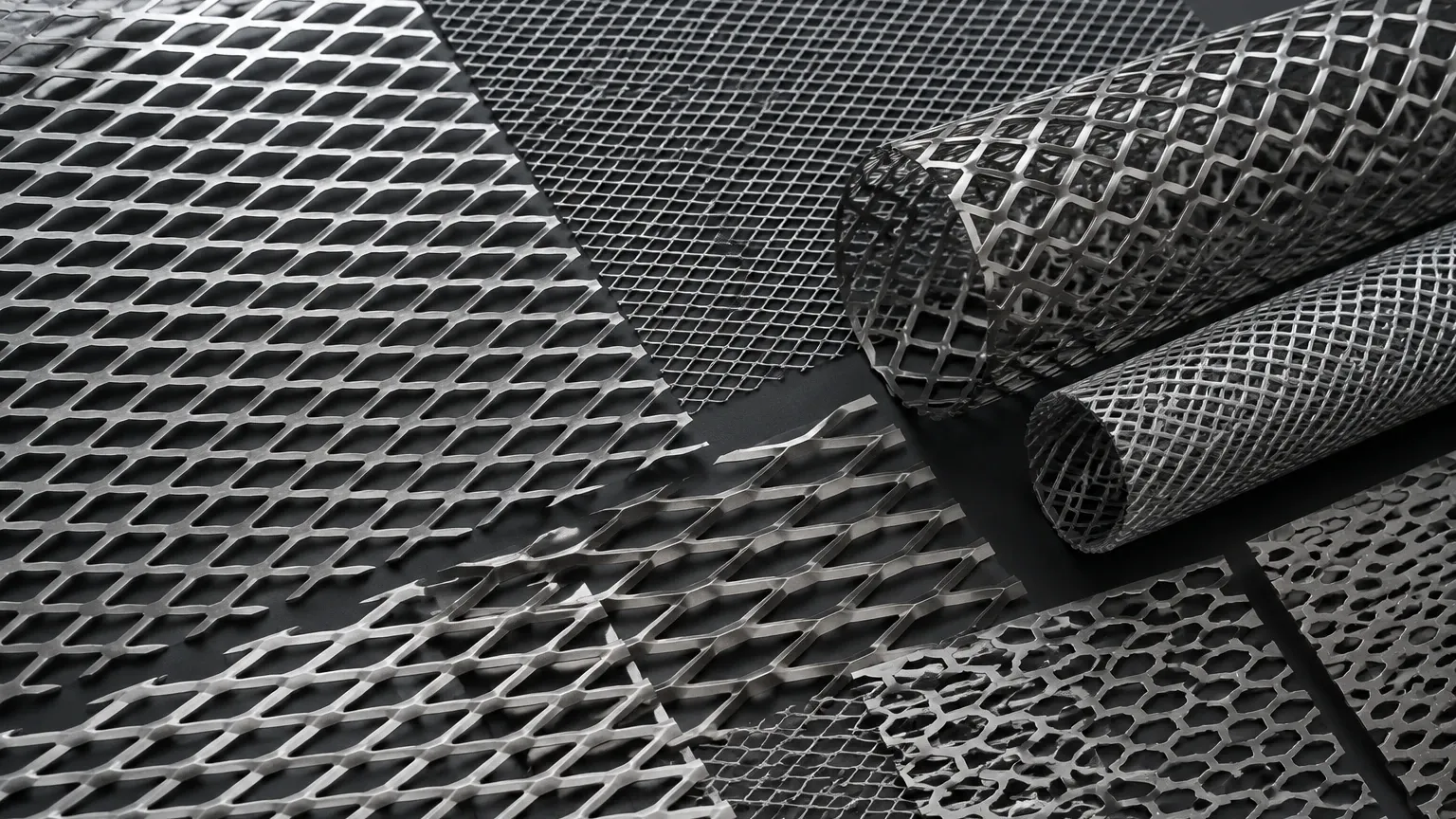
In industrial filtration and structural engineering, the selection of materials depends heavily on precise geometric specifications. Expanded metal is a versatile material produced by simultaneously slitting and stretching a solid sheet of metal, usually stainless steel, to create a diamond-shaped pattern. Unlike perforated metal, which involves punching out material, expanded metal is manufactured without waste, making it a cost-effective and structurally sound choice for various applications. Understanding the specific dimensions of expanded metal is critical for engineers and purchasing teams to ensure that the material meets the mechanical and filtration requirements of their specific industrial environment.
At Kaifil, we specialize in custom stainless steel filtration solutions where the geometry of the mesh directly influences flow rates, pressure drops, and particle retention. This guide provides a technical overview of the dimensional parameters that define expanded metal and how these factors impact performance in demanding sectors like chemical processing, water treatment, and food production.
Fundamentals of Expanded Metal Geometry
The geometry of expanded metal is defined by the diamond-shaped openings created during the expansion process. To specify these products accurately, engineers must understand the four primary measurements that dictate the mesh's appearance and function.
SWD and LWD (Short Way and Long Way of Diamond)
These are the most fundamental dimensions used to describe the size of the diamond pattern.
* SWD (Short Way of Diamond): This refers to the distance from the center of a bond to the center of the next bond across the short axis of the diamond. It is essentially the width of the diamond opening plus one bond.
* LWD (Long Way of Diamond): This is the distance from the center of a bond to the center of the next bond across the long axis of the diamond.
It is important to note that SWD and LWD are measured from center-to-center. When engineers are looking for the actual clear opening space, they must refer to the SWO (Short Way of Opening) and LWO (Long Way of Opening), which measure the internal space of the diamond without including the metal strands.
Strand Width and Strand Thickness
The "strands" are the individual metal strips that form the borders of the diamond openings.
* Strand Thickness: This is the thickness of the base material (the original metal sheet) before it undergoes the expansion process. In stainless steel filtration, this dimension is crucial for determining the overall durability and corrosion resistance of the component.
* Strand Width: This is the amount of metal fed into the expanding machine for each stroke. It represents the width of the metal strip that makes up the diamond's side.
By adjusting the strand width and the degree of stretching, manufacturers can create Perforated & Expanded Metal with varying levels of open area and structural rigidity.
Standard vs. Flattened: Dimensional Variations
Expanded metal is typically available in two forms: standard (raised) and flattened. The choice between these two significantly alters the dimensions of expanded metal and its behavior in industrial systems.
Standard (Raised) Expanded Metal
In its standard form, the strands and bonds are set at a uniform angle to the plane of the sheet. This creates a three-dimensional profile that offers high strength-to-weight ratios and excellent grip. From a dimensional perspective, "Standard" expanded metal has an Overall Thickness that is significantly greater than the original strand thickness. This 3D structure is often used in filtration to create turbulence or to act as a support layer for finer mesh media.
Flattened Expanded Metal
Flattened expanded metal is produced by passing standard expanded metal through a cold-roll reducing mill. This process flattens the strands and bonds into a single plane, resulting in a smooth, flat surface.
Dimensional changes during flattening include:
* Thickness: The overall thickness is reduced to approximately the original strand thickness.
* LWD: The long way of the diamond is usually slightly elongated during the rolling process.
* Surface Area: The material becomes thinner and wider, which can slightly alter the percentage of open area.
For precision filtration applications, flattened expanded metal is often preferred because it provides a consistent thickness that is easier to integrate into filter cartridges and housings.
Critical Dimensions of Expanded Metal for Engineering Specifications
When specifying dimensions of expanded metal for a custom project, several secondary factors must be considered to ensure the material performs as expected under load or fluid pressure.
The Bond
The bond is the intersection where two strands meet. The width of the bond is generally twice the strand width. The integrity of the bond is vital for the structural stability of the mesh. In high-pressure hydraulic or chemical applications, the bond must be robust enough to resist shearing or deformation.
Pitch and Percent Open Area
The pitch refers to the frequency of the diamond pattern over a specific distance. The relationship between the SWD, LWD, and strand width determines the Percent Open Area. This is perhaps the most critical dimension for filtration engineers, as it dictates the flow capacity and the rate at which a filter will clog.
A higher open area allows for higher flow rates and lower initial pressure drops but may reduce the structural strength of the sheet. Conversely, a smaller open area provides a more robust support structure but increases resistance to flow.
Sheet Size and Direction of Diamond
Standard sheet sizes are typically 4×8 feet or 4×10 feet, but custom dimensions are common in OEM manufacturing. When ordering, it is essential to specify the orientation of the diamonds.
* SWD Parallel to Length: The short way of the diamond runs parallel to the long edge of the sheet.
* LWD Parallel to Length: The long way of the diamond runs parallel to the long edge of the sheet.
Correct orientation is crucial for structural applications where the material's load-bearing capacity varies depending on the direction of the expansion.
Impact of Dimensions on Filtration Performance
In the context of industrial filtration, the dimensions of expanded metal serve two primary purposes: acting as the primary filtration media or providing a rigid support structure for thinner wire mesh or membranes.
Particle Retention and Pore Size
While expanded metal is not typically used for ultra-fine filtration (sub-micron levels), it is highly effective for coarse filtration and pre-filtration. The SWO and LWO dimensions define the maximum particle size that can pass through the mesh. Because the openings are diamond-shaped, they can often trap elongated particles more effectively than square mesh of a similar area.
Flow Dynamics and Pressure Drop
The angle of the strands in raised expanded metal can be used to manipulate fluid flow. In some chemical processing applications, this 3D geometry is used to promote mixing or to create a specific flow pattern across a filter bed. However, engineers must account for the increased pressure drop associated with the more complex path the fluid must take compared to a flat perforated sheet.
Structural Support in Filter Cartridges
In many stainless steel filter cartridges, expanded metal serves as the inner core or the outer protective wrap. Here, the strand thickness and bond strength are the most important dimensions. The material must withstand the differential pressure (ΔP) that builds up as the filter captures contaminants. If the dimensions are too light for the application, the filter may collapse or burst.
Material Considerations and Tolerances
The choice of material—most commonly Grade 304 or 316L stainless steel—affects how well the dimensions of expanded metal can be maintained during manufacturing and use.
* 304 Stainless Steel: Suitable for general industrial use, providing good strength and corrosion resistance.
* 316L Stainless Steel: Preferred for pharmaceutical, food and beverage, and marine environments due to its superior resistance to pitting and chloride corrosion.
Manufacturing Tolerances
Like all engineered products, expanded metal is subject to manufacturing tolerances. Standard industry tolerances for SWD and LWD are typically within +/- 5%, while strand width and thickness may vary slightly depending on the gauge of the material. For high-precision filtration components, Kaifil works within tighter tolerances to ensure that the finished product integrates perfectly with the customer’s existing equipment.
Specifying Dimensions for Custom Industrial Applications
To ensure the successful procurement of expanded metal components, engineers should follow a standardized specification process. When consulting with a manufacturer like Kaifil, providing the following data points will streamline the design phase:
1. Material Grade: (e.g., SS304, SS316L).
2. Style: Standard (Raised) or Flattened.
3. SWD and LWD: The desired diamond size.
4. Strand Width and Thickness: The required gauge and rib width.
5. Overall Thickness: Especially important for raised styles.
6. Sheet or Component Dimensions: The final length and width of the piece.
7. Diamond Orientation: Whether the LWD or SWD should run parallel to the length.
By confirming these dimensions, purchasing teams can avoid common risks such as material mismatch, insufficient flow capacity, or structural failure in the field.
Conclusion
The dimensions of expanded metal are more than just measurements; they are the engineering parameters that define the performance, durability, and efficiency of industrial filtration systems. Whether you require a robust support structure for a hydraulic filter or a precision-flattened mesh for chemical processing, understanding the relationship between SWD, LWD, strand geometry, and material thickness is essential.
Kaifil provides a comprehensive range of Perforated & Expanded Metal solutions tailored to the rigorous demands of global industries. By combining advanced manufacturing capabilities with deep technical expertise, we help engineers select the optimal dimensions to achieve reliable and cost-effective filtration performance.
