


Flat vs Raised Expanded Metal
In industrial manufacturing and engineering, selecting the correct material for structural support, filtration, or safety surfaces requires a deep understanding of mechanical properties and production processes. Expanded metal is a versatile material created by slitting and stretching a metal sheet simultaneously, resulting in a diamond-shaped pattern of openings. Depending on the final processing step, this material is categorized as either raised or flat.
Choosing between flat vs raised expanded metal is not merely an aesthetic decision; it impacts structural integrity, flow dynamics, surface friction, and the overall performance of industrial components. For engineers and procurement teams sourcing Perforated & Expanded Metal, understanding these technical nuances is essential to optimizing the lifespan and efficiency of the final application.
The Fundamentals of Expanded Metal Production
To appreciate the differences between flat and raised variants, one must first understand the manufacturing process. Expanded metal is produced from a single sheet of metal—most commonly stainless steel, carbon steel, or aluminum. The sheet is fed through a machine equipped with a knife that slits the metal while a simultaneous stretching action occurs.
Because the metal is stretched rather than punched (as seen in perforated metal), there is zero waste in the production process. This makes it a highly cost-effective solution for industrial applications. The resulting product features "strands" and "bonds" that are set at a uniform angle to the plane of the original sheet. This "as-manufactured" state is known as raised expanded metal.
Characteristics of Raised Expanded Metal
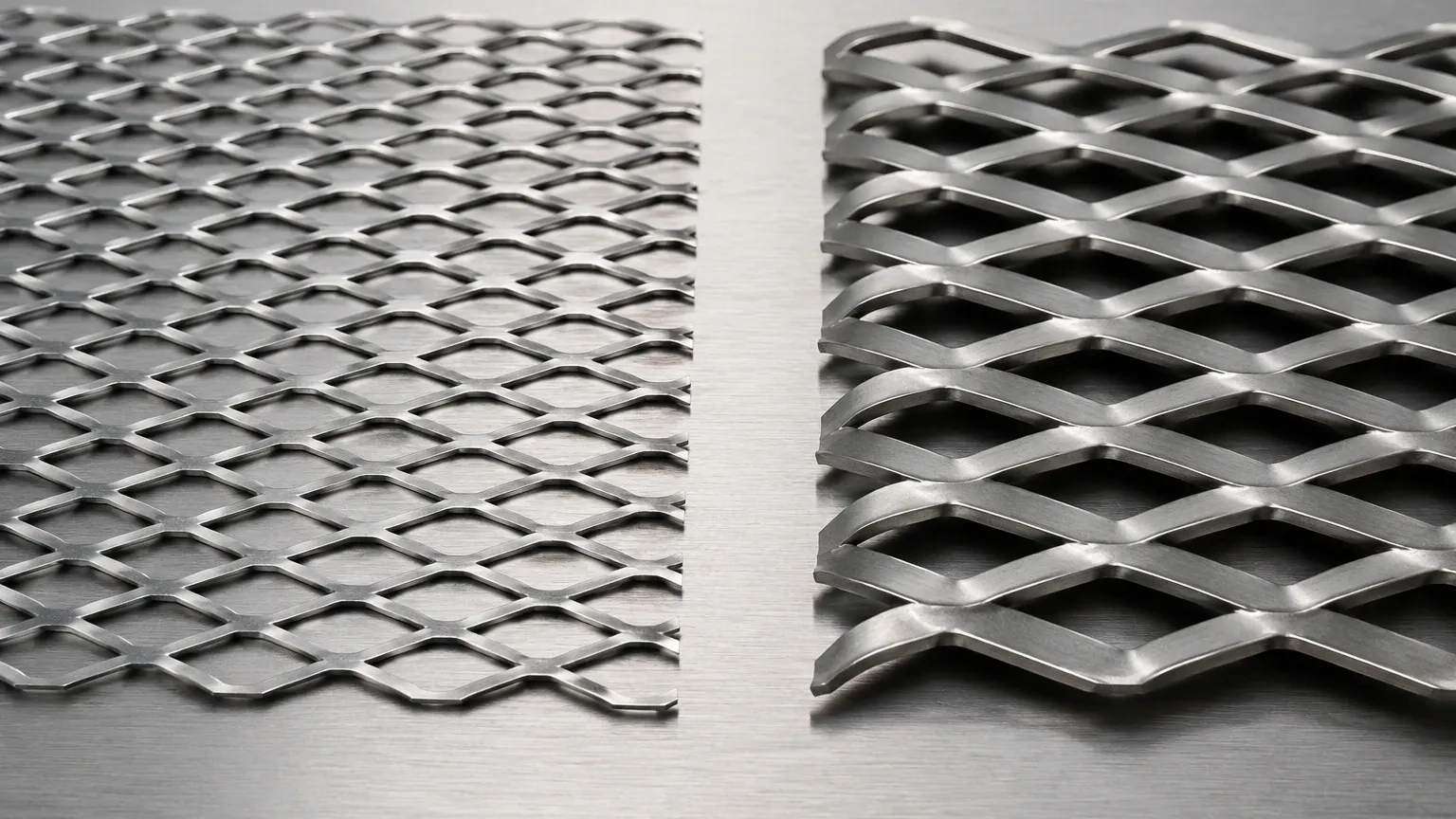
Raised expanded metal, often referred to as "standard" expanded metal, retains the original angular orientation of the strands. When you run your hand across the surface of a raised sheet, you will feel a distinct texture where the bonds and strands protrude from the flat plane of the material.
Structural Rigidity and Strength
Raised expanded metal offers an exceptional strength-to-weight ratio. The angular strands act like structural trusses, providing high rigidity and resistance to deflection. This makes it ideal for heavy-duty applications where the material must support significant weight or resist impact without deforming.
Traction and Safety
The protruding edges of raised expanded metal provide natural slip resistance. In industrial environments where oil, water, or grease may be present, raised expanded metal is frequently used for walkways, ramps, and stair treads to ensure operator safety. The open diamond pattern also allows for the drainage of liquids and the passage of debris, preventing accumulation on the walking surface.
Airflow and Dispersion
In HVAC or protective guarding applications, the angular nature of the strands can be used to deflect or direct airflow. While it provides excellent ventilation, the raised profile also creates a more significant physical barrier against large particles compared to a flat surface of the same open area.
The Cold-Rolling Process for Flat Expanded Metal
Flat expanded metal begins its life as raised expanded metal. To achieve a smooth, planar surface, the raised sheet is passed through a cold-rolling reducing mill. This secondary process flattens the strands and bonds back into the original plane of the sheet.
Dimensional Changes
During the flattening process, the overall thickness of the material is reduced, and the length of the sheet is slightly increased (typically by about 5% to 10%). While the width remains constant, the diamond openings may become slightly elongated. It is important for engineers to account for these dimensional shifts when specifying tolerances for custom filtration components or machine guards.
Surface Smoothness
The primary advantage of flat expanded metal is its smooth, uniform surface. Because the strands are no longer angled, the material is safe to handle without the risk of snagging or cutting. This is particularly important in applications involving delicate materials, such as filter media, or in environments where personnel frequently come into contact with the metal surface.
Technical Comparison: Flat vs Raised Expanded Metal
When evaluating flat vs raised expanded metal for a specific project, several technical factors must be weighed against the application requirements.
| Feature | Raised Expanded Metal | Flat Expanded Metal |
| :— | :— | :— |
| Surface Texture | Rough, angular, high-grip | Smooth, planar, snag-free |
| Thickness | Thicker than original base metal | Approximately same as base metal |
| Rigidity | Very high (truss-like structure) | Lower (more flexible) |
| Weight | Same as flat (per sq. ft.) | Same as raised (per sq. ft.) |
| Safety | Slip-resistant; sharp edges | Safe for skin contact; no snags |
| Flow Resistance | Higher turbulence | Lower turbulence; laminar flow |
Impact on Structural Integrity
Raised expanded metal is inherently stiffer. If your application requires a self-supporting panel over a long span, raised metal is usually the superior choice. Flattened metal, while still strong, loses some of the directional rigidity provided by the angled strands. In filtration systems, if the expanded metal is used as an outer guard for a high-pressure cartridge, raised metal may offer better resistance against collapsing pressures.
Flow Dynamics and Turbulence
For engineers designing fluid or gas filtration systems, the choice between flat and raised metal significantly affects pressure drop. Raised metal creates more turbulence as fluid passes through the angled openings. While this can be beneficial for mixing applications, it may lead to higher energy consumption in high-velocity systems. Flat expanded metal allows for a more streamlined flow, which is often preferred in precision filtration housings to maintain consistent flow rates.
Performance in Filtration and Industrial Support
In the realm of industrial filtration, Perforated & Expanded Metal serves as a critical support structure for finer filter media, such as wire mesh or synthetic membranes. The choice between flat and raised profiles depends on the specific design of the filter cartridge.
Filter Media Protection
Flat expanded metal is the industry standard for supporting delicate pleated filter media. Because the surface is smooth, it does not abrade or puncture the filter paper or mesh during the pleating process or under the stress of pulse-jet cleaning. Using raised metal against soft media can lead to premature failure due to mechanical wear at the contact points.
Outer Guards and Cages
Raised expanded metal is often used as the outermost protective layer of a filter assembly. Its rigidity protects the internal components from mechanical damage during installation or maintenance. Furthermore, the textured surface can provide a better grip for technicians handling large industrial filter elements in wet or oily conditions.
Pre-Filtration and Debris Removal
In water treatment or chemical processing, raised expanded metal can act as a coarse pre-filter. The angled strands are effective at catching larger debris while allowing the fluid to pass through. The choice of material—often 304 or 316L stainless steel—ensures that the expanded metal can withstand corrosive environments without degrading.
Selection Criteria for Engineering and Procurement
When specifying expanded metal for a B2B project, engineers should confirm the following parameters to ensure the material meets the performance expectations:
1. Material Grade: Stainless steel (304, 316, 316L) is preferred for filtration and chemical applications due to its corrosion resistance. Carbon steel may be used for dry, non-corrosive structural applications where cost is a primary driver.
2. LWD and SWD: The Long Way of the Diamond (LWD) and Short Way of the Diamond (SWD) define the size of the openings. These dimensions are critical for determining the open area and filtration accuracy.
3. Strand Width and Thickness: These dimensions dictate the strength and weight of the material. In flattened metal, the thickness will be slightly less than the original gauge of the base metal.
4. Open Area Percentage: This is vital for calculating flow rates and pressure drops. Raised metal may have a different "effective" open area compared to flat metal when considering the angle of approach of the fluid.
5. Total Cost of Ownership: While raised metal is generally less expensive to produce (as it skips the flattening stage), flat metal may reduce long-term costs by preventing damage to expensive internal filter media or reducing maintenance requirements in high-contact areas.
Common Risks and Engineering Pitfalls
A common mistake in procurement is failing to specify whether the material should be "flattened" or "standard." This can lead to significant issues during assembly. For instance, if a technician attempts to weld a raised expanded metal sheet into a tight-tolerance frame designed for a flat sheet, the thickness discrepancy may prevent a proper fit.
Another risk involves the direction of the diamond. Expanded metal has different mechanical properties depending on whether the load is applied parallel to the LWD or the SWD. Engineers must ensure the orientation of the diamonds aligns with the primary stress vectors of the application to prevent sagging or failure.
Customization and OEM Capabilities
For complex industrial applications, off-the-shelf expanded metal may not suffice. Customization options allow engineers to tailor the material to specific needs. This includes:
* Custom Opening Sizes: Precision-engineered diamond sizes to match specific filtration requirements or aesthetic goals.
* Varying Material Gauges: Balancing weight and strength by selecting specific base metal thicknesses.
* Surface Treatments: Beyond flattening, expanded metal can be passivated, electropolished, or coated to enhance corrosion resistance and hygiene, which is critical in food and beverage or pharmaceutical processing.
* Edge Treatments: Providing expanded metal with solid borders or custom-cut shapes to simplify the integration into larger assemblies.
Conclusion
The decision between flat vs raised expanded metal depends entirely on the functional requirements of the application. Raised expanded metal offers superior grip, rigidity, and a cost-effective production cycle, making it the go-to for structural and safety applications. Flat expanded metal, with its smooth surface and reduced thickness, is the essential choice for filtration support and any application where surface contact and flow efficiency are paramount.
By carefully evaluating the mechanical stresses, flow requirements, and environmental conditions of a project, engineering and purchasing teams can select the optimal Perforated & Expanded Metal solution. Whether the goal is to protect a delicate filter membrane or provide a safe walkway for industrial operators, understanding the technical distinctions between these two forms of expanded metal ensures a reliable, high-performance outcome.
