


Perforated Metal Jali
In industrial engineering and manufacturing, the term "jali"—traditionally referring to a latticed screen or perforated pattern—has evolved into a critical technical component. Modern industrial perforated metal jali serves as a foundational element in filtration, separation, and structural protection. Unlike decorative screens, industrial-grade perforated components are engineered for precise aperture control, structural integrity, and resistance to harsh environmental conditions. For engineers and procurement teams, selecting the right Perforated & Expanded Metal requires a deep understanding of material properties, manufacturing tolerances, and the fluid dynamics associated with various hole patterns.
Kaifil specializes in the production of high-performance perforated metal solutions, often utilized as support structures for fine wire mesh or as standalone filtration media. This guide explores the technical nuances of perforated metal jali, focusing on the engineering criteria necessary for industrial applications.
Understanding Perforated Metal Jali in Industrial Environments
Industrial perforated metal jali is produced by mechanically punching or laser-cutting sheets of metal to create a specific pattern of holes, slots, or decorative shapes. In B2B sectors such as chemical processing, pharmaceuticals, and food production, these components are rarely chosen for aesthetics. Instead, they are selected based on their "open area"—the percentage of the sheet that is comprised of holes—which dictates flow rates, pressure drops, and particle retention.
The term "perforated metal jali" is frequently used in international markets to describe screens used for ventilation, machinery guards, and filtration housings. Whether the application involves protecting a high-speed turbine from debris or supporting a multi-stage stainless steel filter cartridge, the precision of the perforation determines the efficiency and safety of the entire system.
Manufacturing Methods: Perforation vs. Expansion
When sourcing metal screens, engineers must distinguish between perforated and expanded metal, as each offers distinct mechanical advantages.
Perforated Metal
Perforated sheets are created using high-speed CNC punching presses. This process allows for extreme precision in hole placement and size. It is the preferred method when a specific open area percentage is required to meet hydraulic or pneumatic flow calculations. Perforation allows for "margins" (solid areas around the edges of the sheet), which are essential for welding the jali into filter housings or frames without compromising the structural integrity of the mesh.
Expanded Metal
Expanded metal is produced by simultaneously slitting and stretching the material. This process creates a diamond-shaped pattern without any material waste, making it a cost-effective alternative for heavy-duty guards and walkways. However, because the metal is stretched, the resulting "jali" has a three-dimensional profile. While this provides excellent grip and strength-to-weight ratios, it may not be suitable for high-precision filtration where a flat surface is required for laminating layers of fine wire mesh.
Material Selection and Engineering Considerations
The performance of perforated metal jali is heavily dependent on the substrate material. In industrial filtration, stainless steel is the industry standard due to its mechanical strength and chemical resistance.
1. Stainless Steel 304: The most common grade, providing excellent corrosion resistance for standard industrial environments, including water treatment and general machinery protection.
2. Stainless Steel 316L: Containing molybdenum, this grade is essential for marine environments, chemical processing plants, and pharmaceutical applications where resistance to pitting and chloride-induced corrosion is critical.
3. Specialty Alloys: For high-temperature or highly acidic environments, materials such as Monel, Inconel, or Hastelloy may be used to manufacture perforated components.
Beyond material chemistry, engineers must consider the mechanical stress the jali will endure. The "ligament"—the solid metal between the holes—must be wide enough to prevent the sheet from deforming under pressure, yet narrow enough to maintain the required flow rate.
Technical Specifications and Performance Metrics
To ensure a perforated metal jali meets the requirements of a specific application, several technical parameters must be defined during the design phase:
Hole Patterns and Pitch
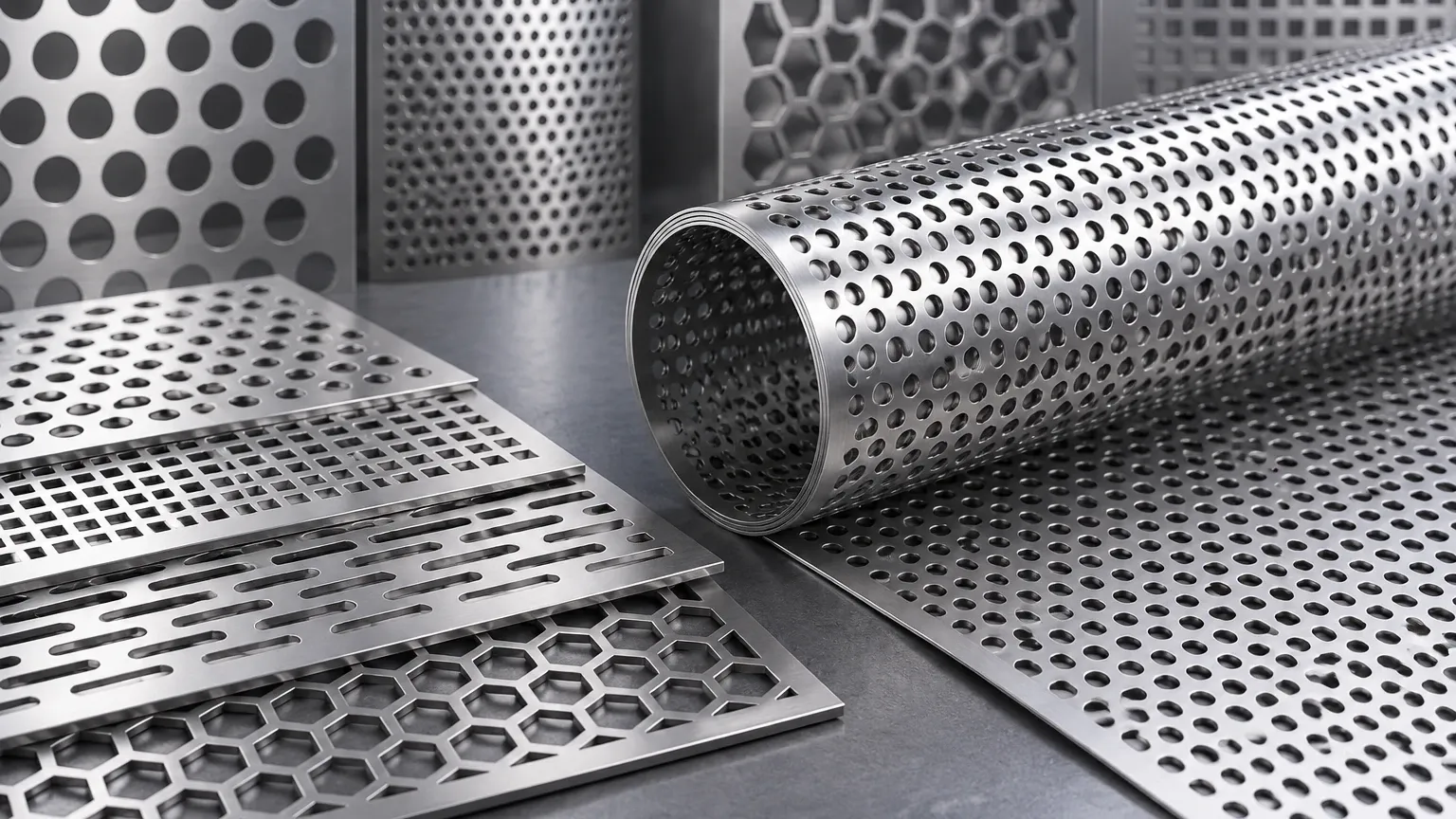
* Round Holes: The most efficient for filtration and airflow. They can be arranged in a 60-degree staggered pattern, which maximizes open area and structural strength.
* Square Holes: Often used for high visibility or specific aesthetic requirements in ventilation, though they offer less structural rigidity than round holes.
* Slotted Holes: Ideal for sorting and sifting applications where elongated particles must be oriented in a specific direction.
Open Area Calculation
The open area percentage is perhaps the most critical metric for engineers. It is calculated based on the hole diameter and the pitch (the distance from the center of one hole to the center of the next). A higher open area reduces pressure drop but decreases the physical strength of the screen. Finding the equilibrium between flow efficiency and structural durability is the core of effective filter design.
Tolerances and Flatness
In high-speed assembly lines or precision filtration housings, even a minor warp in the metal sheet can lead to bypass or mechanical failure. Kaifil utilizes advanced leveling equipment to ensure that every perforated metal jali remains within strict flatness tolerances, facilitating seamless integration into larger assemblies.
Applications Across Key Industrial Sectors
Perforated metal jali is a versatile component found in nearly every heavy industry. Its role varies from simple protective barriers to complex internal components in chemical reactors.
Chemical and Petrochemical Processing
In these environments, perforated metal serves as a support medium for catalyst beds and as internal components for distillation columns. The jali must withstand corrosive fluids and high thermal loads while maintaining its geometric accuracy.
Food and Beverage Production
Perforated screens are used in grain drying, fruit juice straining, and brewery lautering. In these applications, the metal must be "food-grade," meaning it is free of burrs and pits where bacteria could accumulate. Smooth, electropolished stainless steel jali is often required to meet strict hygiene standards.
Pharmaceuticals and Biotechnology
Precision is paramount in pharmaceutical cleanrooms and fluid bed dryers. Perforated metal jali is used to control airflow and as a pre-filter for sensitive HEPA systems. The ability to manufacture these screens with exact hole diameters ensures consistent processing results.
Hydraulic and Industrial Equipment
In hydraulic systems, perforated metal cylinders act as suction strainers, preventing large contaminants from entering pumps. These components must be able to withstand high collapse pressures, necessitating thick-gauge materials and robust longitudinal welds.
Evaluating Quality and Avoiding Common Risks
When procuring perforated metal jali, several common manufacturing defects can compromise the final product. Purchasing teams should evaluate suppliers based on their ability to mitigate these risks:
* Burrs and Sharp Edges: Poorly maintained punching tools leave burrs that can snag fibers, trap contaminants, or injure personnel. High-quality jali undergoes deburring processes to ensure a smooth finish.
* Inconsistent Hole Spacing: Inaccurate CNC programming leads to "blind spots" or uneven flow, which can cause localized pressure spikes in a filtration system.
* Material Fatigue: If the perforation process is too aggressive or the ligaments are too thin, the metal may develop micro-cracks, leading to premature failure under vibration or thermal cycling.
Customization and Procurement Checklist
Because every industrial application has unique flow and structural requirements, off-the-shelf perforated sheets are often insufficient. Customization is the standard for B2B procurement. Before contacting a manufacturer, engineers should have the following data points ready:
1. Material Grade: (e.g., SS316L, SS304).
2. Sheet Thickness: Typically measured in millimeters or gauge.
3. Hole Shape and Size: (e.g., 2mm round holes).
4. Pitch and Pattern: (e.g., 3.5mm staggered pitch).
5. Required Open Area: (e.g., 40%).
6. Dimensions and Margins: Specific length, width, and unperforated border requirements.
7. Post-Processing: Requirements for rolling, welding, coating, or electropolishing.
Kaifil’s expertise in Perforated & Expanded Metal allows for the development of bespoke filtration components that meet these exact specifications. By working closely with a manufacturer that understands both the metallurgy and the application physics, industrial buyers can ensure their perforated metal jali provides long-term reliability and optimal performance.
Conclusion
Perforated metal jali is far more than a simple screen; it is an engineered component vital to the efficiency of modern industrial processes. From providing the structural backbone of high-pressure filter cartridges to ensuring the safety of workers through robust machinery guards, its impact is felt across the global supply chain. By focusing on technical specifications such as open area, material grade, and manufacturing precision, engineers can select filtration and protection solutions that minimize downtime and maximize operational life. For those seeking reliable, high-performance metal components, understanding the intersection of traditional jali design and modern perforation technology is the first step toward optimized industrial performance.
