


Expanded Metal Jakarta
In the rapidly evolving industrial landscape of Southeast Asia, particularly within the manufacturing hubs surrounding Indonesia's capital, the demand for high-performance materials has never been greater. For engineers and procurement specialists sourcing expanded metal Jakarta, understanding the technical nuances of this material is essential for ensuring the longevity and efficiency of industrial systems. Expanded metal is a versatile component used across diverse sectors, including chemical processing, water treatment, and heavy manufacturing, where it serves as both a structural element and a critical part of filtration assemblies.
Unlike traditional perforated sheets, expanded metal is produced through a simultaneous slitting and stretching process. This method creates a diamond-shaped pattern that is integral to the sheet, providing exceptional strength-to-weight ratios and maintaining structural integrity even when cut. For industrial applications in Jakarta’s humid and often corrosive environments, selecting the correct grade and specification of Perforated & Expanded Metal is a decision that impacts both initial capital expenditure and long-term maintenance costs.
Engineering Fundamentals of Expanded Metal
The production of expanded metal is a precision engineering process that differentiates it from other metal mesh products. A solid sheet of metal—typically stainless steel, carbon steel, or aluminum—is fed through an expanding machine. The machine’s knives slit the metal at regular intervals while simultaneously stretching it. This results in a continuous piece of mesh without any joins or welds.
From a technical perspective, this process offers several advantages:
1. Material Efficiency: There is zero waste in the production of expanded metal. Every ounce of the original sheet is utilized in the final product, making it a cost-effective alternative to perforated metal, where the "slugs" or punched-out circles are discarded.
2. Structural Strength: Because the mesh is formed from a single piece of metal, there are no weak points at the intersections. The "strands" and "bonds" (where the strands meet) are angled to provide inherent rigidity, allowing the material to support significant loads relative to its weight.
3. Versatility in Pattern: By adjusting the machine settings, manufacturers can produce a wide variety of diamond sizes and strand widths, tailoring the open area percentage to meet specific filtration or airflow requirements.
Comparing Perforated and Expanded Metal for Industrial Use
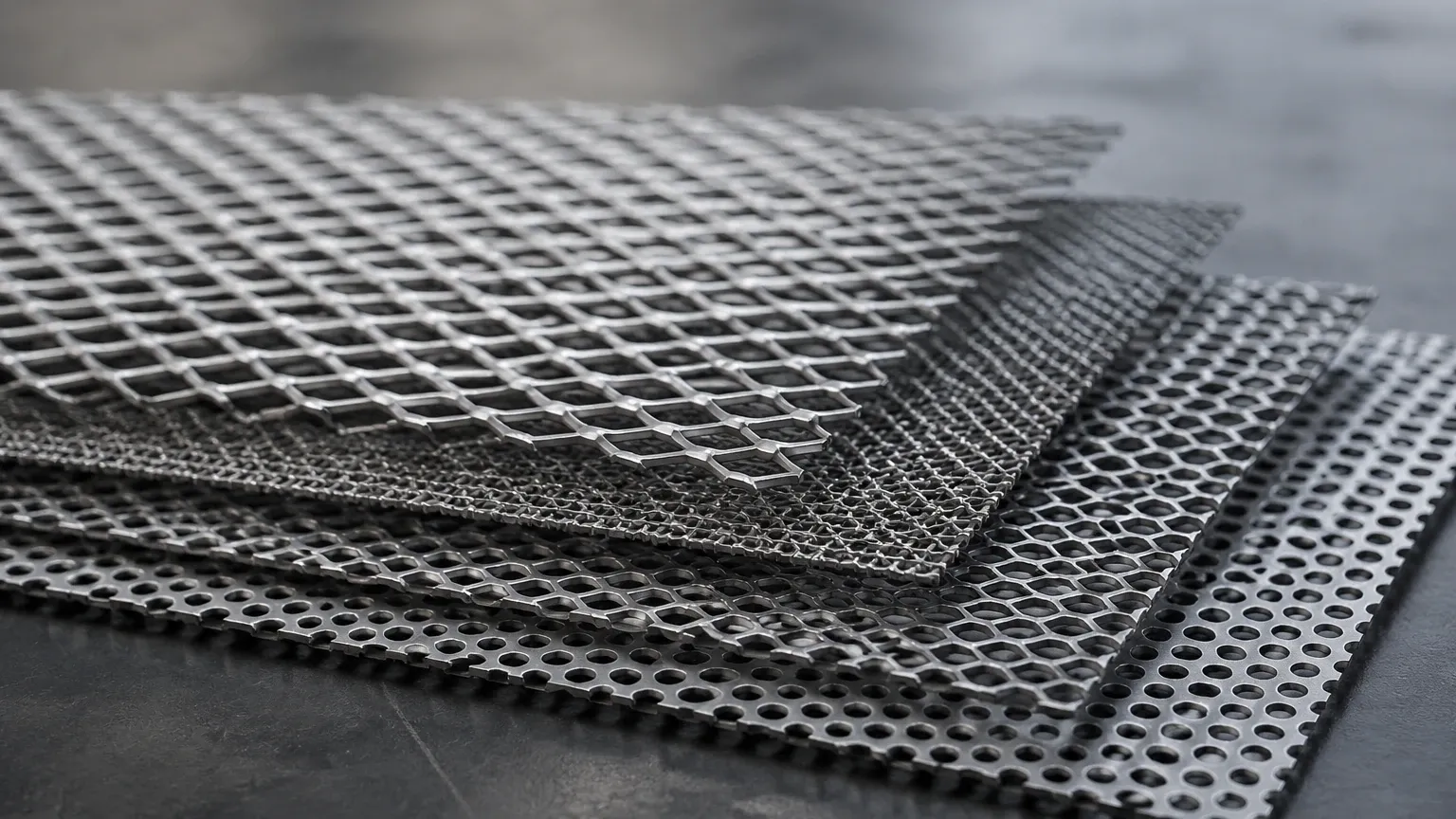
When evaluating materials for industrial projects, engineers often weigh the benefits of perforated sheets against expanded metal. While both fall under the category of Perforated & Expanded Metal, their performance characteristics differ significantly.
Perforated metal is characterized by precise hole shapes—round, square, or slotted—punched into a sheet. This allows for very specific filtration accuracy and a flat surface profile. However, the punching process can introduce internal stresses and results in higher material costs due to waste.
Expanded metal, conversely, offers a three-dimensional profile in its "raised" or "standard" form. This profile is particularly useful for applications requiring high surface area for heat dissipation or as a high-friction surface for industrial walkways. In filtration, the angled strands can act as a pre-filter, capturing larger debris before it reaches finer mesh layers. For applications where a smooth surface is required, the material can be "flattened" through a cold-rolling process, though this slightly reduces its structural rigidity.
Material Selection for the Jakarta Industrial Sector
Sourcing expanded metal Jakarta requires a deep understanding of the local environmental and industrial conditions. Jakarta’s industrial zones, such as Cikarang and Karawang, often host facilities involved in chemical processing, food production, and wastewater treatment. These environments present specific challenges:
Corrosion Resistance
Given the high humidity and potential exposure to saline air in coastal regions, stainless steel is often the preferred material. Grade 304 stainless steel offers excellent resistance for general industrial use, while Grade 316 is recommended for more aggressive chemical environments or pharmaceutical applications due to the addition of molybdenum, which enhances resistance to pitting and crevice corrosion.
Temperature Stability
In high-heat applications, such as industrial ovens or chemical reactors, the expansion and contraction of materials must be managed. Stainless steel expanded metal maintains its mechanical properties at higher temperatures better than carbon steel or aluminum, ensuring that the filtration or support structure does not warp or fail under thermal stress.
Hygiene and Compliance
For the food and beverage industry, which is a major sector in the Jakarta metropolitan area, material purity is paramount. Expanded metal used in these applications must be easy to clean and free of burrs or sharp edges that could trap contaminants. High-quality stainless steel provides the necessary surface finish to meet stringent hygiene standards.
Technical Specifications: SWD, LWD, and Open Area
To accurately specify expanded metal for a project, engineers must use standardized terminology. The geometry of the diamond opening is defined by two primary measurements:
* SWD (Short Way of Design): The distance from the center of one bond to the center of the next bond measured across the short diamond diagonal.
* LWD (Long Way of Design): The distance from the center of one bond to the center of the next bond measured across the long diamond diagonal.
* Strand Width: The amount of metal fed into the machine between the slits.
* Strand Thickness: The thickness of the original base metal sheet.
Calculating the Open Area is critical for filtration and ventilation applications. The open area determines the flow rate and pressure drop across the material. A higher open area allows for greater throughput but may reduce the structural strength of the sheet. Professional manufacturers provide detailed load tables and flow data to help engineers select the optimal balance for their specific application.
Applications in Filtration and Support Structures
In the context of industrial filtration, expanded metal serves several vital roles. It is rarely used alone for fine filtration but is an indispensable component of multi-layer filter cartridges and systems.
Filter Support Cores
In high-pressure hydraulic or chemical filtration, fine wire mesh or synthetic filter media lack the structural strength to withstand the differential pressure. Expanded metal is rolled into cylinders to form the inner or outer support core of a filter cartridge. Its rigidity prevents the media from collapsing or bursting, ensuring consistent performance throughout the filter's service life.
Pre-filtration and Coarse Screening
For water treatment plants in Jakarta, expanded metal screens are used as a first line of defense. They remove large debris, such as leaves, plastic, and stones, from raw water intakes. The 3D structure of raised expanded metal can be particularly effective here, as it provides more surface area to capture solids without immediately clogging.
Diffusers and Protective Guards
In air filtration and HVAC systems, Perforated & Expanded Metal acts as a diffuser, evening out the airflow before it hits the primary filter media. It also serves as a protective guard for delicate components, preventing mechanical damage while allowing for maximum airflow.
Sourcing Expanded Metal Jakarta: Quality Indicators
When procurement teams look for expanded metal Jakarta, the focus should extend beyond price to include quality assurance and customization capabilities. A reliable supplier should provide:
1. Material Certification: Mill test reports (MTRs) are essential to verify the chemical composition and mechanical properties of the steel, ensuring it meets ASTM or ISO standards.
2. Dimensional Precision: Industrial applications require tight tolerances. Variations in SWD or LWD can lead to fitment issues in filter housings or structural frames.
3. Customization (OEM Services): Many industrial projects require non-standard diamond sizes or specific sheet dimensions to minimize on-site cutting and waste. Working with a manufacturer that offers OEM customization allows for the development of bespoke filtration components tailored to unique machinery.
4. Edge Treatment: For safety and ease of installation, expanded metal can be supplied with "random sheared" edges or "bond sheared" edges. Bond shearing provides a closed-diamond edge that is safer to handle and easier to weld into frames.
Maintenance and Longevity in Demanding Environments
The total cost of ownership for expanded metal components is heavily influenced by maintenance requirements. In Jakarta’s industrial sectors, regular inspection is necessary to identify signs of fouling or corrosion.
Stainless steel expanded metal is relatively low-maintenance, but it still requires periodic cleaning, especially in filtration applications. Ultrasonic cleaning or high-pressure backwashing can be used to remove accumulated particulates from the mesh. Because expanded metal is a single-piece construction, it is more resistant to the mechanical stresses of high-pressure cleaning than woven wire mesh, which can suffer from wire displacement.
If the material is used in a structural capacity, such as a walkway or protective cage, checking for mechanical damage or signs of stress at the attachment points is crucial. Properly specified and installed stainless steel expanded metal can last for decades, even in the challenging climate of Indonesia.
Conclusion
Selecting the right expanded metal for industrial applications in Jakarta involves more than just choosing a pattern. It requires a comprehensive evaluation of material science, structural engineering, and environmental factors. Whether used as a robust support core for high-pressure filters or as a durable screen for water treatment, Perforated & Expanded Metal provides the reliability that modern industry demands.
By partnering with manufacturers who prioritize technical accuracy and offer extensive customization options, engineers in Jakarta can ensure their systems operate at peak efficiency. As the region continues to expand its industrial capacity, the role of high-quality metal filtration and structural components will only become more significant in maintaining the infrastructure and production standards of the future.
