


Perforated Metal Kitchen
In the realm of commercial food processing and industrial kitchen equipment manufacturing, the selection of materials is a critical engineering decision that impacts hygiene, durability, and operational efficiency. Perforated and expanded metals are foundational components in these environments, serving functions ranging from high-precision filtration to structural ventilation. For engineers and procurement specialists, understanding the technical nuances of these materials—specifically when applied to the "perforated metal kitchen" context—is essential for ensuring compliance with food safety standards and optimizing equipment performance.
Kaifil specializes in the manufacturing of custom stainless steel filtration and metal components, providing the technical expertise required to navigate the complexities of material selection, hole patterns, and finishing processes. This guide examines the technical requirements and applications of perforated and expanded metal within the industrial kitchen and food processing sectors.
The Role of Perforated & Expanded Metal in Food and Kitchen Environments
Industrial kitchens and food processing facilities operate under rigorous conditions. Equipment must withstand constant moisture, exposure to organic acids, high-temperature cleaning cycles, and mechanical stress. Perforated & Expanded Metal solutions are preferred in these settings because they offer a unique combination of structural strength and permeability.
Perforated metal is created by punching a series of holes into a solid sheet of metal, usually stainless steel. This process allows for extreme precision in hole size, shape, and spacing, making it ideal for filtration and sorting applications. Expanded metal, conversely, is produced by simultaneously slitting and stretching the material, creating a diamond-shaped mesh without any material waste. In a kitchen environment, expanded metal is often utilized for heavy-duty shelving, safety guards, and reinforcement where high strength-to-weight ratios are required.
Material Engineering: Why Stainless Steel Dominates
When specifying perforated metal for kitchen or food-grade applications, the choice of alloy is the most significant factor in determining the component's lifespan and safety profile. Kaifil primarily utilizes stainless steel due to its inherent resistance to corrosion and oxidation.
Grade 304 Stainless Steel
Grade 304 is the standard "food grade" stainless steel. It contains approximately 18% chromium and 8% nickel, providing excellent resistance to corrosion from most oxidizing acids. It is the most common choice for perforated metal kitchen components such as colanders, steam trays, and ventilation housings.
Grade 316 Stainless Steel
For environments involving high salt concentrations, brine, or highly acidic food products (such as tomato processing or pickling), Grade 316 is required. The addition of molybdenum (2-3%) significantly enhances resistance to pitting and crevice corrosion in chloride-rich environments. In industrial filtration systems, 316L (low carbon) is often preferred to prevent carbide precipitation during welding, ensuring the structural integrity of the filter cartridge.
Surface Finishing and Hygiene
In an industrial kitchen, the surface finish of the metal is as important as the alloy itself. Raw perforated sheets can have burrs or sharp edges from the punching process, which can trap food particles and harbor bacteria. Technical specifications should include:
- Deburring: Mechanical removal of sharp edges.
- Electropolishing: An electrochemical process that removes a fine layer of surface material, resulting in a microscopic smoothness that is easier to sanitize and highly resistant to bacterial adhesion.
- Passivation: A chemical treatment that enhances the protective oxide layer on the stainless steel surface.
Key Technical Specifications for Kitchen Filtration and Components
Engineers must define several parameters when ordering perforated metal to ensure it meets the functional requirements of the application.
1. Hole Pattern and Shape
- Round Holes: The most common and versatile pattern. They offer the best structural integrity and are the easiest to clean, making them the standard for perforated metal kitchen strainers and drainage grates.
- Square Holes: Provide a larger open area for increased airflow or drainage but may have lower structural strength compared to round holes.
- Slotted Holes: Often used for specific sorting or dewatering tasks where the orientation of the particles matters.
2. Open Area Calculation
The "open area" is the percentage of the sheet that is made up of holes. This dictates the flow rate of air or liquid. For example, a grease filter in a commercial kitchen hood requires a specific open area to balance airflow with grease-trapping efficiency. The formula for a staggered round hole pattern is:
*Open Area % = (D² × 90.69) / P²*
*(Where D = Hole Diameter and P = Pitch/Center-to-Center distance)*
3. Gauge and Thickness
The thickness of the metal (gauge) must be balanced against the hole diameter. A general engineering rule is that the hole diameter should not be smaller than the material thickness to avoid excessive tool wear and potential material deformation during the punching process.
Functional Applications of Perforated Metal in Industrial Kitchens
Beyond simple aesthetics, perforated metal serves critical mechanical functions in food service and processing equipment.
Filtration and Straining
In large-scale food production, perforated metal serves as the primary stage of filtration. This includes custom filter cartridges for liquid processing, where the perforated sheet acts as a support for finer wire mesh or as a standalone coarse filter. These components are essential for removing solids from oils, broths, and wastewater.
Ventilation and Heat Dissipation
Commercial ovens, proofing cabinets, and refrigeration units rely on perforated panels for controlled airflow. The precision of the perforation ensures that heat is distributed evenly, which is vital for consistent food quality in high-volume environments.
Drainage Systems
Floor drains and sink strainers in industrial kitchens utilize heavy-gauge perforated stainless steel. These must be designed to withstand heavy foot traffic and equipment loads while effectively preventing debris from entering the plumbing system.
Drying and Dehydration Trays
In food dehydration, perforated trays allow for 360-degree air circulation around the product. The choice of hole size is determined by the size of the food item to prevent fall-through while maximizing exposure to the drying medium.
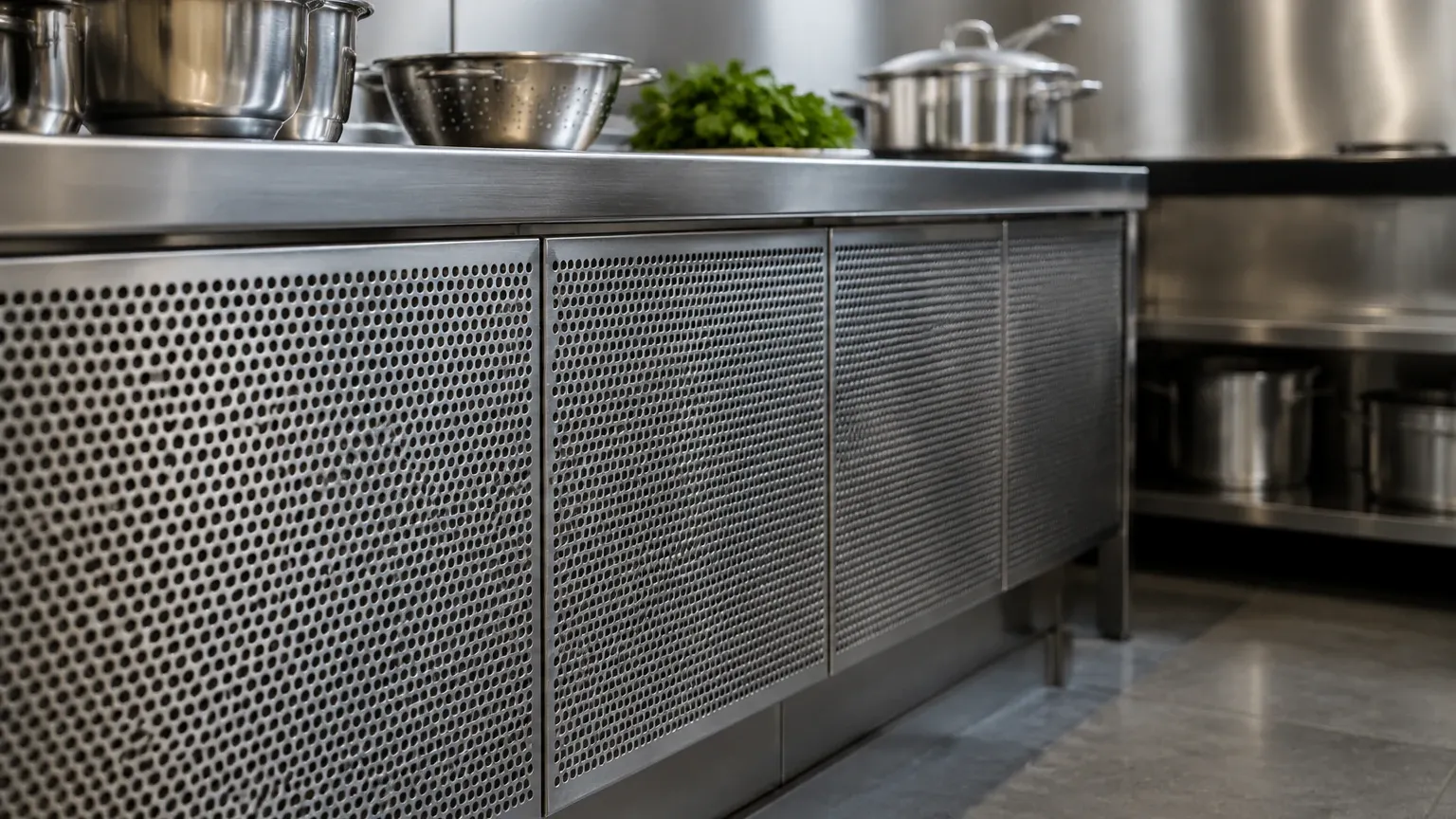
Comparing Perforated Metal and Expanded Metal for Kitchen Use
While both materials provide permeability, their mechanical properties differ significantly, influencing where they should be deployed.
| Feature | Perforated Metal | Expanded Metal |
| :— | :— | :— |
| Manufacturing | Material is punched out (creates scrap). | Material is slit and stretched (no waste). |
| Precision | High; exact hole sizes and spacing. | Moderate; opening sizes are approximate. |
| Strength | High, but depends on open area. | Extremely high due to the truss-like structure. |
| Cleaning | Easier; flat surface (if deburred). | More difficult; angular strands can trap debris. |
| Primary Use | Filtration, sorting, precise airflow. | Support structures, shelving, safety guards. |
In a "perforated metal kitchen" scenario, perforated sheets are typically used for surfaces in direct contact with food or where precise filtration is needed. Expanded metal is more commonly found in the sub-structures of equipment, such as the internal racks of a walk-in freezer or the protective cages around ventilation fans.
Critical Selection Criteria for Purchasing Teams
When sourcing components for industrial kitchen projects, procurement teams should confirm the following with their manufacturer:
1. Dimensional Tolerances: Ensure the perforated sheets or formed cartridges fit precisely within the equipment housing to prevent bypass in filtration or mechanical rattling.
2. Flatness Requirements: Punching holes can introduce internal stresses that cause the metal to curl. Specifying a leveling process is necessary for panels that must sit flush.
3. Edge Configurations: Determine if the sheet requires "safe sides" (unperforated borders) for welding or mounting. This adds structural stability and simplifies the assembly process.
4. Compliance Documentation: Request material test reports (MTRs) to verify the alloy composition and ensure the material meets FDA or local food safety regulations.
Maintenance and Longevity of Kitchen Filtration Components
The total cost of ownership for perforated metal components is heavily influenced by their maintenance requirements. Stainless steel is favored because it can withstand aggressive Clean-in-Place (CIP) protocols. However, several factors can compromise its longevity:
- Chloride Attack: If cleaning agents containing bleach are not thoroughly rinsed, they can cause pitting in 304 stainless steel.
- Galvanic Corrosion: Ensure that the perforated stainless steel is not in direct contact with dissimilar metals (like carbon steel) in the presence of moisture, as this will accelerate corrosion.
- Scaling: In hard water environments, mineral deposits can clog small perforations. Regular descaling is necessary to maintain the calculated flow rates and open area efficiency.
Conclusion
Perforated and expanded metals are indispensable in the design and operation of modern industrial kitchens and food processing facilities. From the precise filtration of oils and liquids to the structural integrity of ventilation and drainage systems, these materials provide the hygiene and durability required by the industry. By focusing on material grade, hole geometry, and proper surface finishing, engineers can specify components that not only meet regulatory standards but also enhance the overall efficiency of their equipment.
Kaifil continues to support global industries by providing high-performance, customized filtration solutions. Whether the requirement is for a specific micron-rated filter cartridge or a custom-formed perforated panel for a commercial kitchen application, our engineering-led approach ensures that every component is optimized for its specific industrial environment.
