


Expanded Metal Mesh Sheet
In the landscape of industrial filtration and structural engineering, the expanded metal mesh sheet represents a unique combination of material efficiency and mechanical strength. Unlike perforated materials that are created by punching holes and discarding the resulting slugs, expanded metal is produced through a process of simultaneous slitting and stretching. This manufacturing method results in a continuous, jointless piece of metal that retains the inherent strength of the original sheet while providing a high degree of open area for fluid or gas passage.
For engineers and procurement professionals, selecting the correct expanded metal mesh sheet involves more than choosing a material type. It requires a deep understanding of diamond geometry, strand dimensions, and the mechanical stresses the component will face within a filtration system or industrial assembly. As a specialized manufacturer, Kaifil provides technical insight into how these variables impact the performance and longevity of industrial filtration solutions.
Understanding the Geometry of Expanded Metal Mesh Sheets
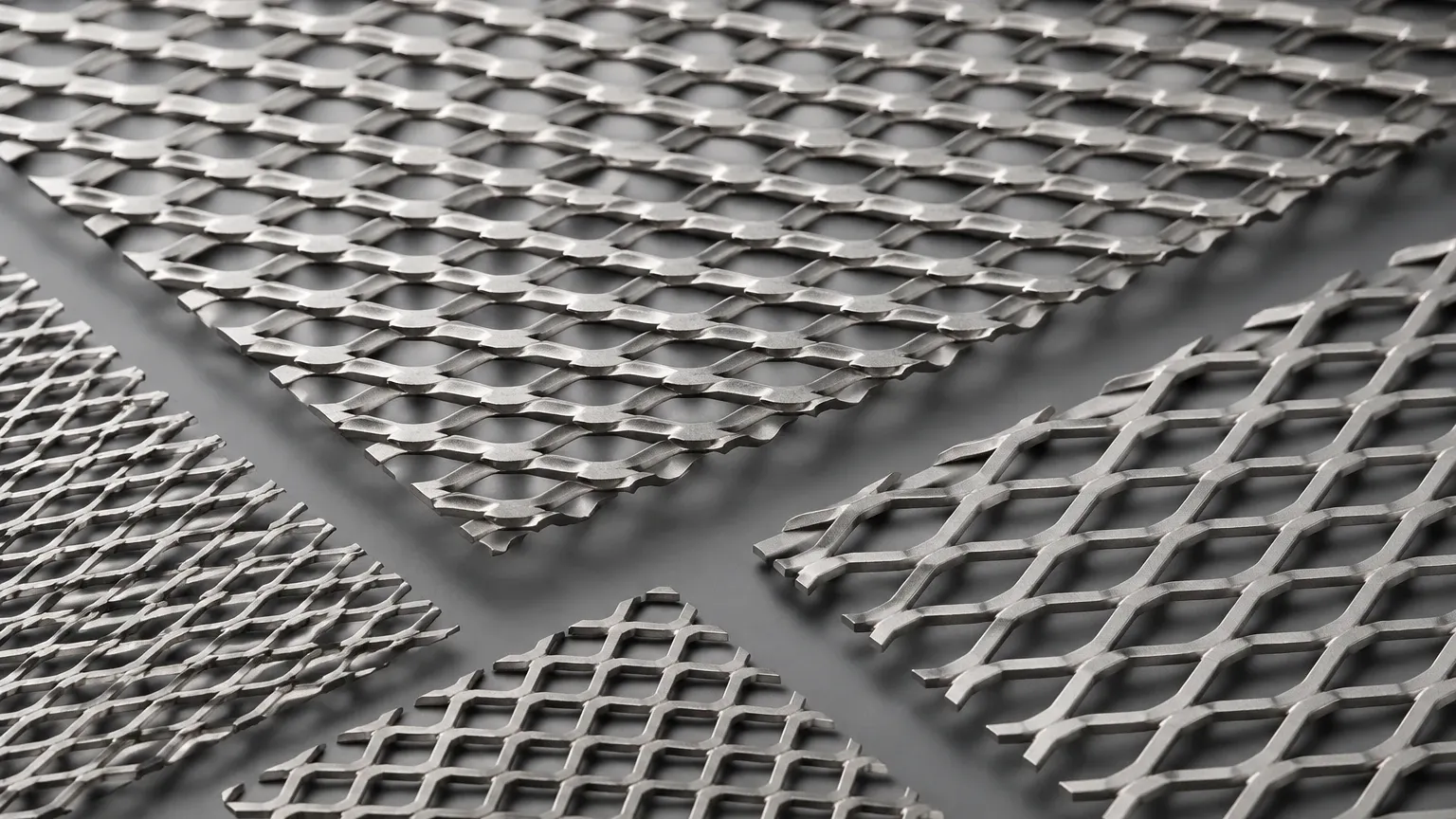
The performance of an expanded metal mesh sheet is primarily dictated by its diamond-shaped openings. Unlike woven wire mesh, where wires overlap, expanded metal consists of "strands" and "bonds." The strands are the individual metal strips that form the sides of the diamond, while the bonds are the points where the strands intersect.
When specifying these sheets for industrial use, four critical measurements define the geometry:
1. Short Way of Design (SWD): The distance from the center of one bond to the center of the next bond measured across the short diamond diagonal.
2. Long Way of Design (LWD): The distance from the center of one bond to the center of the next bond measured across the long diamond diagonal.
3. Short Way of Opening (SWO): The actual clear opening distance across the short axis.
4. Long Way of Opening (LWO): The actual clear opening distance across the long axis.
These dimensions are critical for calculating flow rates and particle retention. In filtration applications, the SWO is often the most important metric, as it determines the maximum size of a particle that can pass through the mesh. For those evaluating different rigid media, Perforated & Expanded Metal options offer varying levels of structural support and open area percentages, depending on the specific industrial requirement.
Manufacturing Process: Slitting and Stretching Without Waste
The production of an expanded metal mesh sheet is an exercise in material efficiency. A solid sheet or coil of metal is fed through an expanding machine equipped with a specialized knife. As the knife descends, it slits the metal and simultaneously stretches it forward. On the next stroke, the knife shifts laterally and repeats the process, creating the characteristic staggered diamond pattern.
Because no material is removed during this process, the resulting mesh can be up to ten times the length of the original sheet, depending on the expansion ratio. This makes expanded metal a cost-effective alternative to perforated metal for applications where high open areas are required without the cost of wasted material. Furthermore, because the mesh is made from a single piece of metal, there are no welds to break or wires to unravel, which is a significant advantage in high-vibration environments like hydraulic systems or industrial centrifuges.
Material Selection for Corrosive and High-Temperature Environments
The choice of alloy for an expanded metal mesh sheet is determined by the chemical and thermal conditions of the application. In the filtration industry, stainless steel is the standard due to its corrosion resistance and mechanical stability.
* Stainless Steel 304: The most common grade, offering excellent cost-to-performance ratios for general industrial applications, food processing, and water treatment.
* Stainless Steel 316/316L: Contains molybdenum, providing superior resistance to chlorides and pitting. This is the preferred material for marine environments, chemical processing, and pharmaceutical filtration.
* Carbon Steel: Often used in applications where corrosion is not a primary concern or where the mesh will be coated (e.g., galvanized or powder-coated). It offers high strength but requires surface protection to prevent oxidation.
* Aluminum: Lightweight and naturally corrosion-resistant, aluminum expanded mesh is frequently used in HVAC filtration and architectural applications where weight reduction is a priority.
When integrating these materials into custom filtration components, engineers must consider the galvanic compatibility between the mesh and the filter housing to prevent accelerated corrosion at contact points.
Structural Applications in Industrial Filtration Systems
While expanded metal can serve as a primary coarse filter, its most common role in high-performance filtration is as a support structure. Within a stainless steel filter cartridge, an expanded metal mesh sheet often serves as the inner core or the outer protective cage.
Pleat Support and Media Protection
In pleated filter elements, the expanded mesh provides the necessary rigidity to prevent the pleats from collapsing under high differential pressure. The 3D structure of "raised" expanded metal creates a natural drainage path, allowing the fluid to flow across the entire surface of the filter media rather than being restricted at the points of contact.
Coarse Pre-filtration
In water treatment and heavy industrial processes, expanded metal acts as a pre-filter to remove large debris before the fluid reaches more delicate fine-filtration stages. Its high strength allows it to withstand the impact of large solids without deforming.
Flow Diffusion
The angled strands of an expanded metal mesh sheet can also be used to diffuse flow. By breaking up laminar flow into turbulent flow, the mesh helps in distributing the fluid evenly across the downstream filter media, preventing localized blinding and extending the service life of the filter.
Flattened vs. Raised Mesh: Selecting the Right Profile
One of the most important decisions during the specification of an expanded metal mesh sheet is whether to use the material in its "raised" (standard) or "flattened" state.
Raised Expanded Metal
As it comes off the expanding machine, the strands are set at an angle to the plane of the sheet. This creates a three-dimensional surface that offers high rigidity and a slip-resistant texture. In filtration, the raised profile is beneficial for creating space between layers of media, which enhances flow distribution. However, the raised edges can be sharp, which may necessitate deburring or edge-cladding if the mesh is handled frequently.
Flattened Expanded Metal
To produce flattened mesh, the raised sheet is passed through a cold-rolling reducing mill. This process flattens the strands and bonds into a single plane, resulting in a smooth, 2D surface. Flattened expanded metal is approximately 5% to 10% thinner than the original base sheet. It is ideal for applications where a smooth surface is required to prevent abrasion of adjacent filter membranes or where a low profile is necessary for tight mechanical tolerances.
Quality Evaluation and Specification Standards
When sourcing an expanded metal mesh sheet for critical industrial applications, engineers should confirm several quality parameters to ensure the component meets performance expectations:
* Dimensional Tolerance: Standard tolerances for SWD and LWD usually fall within +/- 5%, but precision applications may require tighter controls. Thickness tolerances should also be verified, especially for flattened mesh.
* Flatness: For use in automated assembly lines or as a support for fine membranes, the sheet must be free from significant camber or waviness.
* Burr Presence: The expansion process naturally creates sharp edges. For filtration applications involving delicate synthetic media, specialized deburring or electropolishing may be required to prevent the mesh from piercing the primary filter layer.
* Open Area Calculation: Unlike perforated metal, where the open area is a simple ratio of hole area to total area, expanded metal's open area is influenced by the strand angle. Engineers must use the specific manufacturer's formula to ensure the mesh provides the required flow capacity.
Procurement Considerations: Customization and OEM Support
For many B2B applications, a standard off-the-shelf expanded metal mesh sheet is insufficient. Customization is often required to meet specific filtration efficiencies or mechanical footprints. When working with a manufacturer like Kaifil, several OEM options should be discussed:
* Custom Mesh Sizes: Tailoring the SWD and LWD to match the specific particle size distribution of the process fluid.
* Edge Treatments: Providing the mesh in circles, strips, or custom shapes with finished edges to simplify the final assembly of the filter cartridge.
* Surface Finishes: Passivation is essential for stainless steel components to restore the chromium oxide layer after manufacturing. Electropolishing can be used to achieve a mirror-like finish and further enhance corrosion resistance in pharmaceutical or food-grade applications.
Total Cost of Ownership (TCO) in Filtration
While the initial purchase price of an expanded metal mesh sheet is a factor, the total cost of ownership is driven by durability and maintenance cycles. A high-quality stainless steel expanded mesh might have a higher upfront cost than a plastic or lower-grade metal alternative, but its ability to withstand repeated cleaning cycles (such as backwashing or ultrasonic cleaning) significantly reduces the long-term cost per gallon of filtered product.
Furthermore, the structural integrity provided by expanded metal reduces the risk of catastrophic filter failure, which can lead to downstream equipment damage and expensive unscheduled downtime. By selecting a mesh that is specifically engineered for the pressure drops and chemical exposures of the environment, purchasing teams can ensure a more stable and predictable production process.
Conclusion: Confirming Technical Requirements
Before finalizing a specification for an expanded metal mesh sheet, engineers should confirm the following data points with their supplier:
1. The exact chemical composition of the alloy to ensure compatibility with the process fluid.
2. The maximum differential pressure the mesh will encounter during the end of the filter's life cycle.
3. Whether a raised or flattened profile is better suited for the internal geometry of the filter housing.
4. The required open area percentage to maintain system flow rates without excessive energy consumption from pumps.
By addressing these technical details early in the design phase, industrial teams can leverage the unique benefits of expanded metal to create robust, efficient, and cost-effective filtration solutions.
