


Laser Cutting Expanded Metal
In industrial manufacturing and filtration engineering, the demand for high-precision components has led to a significant shift in how materials are processed. Expanded metal, a versatile material created by simultaneously slitting and stretching a solid metal sheet, offers a unique combination of strength, light weight, and open area. However, its complex geometry—characterized by a series of interconnected strands and bonds—presents specific challenges when it comes to secondary fabrication. For engineers and procurement specialists, understanding the nuances of laser cutting expanded metal is essential for ensuring the structural integrity and filtration efficiency of the final product.
While traditional mechanical shearing and die-punching remain viable for high-volume, simple rectangular shapes, they often fall short when a project requires intricate geometries, tight tolerances, or minimal material distortion. Laser cutting has emerged as the preferred method for processing Perforated & Expanded Metal when precision is the primary requirement. This guide examines the technical considerations, advantages, and engineering challenges associated with laser cutting this unique material.
The Geometry of Expanded Metal and Laser Compatibility
To understand why laser cutting is a specialized process for expanded metal, one must first look at the material's architecture. Expanded metal is not a flat, uniform surface like a standard cold-rolled sheet. It consists of "strands" (the metal strips) and "bonds" (where the strands intersect). In its "raised" or "standard" form, these strands are angled relative to the original plane of the sheet, creating a three-dimensional profile.
Raised vs. Flattened Expanded Metal
When laser cutting expanded metal, the first consideration is whether the material is raised or flattened.
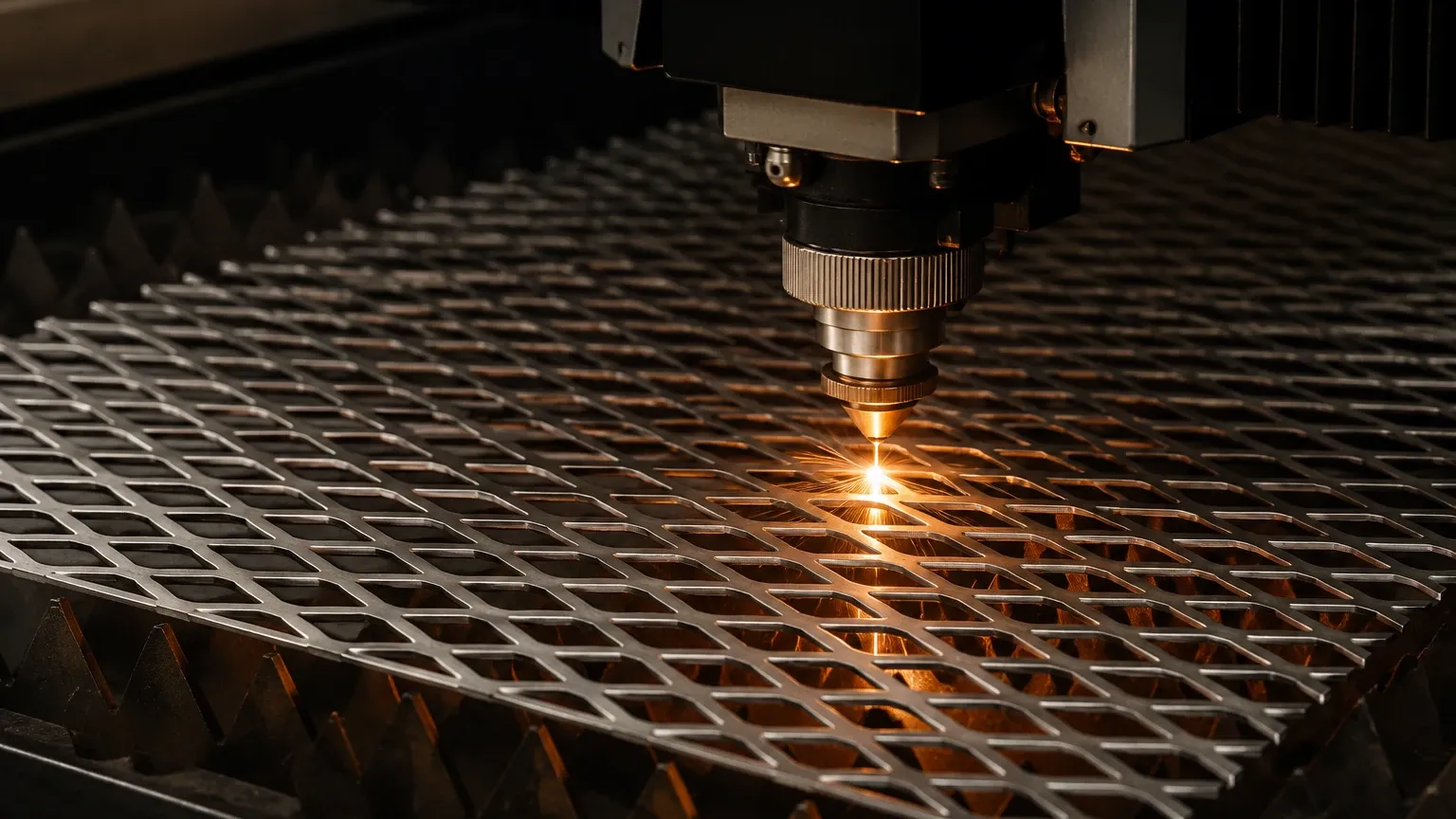
1. Raised Expanded Metal: The angled strands can cause issues with laser focus. Since the laser head maintains a specific "standoff" distance from the material surface, the varying height of raised strands can lead to fluctuations in the focal point. For high-precision industrial filters, this may require advanced height-sensing nozzles that can react rapidly to the changing topography.
2. Flattened Expanded Metal: This material has been passed through a cold-rolling mill to flatten the strands back into the same plane as the original sheet. Flattened expanded metal is significantly easier to laser cut because it provides a consistent focal plane, reducing the risk of beam divergence and ensuring a cleaner kerf.
The "Air Gap" Challenge
Unlike solid plate, expanded metal is mostly air. When the laser moves from a metal strand into an open diamond (the void), the beam must be managed carefully. If the laser power is not modulated correctly, the transition back onto a metal strand can cause "pierce-point" artifacts or excessive dross (slag) on the underside of the strand. Modern CNC laser systems solve this through high-speed pulsing and sophisticated path planning that accounts for the material's open area.
Technical Advantages of Laser Cutting Expanded Metal
For B2B applications, particularly in the chemical processing and pharmaceutical industries where Kaifil operates, the advantages of laser cutting over mechanical methods are numerous.
1. Superior Precision and Tolerances
Industrial filtration systems often require expanded metal to serve as a support cage or an outer protective wrap for finer wire mesh. These components must fit perfectly within cylindrical housings. Laser cutting allows for tolerances as tight as ±0.1mm, ensuring that the expanded metal wrap aligns perfectly with the filter end caps. This level of precision is virtually impossible to achieve with manual shearing.
2. Complex Geometries
Mechanical tooling is limited to straight lines or specific die shapes. Laser cutting expanded metal allows engineers to design components with complex notches, circular cutouts for pipe inlets, or irregular outer profiles without the need for expensive custom tooling. This flexibility is critical for OEM filtration solutions where custom designs are the norm.
3. Minimal Heat-Affected Zone (HAZ)
One of the primary concerns when processing stainless steel (such as Grade 304 or 316L) is the Heat-Affected Zone. Excessive heat can alter the metallurgical properties of the steel, potentially reducing its corrosion resistance. Fiber lasers, in particular, offer a very concentrated energy beam that minimizes the HAZ, preserving the integrity of the stainless steel strands. This is vital for filters used in corrosive chemical environments.
4. Edge Quality and Reduced Post-Processing
Mechanical shearing of expanded metal often leaves "burrs" or sharp, jagged edges where the strands were cut. In a filtration or food-processing environment, these burrs can trap contaminants or even break off and enter the process stream. Laser cutting produces a much cleaner edge. While some dross may occur on the underside, it is typically minimal and easily removed, reducing the total cost of secondary finishing.
Engineering Considerations: Fiber vs. CO2 Lasers
When selecting a partner for laser cutting Perforated & Expanded Metal, the type of laser technology used is a critical factor in performance and cost.
Fiber Lasers
Fiber lasers are the current industry standard for cutting thin to medium-thickness stainless steel. They operate at a wavelength that is highly absorbed by metals, allowing for faster cutting speeds and higher efficiency. For expanded metal with thin strands (common in precision filtration), fiber lasers provide exceptional detail and lower operating costs. They are also more effective at cutting reflective materials, which is a common characteristic of high-polish stainless steel.
CO2 Lasers
While older, CO2 lasers are still used for thicker expanded metal sections or when a specific edge finish is required on non-stainless alloys. However, for the majority of industrial filtration components, the fiber laser's ability to maintain a stable beam across the "voids" of the expanded mesh makes it the superior choice.
Assist Gas Selection
The choice of assist gas—typically Oxygen or Nitrogen—significantly impacts the cut quality.
* Nitrogen: Used for "clean cutting" stainless steel. It prevents oxidation at the cut edge, maintaining the silver-bright appearance and maximum corrosion resistance. This is the standard for pharmaceutical and food-grade components.
* Oxygen: Typically used for carbon steel. It creates an exothermic reaction that speeds up the cutting of thicker materials but leaves an oxidized edge that may require cleaning before painting or coating.
Challenges and Solutions in the Laser Cutting Process
Engineers must be aware of the specific risks associated with laser cutting expanded metal to avoid production delays or part failure.
Material Movement and Nesting
Because expanded metal is less rigid than solid plate, it can vibrate or shift during the cutting process, especially when high-pressure assist gases are used. Secure workholding is essential. Furthermore, "nesting" (the arrangement of parts on a sheet) must account for the orientation of the diamonds. Cutting across the "long way of the diamond" (LWD) versus the "short way of the diamond" (SWD) can affect the structural rigidity of the finished part.
Beam Reflection and Sensor Errors
In raised expanded metal, the angled surfaces can occasionally reflect the laser beam in unintended directions or confuse the capacitive height sensors on the laser head. To mitigate this, experienced operators often use "leapfrog" programming, where the laser head lifts significantly between cuts to avoid colliding with any strands that might have bowed upward due to thermal stress.
Thermal Distortion
Even with the precision of a laser, the concentrated heat can cause thin expanded metal to warp. This is particularly true for high-density meshes with very small openings. Strategic path planning—cutting non-adjacent sections to allow for heat dissipation—is a common technique used to maintain dimensional stability.
Applications in Industrial Filtration and Beyond
Laser-cut expanded metal is a foundational component in many high-performance systems. At Kaifil, we see these components utilized in several key areas:
* Filter Cartridge Support Cores: Expanded metal provides the necessary burst strength for filter cartridges while maintaining a high open area for fluid flow. Laser cutting ensures the core is perfectly cylindrical and the seams are ready for welding.
* Protective Outer Guards: In hydraulic and water treatment applications, expanded metal guards protect delicate inner filter media from large debris. Laser cutting allows these guards to be customized to fit specific housing geometries.
* Centrifuge Baskets: Precision-cut expanded metal is used in centrifugal separation, where the balance of the basket is critical. The accuracy of laser cutting ensures uniform weight distribution.
* Architectural and Acoustic Panels: Beyond filtration, laser cutting expanded metal allows for the creation of aesthetic patterns and functional acoustic baffles used in industrial facility design.
Selection Criteria for Engineers and Purchasing Teams
When specifying laser-cut expanded metal for a project, engineers should confirm the following details with their manufacturer:
1. Material Grade: Ensure the stainless steel grade (e.g., 304, 316, 316L, 321) matches the chemical compatibility requirements of the application.
2. Flattened vs. Raised: Specify flattened expanded metal if the tightest tolerances and cleanest laser edges are required.
3. Strand and Bond Dimensions: Provide exact measurements for strand width and thickness, as these impact the laser's power settings and the final part's strength.
4. Open Area Percentage: This is critical for filtration flow calculations. Ensure the laser cutting process does not inadvertently reduce the effective open area through excessive dross or wide kerfs.
5. Post-Processing Requirements: Determine if the part requires ultrasonic cleaning, electropolishing, or deburring after the laser cutting process.
Total Cost Considerations
While the hourly rate for laser cutting may be higher than mechanical shearing, the "Total Cost of Ownership" (TCO) is often lower for complex parts. The elimination of custom tool costs, the reduction in scrap material due to precise nesting, and the minimal need for secondary finishing make laser cutting expanded metal a cost-effective solution for high-specification industrial projects. Furthermore, the speed of CNC laser programming allows for rapid prototyping and shorter lead times compared to traditional manufacturing methods.
Conclusion
Laser cutting expanded metal represents the intersection of traditional material strength and modern manufacturing precision. For industries that rely on high-performance filtration and durable metal components, the ability to precisely shape expanded metal without compromising its structural or metallurgical integrity is invaluable. By understanding the technical requirements—from assist gas selection to the management of the "air gap"—engineers can better leverage Perforated & Expanded Metal in their custom designs.
As a professional manufacturer specializing in custom stainless steel filtration, Kaifil provides the engineering expertise and advanced manufacturing capabilities required to deliver high-precision filtration components. Whether you are designing a complex hydraulic filter or a robust chemical processing strainer, selecting the right processing method for your expanded metal components is the first step toward long-term equipment reliability.
