


Expanded Metal Mesh Sizes
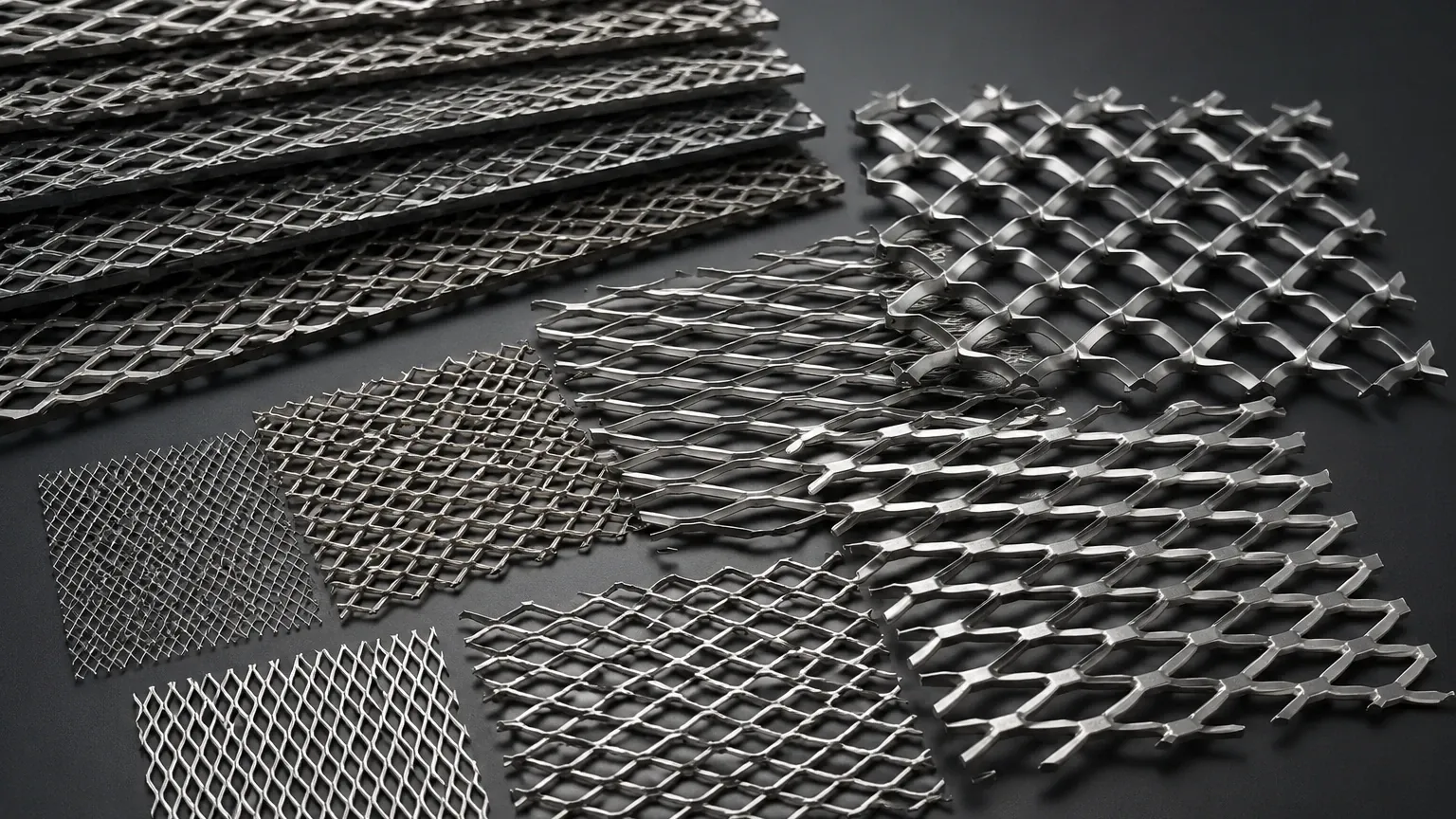
In industrial filtration and structural engineering, the selection of Perforated & Expanded Metal components is a critical decision that directly impacts flow dynamics, structural integrity, and filtration efficiency. Expanded metal is a versatile material created by simultaneously slitting and stretching a metal sheet, resulting in a diamond-shaped pattern of openings. Unlike perforated metal, which is created by punching holes and generating scrap, expanded metal is produced through a process that preserves material volume while providing a high strength-to-weight ratio.
For engineers and procurement professionals, understanding the nuances of expanded metal mesh sizes is essential for ensuring that the chosen component meets the rigorous demands of chemical processing, hydraulic systems, and pharmaceutical manufacturing. This guide provides a technical deep dive into the dimensions, terminology, and selection criteria for expanded metal mesh.
Understanding the Geometry of Expanded Metal
To accurately specify expanded metal, one must move beyond simple hole diameters. The geometry of expanded metal is defined by several distinct measurements that determine both the physical footprint and the performance characteristics of the mesh.
SWD and LWD (Short Way and Long Way of Diamond)
The most fundamental measurements in expanded metal mesh sizes are the SWD and LWD.
* SWD (Short Way of Diamond): This is the distance from the center of a bond to the center of the next bond across the short axis of the diamond. It is important to distinguish this from the "Short Way of Opening" (SWO), which is the actual clear space between the strands.
* LWD (Long Way of Diamond): This is the distance from the center of a bond to the center of the next bond across the long axis of the diamond.
When an engineer specifies a mesh as "1/2-inch expanded metal," they are typically referring to the nominal SWD. However, for precision filtration applications, relying on nominal sizes is insufficient. Precise measurements of the SWO and LWO (Long Way of Opening) are required to determine the largest particle size that can pass through the mesh.
Strand Width and Thickness
The strand width refers to the amount of metal between the openings, while the strand thickness refers to the thickness of the original base metal sheet. In industrial filtration, the relationship between strand width and thickness determines the rigidity of the filter cartridge and its resistance to pressure differentials. A wider strand increases the surface area for potential blinding but provides greater structural support for secondary filter media, such as fine wire mesh.
Standard vs. Flattened Expanded Metal
When evaluating expanded metal mesh sizes, professionals must choose between "standard" (raised) and "flattened" varieties. This choice significantly alters the dimensional profile and the hydraulic performance of the component.
Standard (Raised) Expanded Metal
In its standard form, expanded metal emerges from the machine with the strands and bonds set at a uniform angle to the plane of the sheet. This creates a three-dimensional profile that offers several technical advantages:
1. Enhanced Rigidity: The angled strands act like structural trusses, providing high resistance to bending.
2. Directional Flow Control: The orientation of the diamonds can be used to deflect or channel fluid flow in specific directions.
3. Increased Surface Area: The 3D structure provides more surface area for catalyst support or heat dissipation.
Flattened Expanded Metal
Flattened expanded metal is produced by passing the standard expanded sheet through a cold-rolling reducing mill. This process flattens the strands and bonds into the same plane as the sheet. While this reduces the overall thickness of the material, it also alters the expanded metal mesh sizes. The LWD is typically elongated during the flattening process, while the SWD remains relatively constant.
Flattened mesh is often preferred in filtration applications where a smooth surface is required to prevent damage to delicate filter membranes or to facilitate easier cleaning and backwashing. At Kaifil, we often recommend flattened stainless steel mesh for food and beverage applications where hygienic surfaces are paramount.
The Impact of Mesh Size on Filtration Performance
The primary function of expanded metal in a filtration system is often to serve as a support structure (a "drainage layer") for finer mesh or as a coarse pre-filter. In both roles, the open area percentage is a critical metric.
Calculating Open Area
The open area is the ratio of the area of the openings to the total area of the sheet, expressed as a percentage. This value determines the flow rate and the pressure drop across the filter. A higher open area reduces the resistance to fluid flow but may compromise the structural integrity of the filter cartridge under high-pressure conditions.
Engineers must balance the expanded metal mesh sizes with the required mechanical strength. For instance, in high-viscosity hydraulic oil filtration, a larger SWD with thicker strands might be necessary to prevent the mesh from collapsing under the force of the fluid, even if it results in a slightly lower open area.
Particle Retention and Blinding
While the SWO determines the absolute filtration rating of the expanded metal, the geometry of the diamond opening also influences "blinding"—the phenomenon where particles become trapped in the mesh and restrict flow. Diamond-shaped openings are generally less prone to blinding than square meshes in certain industrial contexts because the angled strands allow for more fluid bypass around trapped particles.
Material Selection and Dimensional Stability
The choice of material is inseparable from the discussion of expanded metal mesh sizes. Kaifil specializes in stainless steel filtration solutions, primarily utilizing Grade 304 and Grade 316 stainless steel.
Stainless Steel 304 vs. 316
* Grade 304: Offers excellent strength and basic corrosion resistance, suitable for many industrial and water treatment applications.
* Grade 316: Contains molybdenum, providing superior resistance to chlorides and pitting. This is the standard for chemical processing and pharmaceutical environments.
Material choice affects the manufacturing tolerances of the mesh. Harder alloys may exhibit more "spring-back" during the expansion process, which can lead to slight variations in the SWD and LWD. When designing custom filtration components, Kaifil’s engineering team accounts for these material properties to ensure that the final product adheres to the specified tolerances.
Engineering Considerations for Customization
Off-the-shelf expanded metal mesh sizes may not always meet the specific requirements of a specialized industrial process. Customization allows engineers to optimize the filter for specific variables:
1. Custom Bond Lengths: Adjusting the bond length can increase the strength of the mesh at specific stress points.
2. Variable Pitch: In some advanced applications, the pitch of the expansion can be varied across the sheet to create zones of different filtration densities.
3. Edge Treatments: For filter cartridges, the way the expanded metal is cut and finished at the edges (random shear vs. bond shear) is vital for the integrity of the weld and the safety of the assembly.
At Kaifil, our OEM capabilities allow us to work closely with global customers to develop bespoke expanded metal components. Whether the application requires a micro-mesh for precision electronics or a heavy-duty support cage for a large-scale chemical reactor, the focus remains on technical precision and durability.
Common Risks in Mesh Selection
Failure to properly account for expanded metal mesh sizes and material properties can lead to several operational risks:
* Pressure Spikes: If the open area is too low for the required flow rate, the resulting pressure drop can trigger system bypass valves or damage pumps.
* Media Migration: If the expanded metal is used as a support for a finer wire mesh, and the SWO is too large, the fine mesh may sag into the openings (a phenomenon known as "quilting"). This can lead to mechanical failure of the fine mesh over time.
* Corrosion-Induced Sizing Changes: In aggressive chemical environments, choosing an inferior material can lead to strand thinning. As the strands thin, the SWO effectively increases, potentially allowing larger contaminants to pass through the system.
Confirming Specifications Before Purchase
Before finalizing a purchase order for expanded metal components, technical professionals should confirm the following data points with their manufacturer:
1. Exact SWD/LWD and SWO/LWO: Ensure there is no ambiguity between center-to-center measurements and clear opening measurements.
2. Strand Dimensions: Confirm both width and thickness, especially if the material is to be flattened.
3. Material Grade: Verify the alloy and ask for material mill certificates if traceability is required (common in pharmaceutical and aerospace sectors).
4. Flattening Requirements: Specify whether the material should be standard or flattened, and define the maximum allowable thickness after flattening.
5. Tolerances: Define the acceptable variance in mesh dimensions. For high-speed automated assembly lines, tight tolerances are often non-negotiable.
Conclusion
Selecting the correct expanded metal mesh sizes is a foundational step in designing efficient and durable industrial filtration systems. By understanding the geometric terminology, the effects of processing (standard vs. flattened), and the relationship between open area and mechanical strength, engineers can optimize their systems for longevity and performance.
Kaifil remains committed to providing the technical expertise and manufacturing precision necessary to support these complex decisions. From initial material selection to the delivery of customized Perforated & Expanded Metal solutions, our goal is to ensure that every filtration component we produce meets the highest standards of the industries we serve.
