


Expanded Metal Machine
In the realm of industrial manufacturing and filtration, the expanded metal machine stands as a pivotal piece of equipment, transforming solid metal sheets into a versatile, mesh-like structure through a precise process of simultaneous slitting and stretching. Unlike perforated metal, which involves punching holes and generating scrap material, the expansion process is a zero-waste manufacturing method. For engineers and procurement specialists, understanding the technical nuances of the expanded metal machine is essential for evaluating the quality, structural integrity, and performance of the resulting components used in demanding industrial environments.
As a specialized manufacturer of stainless steel filtration solutions, Kaifil utilizes advanced manufacturing techniques to produce high-precision Perforated & Expanded Metal components. These products serve as critical support structures in filter cartridges or as primary filtration media in heavy-duty applications. This guide examines the mechanical principles, engineering considerations, and performance variables associated with expanded metal machinery.
The Mechanics of Expanded Metal Production
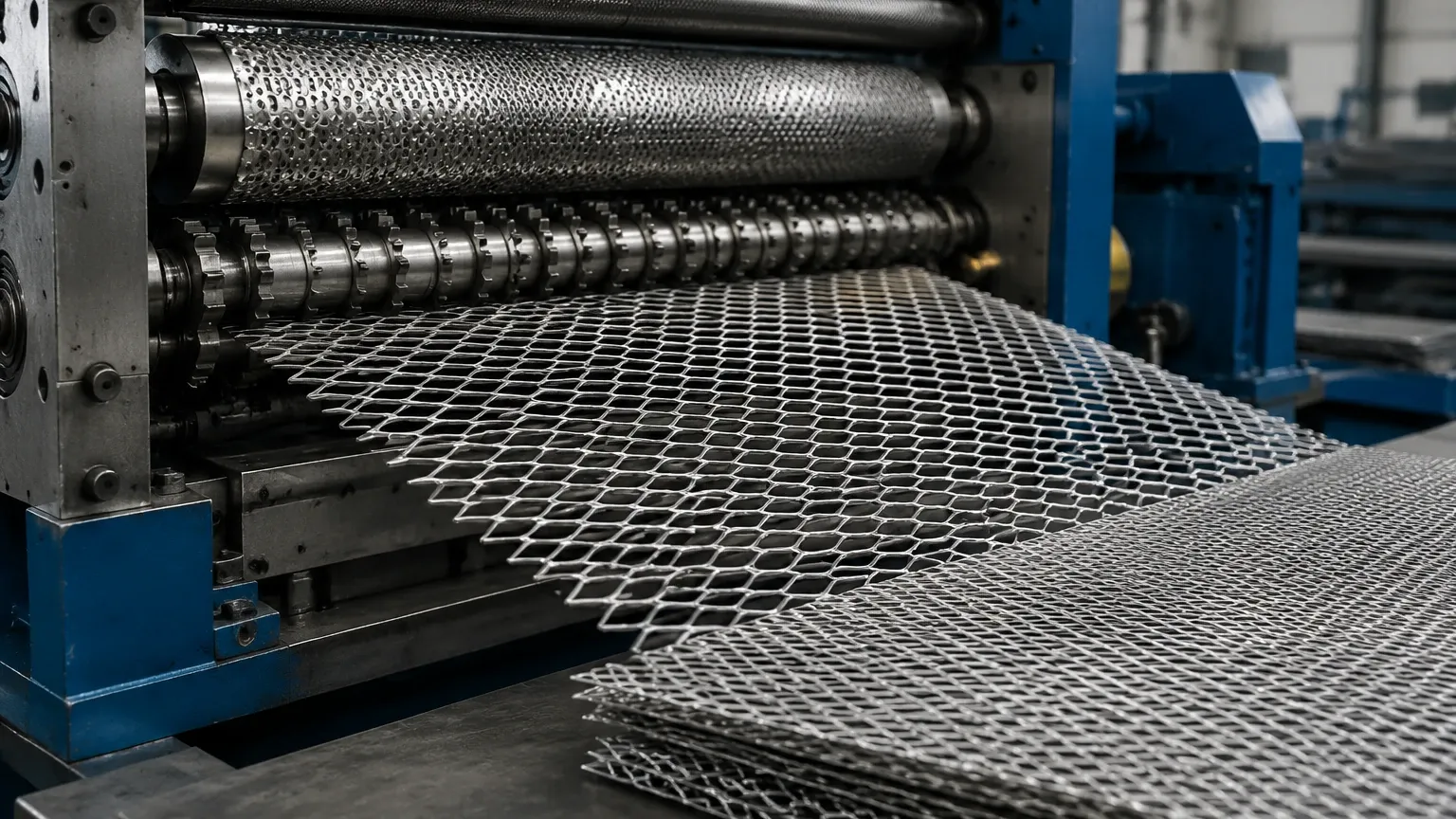
The operation of an expanded metal machine is defined by a reciprocating motion that combines shearing and tension. The process does not involve the removal of material; instead, it reconfigures the molecular structure of the metal sheet to create a diamond-shaped pattern.
The Slitting and Stretching Process
The core of the machine consists of an upper reciprocating blade and a lower fixed bed-knife. The metal sheet or coil is fed into the machine in precise increments. As the upper blade descends, it slits the metal while simultaneously stretching it downward. The blade then retracts, shifts laterally by half the width of a diamond, and descends again to create the next row of openings. This staggered pattern creates the characteristic "bonds" and "strands" that give expanded metal its unique strength-to-weight ratio.
Key Components of the Machine
1. Feeding System: High-precision servo motors or mechanical ratchets control the advancement of the base material. The accuracy of the feed determines the Short Way of the Diamond (SWD) and the overall consistency of the mesh.
2. Tooling (The Knife): The geometry of the knife determines the Long Way of the Diamond (LWD). Tooling must be crafted from high-grade tool steel to withstand the repetitive shear forces, especially when processing hardened stainless steel alloys.
3. Lateral Shifting Mechanism: This ensures the alternating pattern of the slits, which is vital for the structural integrity of the finished product. If the shift is imprecise, the bonds will be weak, leading to structural failure under pressure.
Machine Types and Capacity Classifications
Expanded metal machines are categorized based on the thickness of the material they can process and the size of the openings they can produce. Selecting the right machine class is critical for ensuring the final product meets the required engineering tolerances.
Micro-Mesh Machines
These machines are designed for high-precision applications, often used in the production of battery electrodes, acoustic filters, and fine chemical strainers. They process thin foils, often ranging from 0.05mm to 0.5mm in thickness. In the context of industrial filtration, micro-expanded metal produced on these machines provides a more rigid alternative to woven wire mesh while maintaining high open-area percentages.
Standard Industrial Machines
The most common class of expanded metal machine, these units handle medium-gauge materials (0.5mm to 3.0mm). They are the workhorses for producing support cores for hydraulic filters and outer protective wraps for stainless steel filter cartridges. These machines must balance speed with the ability to maintain flat, uniform sheets that can be easily rolled or welded in subsequent assembly stages.
Heavy-Duty and Grating Machines
Used for structural applications such as walkways, platforms, and heavy-duty debris guards, these machines exert massive force to expand thick plates (up to 8mm or more). While less common in fine filtration, they are essential for the primary intake screens used in water treatment and large-scale industrial processing plants.
Material Dynamics and Tooling Precision
The performance of an expanded metal machine is heavily influenced by the physical properties of the material being processed. When manufacturing filtration components, material selection is usually dictated by chemical compatibility and thermal resistance.
Stainless Steel Processing
Stainless steel (304, 316, and 316L) is the standard for industrial filtration due to its corrosion resistance. However, stainless steel work-hardens during the expansion process. An expanded metal machine must be robust enough to handle the increased resistance of the material as it is stretched. High-quality machinery ensures that the "bonds" (where the strands meet) remain intact without micro-fractures, which could otherwise become sites for stress corrosion cracking in acidic or high-pressure environments.
Ductility and Tensile Strength
The machine must be calibrated to the specific ductility of the alloy. If the material is too brittle or the machine's stroke is too aggressive, the strands may snap. Conversely, if the material is too soft, the diamond shapes may deform. Precision expanded metal machines allow for the adjustment of the "strand width" and "opening size" to optimize the balance between flow rate and structural support.
Engineering Specifications for Industrial Filtration
When engineers specify expanded metal for filtration, they rely on the precision of the machine to deliver exact dimensions. The following parameters are critical:
* SWD (Short Way of the Diamond): The distance from the middle of one bond to the middle of the next bond across the short axis.
* LWD (Long Way of the Diamond): The distance across the long axis.
* Strand Width: The amount of metal fed into the machine between strokes.
* Strand Thickness: The original thickness of the base material.
* Open Area: Calculated based on the relationship between the strand width and the SWD. This determines the pressure drop across the filter.
In filtration applications, the expanded metal often acts as a pleat support. If the expanded metal machine produces inconsistent strand widths, the pleat pack may collapse under high differential pressure, leading to bypass or filter failure. Therefore, the machine's ability to maintain tight tolerances is a direct contributor to the reliability of the filtration system.
Quality Control and Post-Processing Requirements
The output of an expanded metal machine is typically "raised" or "standard" expanded metal. In this state, the strands are set at an angle to the plane of the sheet. For many filtration applications, further processing is required.
Flattening (Cold Rolling)
Many filter designs require "flattened" expanded metal. This is achieved by passing the raised mesh through a heavy-duty leveling or reducing mill. This process flattens the strands and bonds back into the same plane as the original sheet. Engineers must confirm that the flattening process has not compromised the bond strength or introduced burrs that could damage delicate filter media like glass fiber or fine wire mesh.
Annealing and Cleaning
Because the expansion process involves significant cold working, the metal can become brittle. For components that require subsequent forming or welding—such as cylindrical filter cartridges—stress-relief annealing may be necessary. Furthermore, the lubricants used in the expanded metal machine must be thoroughly removed, especially for food-grade or pharmaceutical applications, to prevent contamination of the process fluid.
Selecting the Right Expanded Metal Solution
When sourcing expanded metal components, it is important to look beyond the basic dimensions. The quality of the expanded metal machine and the expertise of the manufacturer determine the longevity of the part. Key questions for engineers to consider include:
1. Burr Levels: Does the machine produce clean shears, or are there significant burrs that could cause turbulence or trap contaminants?
2. Flatness Tolerances: For automatic welding of filter end caps, the expanded metal must be perfectly flat. What are the machine's leveling capabilities?
3. Material Traceability: Especially for 316L stainless steel, is the material source verified to ensure the machine is processing the correct alloy for the application's chemical environment?
4. Customization: Can the machine be adjusted to provide a specific open area to meet a calculated pressure drop requirement?
At Kaifil, we understand that the structural integrity of a filter is only as good as its components. By utilizing high-precision machinery and rigorous quality control, we provide expanded metal solutions that meet the exacting standards of the chemical, pharmaceutical, and hydraulic industries. Whether you require a support core for a high-pressure hydraulic system or a protective outer wrap for a food-grade filter, our technical team can assist in selecting the optimal mesh configuration for your specific needs.
For more information on our manufacturing capabilities and to explore our range of filtration components, you can Review product options and application support to find the right solution for your industrial requirements.
