


Expanded Metal of Aluminium and Aluminium Alloys
In industrial filtration and structural engineering, the selection of materials is dictated by the balance between mechanical strength, chemical compatibility, and weight. Expanded metal of aluminium and aluminium alloys represents a critical category of materials used to provide structural integrity and filtration support in environments where traditional steel might be too heavy or prone to rapid oxidation. Unlike perforated metal, which is created by punching holes and generating scrap, expanded metal is produced through a simultaneous slitting and stretching process, resulting in a continuous mesh with no material waste and a high strength-to-weight ratio.
For engineers and procurement teams, understanding the nuances of different aluminium alloys and the geometric configurations of expanded mesh is essential for optimizing system performance and ensuring long-term durability in demanding B2B applications.
The Manufacturing Process and Structural Integrity
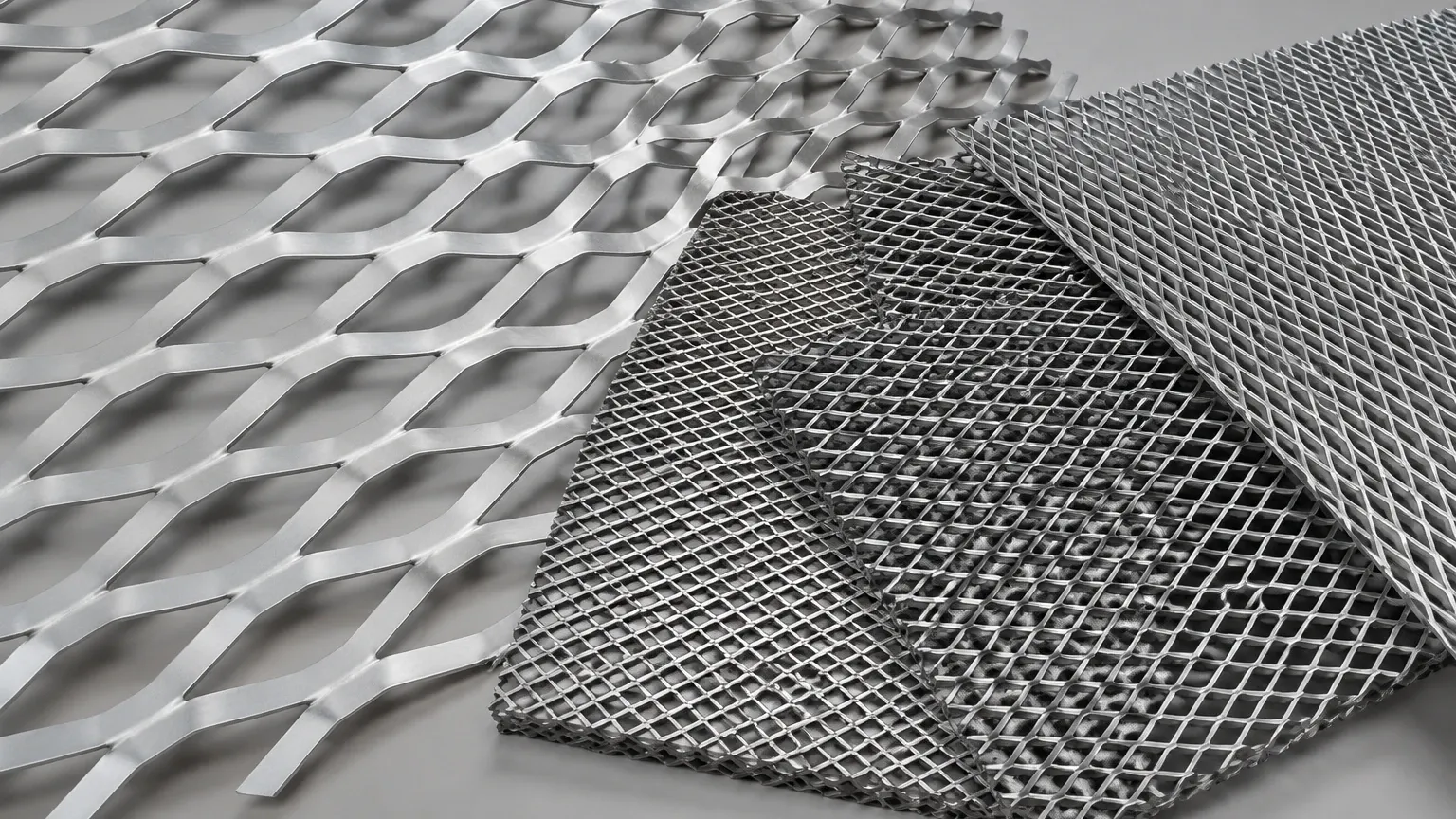
The production of expanded metal involves a specialized machine that slits a solid metal sheet while stretching it into a diamond-shaped pattern. This process creates a truss-like structure where the "bonds" (the intersections of the diamonds) and "strands" (the sides of the diamonds) are angled to the original plane of the sheet. This angularity provides inherent rigidity and allows the material to resist deformation under pressure better than many woven wire meshes.
There are two primary forms of expanded metal used in industrial settings:
1. Standard (Raised) Expanded Metal: The strands and bonds are set at a uniform angle to the plane of the sheet. This provides a three-dimensional surface that increases the surface area and adds mechanical grip, which is often useful in pre-filtration stages to capture larger particulates or to create turbulence in fluid flow.
2. Flattened Expanded Metal: After the expansion process, the sheet is passed through a cold-rolling reducing mill. This flattens the strands and bonds back into a single plane. Flattened mesh is preferred when a smooth surface is required, such as when the expanded metal serves as a support layer for a fine wire cloth or a delicate filter membrane, preventing the sharp edges of raised strands from puncturing the primary filtration media.
Analysis of Aluminium Alloys in Industrial Filtration
While stainless steel is a staple in the filtration industry, expanded metal of aluminium and aluminium alloys offers distinct advantages, particularly regarding weight reduction and thermal conductivity. The choice of alloy significantly impacts the material's performance in specific chemical environments.
1000 Series (Commercially Pure Aluminium)
Alloys like 1050 and 1060 consist of 99% or higher aluminium content. These are characterized by excellent corrosion resistance and high ductility. In filtration, they are often used in light-duty applications where chemical purity is paramount, but high mechanical stress is not expected.
3000 Series (Manganese Alloys)
Alloy 3003 is perhaps the most common choice for industrial expanded metal. The addition of manganese increases the strength by approximately 20% over 1000 series alloys while maintaining excellent workability. It is widely used in HVAC filtration components and air intake screens due to its balance of cost and durability.
5000 Series (Magnesium Alloys)
Alloys such as 5052 and 5083 are engineered for high-corrosion environments. The magnesium content provides superior resistance to alkaline conditions and marine environments (saltwater). Engineers specify 5052 expanded metal for offshore filtration systems, hydraulic reservoirs in maritime equipment, and chemical processing units where moisture and salt are prevalent.
6000 Series (Magnesium and Silicon Alloys)
Alloy 6061 is a heat-treatable grade known for its structural strength. While less common in fine filtration, it is frequently used as the structural framework or outer protective cage for heavy-duty industrial filter cartridges. Its ability to be welded and its high yield strength make it ideal for components that must withstand significant mechanical impact or high-pressure differentials.
Technical Parameters for Engineering Selection
When specifying Perforated & Expanded Metal for a project, several geometric variables must be defined to ensure the component meets the flow and structural requirements of the application.
* LWD (Long Way of Diamond): The distance from the center of one bond to the center of the next bond across the long axis of the diamond.
* SWD (Short Way of Diamond): The distance across the short axis of the diamond. This dimension is critical as it determines the size of the particles that can pass through the mesh.
* Strand Width: The amount of metal fed into the machine between each stroke of the upper die. This, combined with the material thickness, determines the cross-sectional area of the strand and the overall strength of the mesh.
* Strand Thickness: The original thickness of the aluminium sheet. In flattened expanded metal, this thickness is reduced during the rolling process.
* Percentage of Open Area: This is the most vital metric for filtration engineers. It defines the ratio of the open space to the total area of the sheet. A higher open area reduces pressure drop (resistance to flow) but may compromise the structural support provided to the primary filter media.
The Role of Expanded Metal in Filtration Systems
Expanded metal of aluminium and aluminium alloys is rarely the primary filtration media for sub-micron particles; instead, it serves as a critical auxiliary component in complex filtration assemblies.
Support and Pleat Spacing
In pleated filter cartridges, expanded metal is often used as a support layer on both the upstream and downstream sides of the filter media. It ensures that the pleats remain open and evenly spaced under high-pressure flow, preventing "pleat bunching" which can significantly reduce the effective filtration area and lead to premature filter failure.
Protective Cages and Outer Wraps
Industrial filters used in hydraulic systems or heavy machinery are often exposed to mechanical debris and rough handling. An outer wrap of expanded aluminium provides a lightweight yet rigid cage that protects the delicate internal mesh from physical damage during installation and operation. Because aluminium is non-sparking, these cages are often preferred in explosive or flammable environments, such as oil and gas processing.
Pre-Filtration and Mist Elimination
In air handling units and gas scrubbing towers, multiple layers of expanded aluminium mesh can be stacked to act as a depth filter. The irregular, angular surface of the raised strands is highly effective at capturing grease, oil mist, or large dust particles through impingement. This protects more expensive secondary filters from rapid loading.
Engineering Considerations: Compatibility and Performance
Before finalizing the specification of expanded aluminium mesh, technical teams must evaluate the following factors:
Chemical Compatibility
Aluminium is highly resistant to atmospheric corrosion due to the spontaneous formation of a protective oxide layer. However, it is sensitive to pH levels outside the 4.5 to 8.5 range. In highly acidic or strongly alkaline environments, the oxide layer can dissolve, leading to rapid corrosion. Furthermore, engineers must be cautious of galvanic corrosion when aluminium expanded metal is in contact with more noble metals (like copper or certain stainless steels) in the presence of an electrolyte.
Thermal Conductivity
Aluminium has a thermal conductivity significantly higher than that of stainless steel. In applications where the filtration system is also involved in heat exchange or where rapid temperature dissipation is required, expanded aluminium is the superior choice. This is particularly relevant in electronic cooling filters and specialized chemical reactors.
Weight and Cost-Efficiency
With a density approximately one-third that of steel, aluminium expanded metal allows for the design of lighter filtration units. This reduces the load on support structures and can lower shipping and installation costs. Additionally, because the expansion process produces no scrap, it is often a more cost-effective solution than perforated metal for large-scale industrial projects.
Customization and OEM Capabilities
Industrial filtration requirements are rarely "one size fits all." Customization is often necessary to meet specific flow rates, pressure ratings, and housing dimensions. Professional manufacturers provide a range of post-processing options for expanded metal of aluminium and aluminium alloys:
* Anodizing: This electrochemical process thickens the natural oxide layer, enhancing corrosion resistance and surface hardness. It is frequently specified for components exposed to harsh outdoor environments or decorative industrial applications.
* Precision Cutting and Forming: Expanded metal can be sheared to exact tolerances or formed into cylinders and cones to fit specific filter housings. Unlike woven mesh, the edges of expanded metal are more stable and less prone to fraying during the fabrication process.
* Surface Cleaning and Degreasing: For applications in the food and beverage or pharmaceutical industries, expanded metal must be thoroughly cleaned of manufacturing oils and lubricants to prevent contamination of the process stream.
Procurement Checklist for Technical Professionals
When sourcing expanded metal for industrial filtration projects, confirming the following details with the manufacturer will prevent integration issues and performance gaps:
1. Alloy Specification: Ensure the alloy grade (e.g., 3003-H14, 5052-H32) matches the environmental requirements of the application.
2. Dimensional Tolerances: Specify the allowable variance in LWD, SWD, and overall sheet dimensions, especially if the mesh is being integrated into a precision-machined housing.
3. Flattening Requirements: Determine if the application requires a smooth surface (flattened) or if the added grip and surface area of raised mesh are beneficial.
4. Flow Characteristics: Confirm the calculated open area to ensure the mesh will not introduce an unacceptable pressure drop into the system.
5. Compliance and Standards: Verify that the material meets relevant industry standards, such as ASTM B209 for aluminium alloy sheets.
By focusing on these technical parameters and understanding the inherent properties of expanded metal of aluminium and aluminium alloys, engineers can design filtration systems that are both high-performing and durable. Whether used as a protective guard, a pleat support, or a primary pre-filter, this material remains a cornerstone of modern industrial filtration architecture.
Download Expanded Metal of Aluminium and Aluminium Alloys as a PDF
