


Expanded Metal B&q
In the procurement of industrial materials, engineers and maintenance professionals often face a choice between off-the-shelf retail products and custom-engineered industrial components. When searching for terms like "expanded metal b&q," the intent often stems from a need for immediate, small-scale material availability for non-critical repairs or basic structural guarding. However, for industrial filtration, chemical processing, and heavy-duty mechanical applications, the technical requirements for Perforated & Expanded Metal far exceed the specifications typically found in consumer-grade hardware outlets.
Understanding the distinction between retail-grade expanded metal and industrial-grade filtration components is essential for ensuring system longevity, chemical compatibility, and structural integrity. This guide examines the technical parameters, material considerations, and engineering criteria that distinguish professional filtration solutions from general-purpose hardware.
Understanding Expanded Metal Specifications
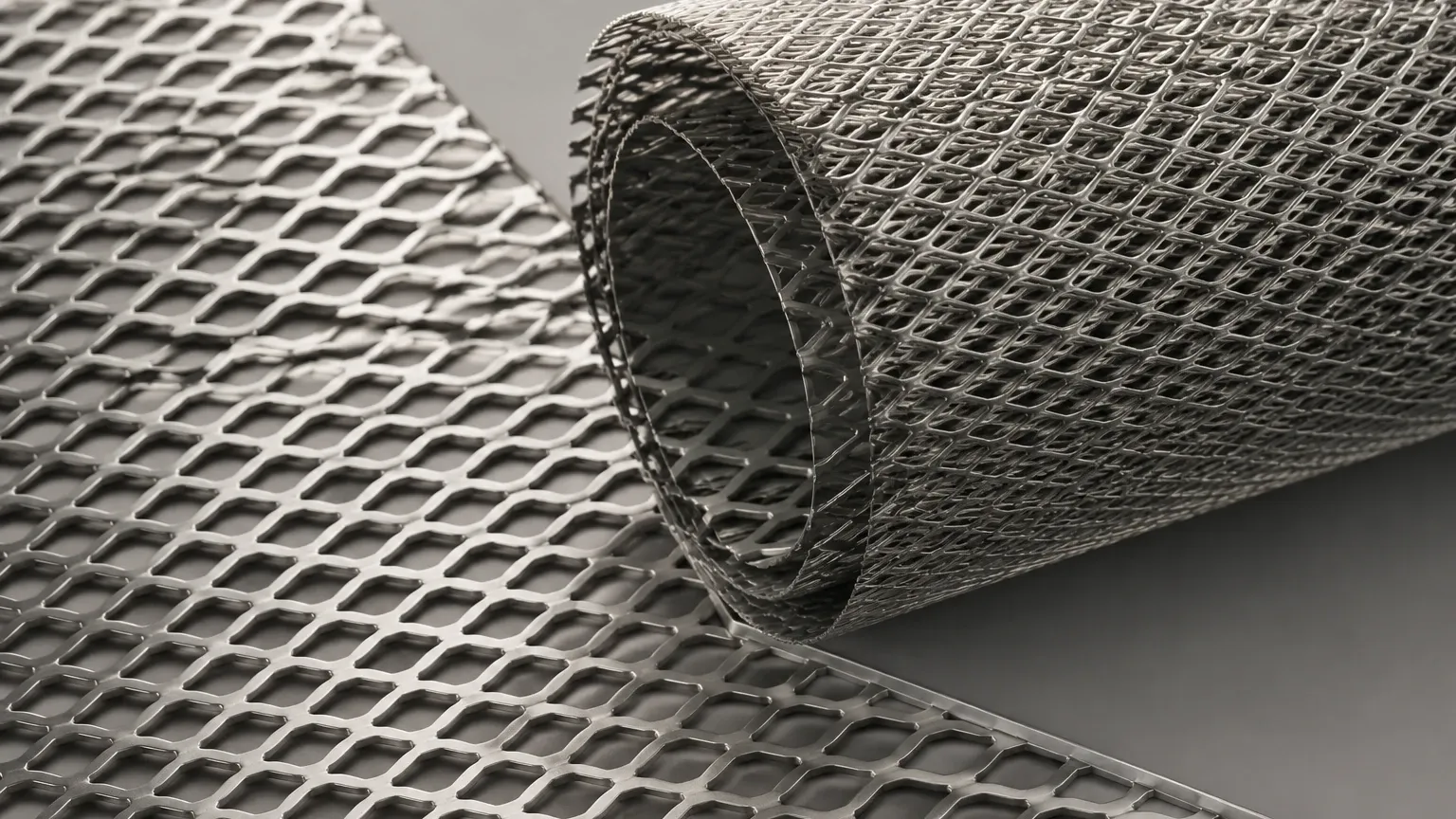
Expanded metal is manufactured by simultaneously slitting and stretching a solid metal sheet to create a diamond-shaped pattern. Unlike perforated metal, which involves punching holes and generating scrap, expanded metal is produced with minimal waste, making it a cost-effective choice for many industrial applications. However, the performance of the material is dictated by several precise measurements that must be specified during the design phase.
Key Geometric Parameters
1. SWD (Short Way of Diamond): The distance from the center of the bond on one side to the center of the bond on the opposite side, measured across the short axis of the diamond.
2. LWD (Long Way of Diamond): The distance across the long axis of the diamond, measured from center to center of the bonds.
3. Strand Width: The amount of metal fed into the machine between the slits, which determines the thickness of the individual "ribs" of the mesh.
4. Strand Thickness: The original thickness of the base metal sheet.
5. Open Area: Calculated as a percentage, this determines the flow rate and pressure drop in filtration applications.
While retail options like expanded metal b&q products provide a standard set of dimensions suitable for domestic fencing or simple ventilation covers, industrial applications often require specific SWD/LWD ratios to optimize the balance between structural support and fluid dynamics.
Material Selection: Industrial Grades vs. Retail Standards
One of the primary limitations of retail-sourced expanded metal is the restricted range of material grades. Most consumer-grade products are manufactured from mild steel, often galvanized for basic corrosion resistance, or lightweight aluminum. In contrast, industrial filtration environments—such as those found in pharmaceutical or chemical processing—demand high-performance alloys.
Stainless Steel 304 and 316L
Kaifil specializes in stainless steel expanded metal, focusing on grades 304 and 316L. Grade 304 offers excellent corrosion resistance for general industrial use, while 316L (low carbon) is essential for applications involving high chlorides or acidic environments. The use of 316L prevents intergranular corrosion after welding, which is a critical failure point in custom filter cartridge assembly.
Specialized Alloys
For extreme environments, engineers may require exotic materials such as Monel, Inconel, or Titanium. These materials are rarely, if ever, available through retail channels. Industrial manufacturers provide full material traceability and mill test reports (MTRs), ensuring that the chemical composition of the metal meets the rigorous standards required for pressure vessels and high-temperature filtration systems.
Applications in Industrial Filtration and Support
In a B2B context, expanded metal is rarely a standalone product; it is often a critical component of a larger filtration assembly. Its role varies depending on the position within the system.
Support Media for Fine Mesh
In many high-pressure hydraulic or gas filtration systems, fine wire mesh is used for precise particle capture. However, fine mesh lacks the structural rigidity to withstand high differential pressures. Expanded metal serves as a robust support cage or inner core, preventing the fine mesh from collapsing or pleat-bunching under flow stress.
Pre-Filtration and Coarse Screening
Expanded metal is highly effective as a primary screen for removing large debris from fluid streams. In water treatment or intake systems, the raised (standard) version of expanded metal creates turbulence that can help in certain separation processes, while flattened expanded metal provides a smooth surface that is easier to clean via backwashing.
Diffusion and Flow Distribution
The geometry of expanded metal can be used to break up laminar flow and create a more uniform distribution of fluid across a filter bed. This is particularly useful in chemical reactors where even distribution of reactants is necessary for process efficiency.
Engineering Considerations: Load Bearing and Open Area
When transitioning from a retail mindset to an engineering-led procurement strategy, load-bearing capacity becomes a primary focus. The strength of expanded metal is directional. The bond (where the strands intersect) is stronger than the individual strands.
Standard vs. Flattened Expanded Metal
* Standard (Raised) Expanded Metal: The strands are set at an angle to the plane of the sheet. This provides maximum rigidity and a high strength-to-weight ratio. It is ideal for heavy-duty grates or filter housings that must resist mechanical impact.
* Flattened Expanded Metal: After the expansion process, the sheet is passed through a cold-rolling mill. This flattens the strands and bonds into the same plane, reducing the overall thickness and providing a smooth surface. Flattened metal is preferred when the component must be integrated into a tight-tolerance assembly or when a smooth surface is required to prevent damage to adjacent filter media.
Calculation of Pressure Drop
For engineers, the "open area" is not just a visual characteristic; it is a mathematical necessity for calculating pressure drop (ΔP). A retail product labeled as "expanded metal b&q" may not provide the precise open area data required for flow modeling. Industrial manufacturers provide exact percentages of open area based on the strand width and diamond dimensions, allowing engineers to size pumps and vessels accurately.
Customization and OEM Solutions for Filtration
The most significant advantage of working with a professional manufacturer like Kaifil over a retail supplier is the ability to customize every aspect of the product. Industrial filtration often requires non-standard configurations that cannot be met by off-the-shelf sheets.
Custom Dimensions and Shapes
While retail sheets come in fixed sizes (e.g., 500mm x 500mm), industrial orders can be produced to exact dimensions, reducing material waste and eliminating the need for on-site cutting. Furthermore, expanded metal can be formed into cylinders, cones, or custom-shaped baskets to fit specific filter housings.
Edge Treatments and Welding
In filtration, the edges of the expanded metal are critical. Raw, cut edges can be sharp and may damage other filter layers or pose a safety risk during maintenance. Industrial suppliers can provide "bond-sheared" edges or integrate the mesh into custom frames and flanges. Kaifil’s expertise in welding stainless steel ensures that the joints in a filter cartridge maintain the same level of corrosion resistance as the base metal.
Total Cost of Ownership and Procurement Strategies
While the initial price point of a retail product might seem lower for a single piece, the total cost of ownership (TCO) in an industrial setting tells a different story. Choosing the wrong grade of metal or a mesh with insufficient structural integrity leads to frequent replacements, unplanned downtime, and potential contamination of the process stream.
Durability and Replacement Cycles
Industrial-grade stainless steel expanded metal is designed for multi-year service lives in harsh conditions. In contrast, galvanized mild steel from a retail source may fail within months in a high-moisture or chemical environment. The labor costs associated with replacing a failed filter component often far outweigh the initial savings of a cheaper material.
Technical Support and Compliance
When purchasing through B2B channels, engineers gain access to technical support. This includes advice on material compatibility, assistance with filtration calculations, and compliance with industry standards such as FDA requirements for food and beverage applications or ISO standards for hydraulic fluid power. Retail outlets cannot provide the documentation necessary for regulated industries.
Conclusion: Transitioning to Engineered Solutions
For simple, non-structural tasks, retail products like expanded metal b&q may suffice. However, when the application involves fluid dynamics, chemical resistance, or mechanical stress, the precision of Perforated & Expanded Metal becomes indispensable.
By focusing on technical specifications such as SWD, LWD, and material grade (SS304/316L), and by partnering with a manufacturer that understands the nuances of industrial filtration, procurement teams can ensure they are installing components that enhance system performance rather than creating a point of failure. Whether you are designing a new filtration system or upgrading an existing one, the move toward customized, high-performance expanded metal is an investment in the reliability and efficiency of your industrial operations.
