


Expanded Metal Raised vs Flattened
In industrial design and engineering, selecting the appropriate material for filtration, structural support, or protective screening requires a deep understanding of manufacturing processes and their impact on material performance. Expanded metal is a staple in these sectors due to its high strength-to-weight ratio and cost-effectiveness. However, a primary decision engineers must face is the choice between expanded metal raised vs flattened.
While both varieties originate from the same production method, their physical properties, surface textures, and mechanical behaviors differ significantly. This guide explores the technical nuances of both types, providing the necessary data for informed procurement and application in demanding environments such as chemical processing, water treatment, and industrial filtration.
The Fundamentals of Expanded Metal Production
To understand the differences between raised and flattened expanded metal, one must first understand how the material is created. Unlike perforated metal, which is produced by punching holes out of a solid sheet (resulting in material waste), expanded metal is manufactured through a simultaneous slitting and stretching process.
During production, a metal sheet or coil—often stainless steel, carbon steel, or aluminum—is fed through a machine equipped with a reciprocating knife. This knife creates a series of small slits while the machine pulls the metal apart. The result is a continuous web of diamond-shaped openings. Because no material is removed, the process is highly efficient and results in a product that is stronger than the original sheet in certain orientations.
The immediate result of this process is known as "raised" or "standard" expanded metal. The "flattened" version is a secondary stage of processing that modifies the initial raised product.
Raised Expanded Metal: Characteristics and Advantages
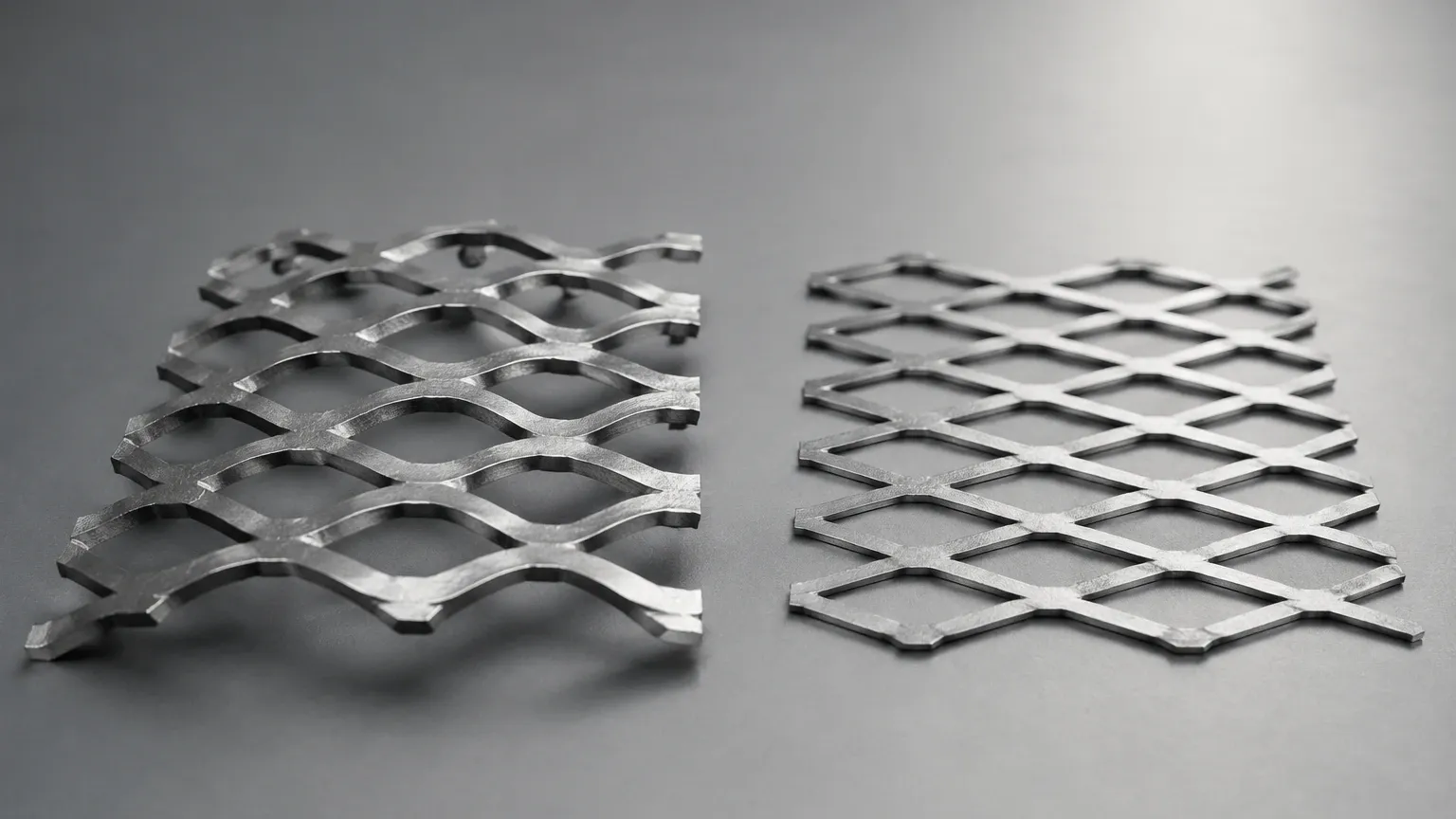
Raised expanded metal, often referred to as standard expanded metal, is the product exactly as it comes off the expanding machine. The strands and bonds (the intersections of the strands) are set at a uniform angle to the plane of the sheet. This creates a three-dimensional, textured surface.
Structural Rigidity and Strength
One of the primary benefits of raised expanded metal is its inherent structural rigidity. Because the strands are tilted, the material acts like a series of small trusses. This geometry provides exceptional resistance to bending and deflection, making it an ideal choice for heavy-duty applications where the material must support weight or resist impact.
Enhanced Grip and Friction
The angular nature of the strands provides a high-friction surface. In industrial environments, this is critical for safety and utility. Raised expanded metal is frequently used for catwalks, stair treads, and ramps because it offers superior slip resistance, even when exposed to oils, water, or industrial lubricants.
Airflow and Light Diffusion
The 3D profile of raised metal allows for unique airflow dynamics. Depending on the angle of the strands, it can deflect or direct air and light. This makes it useful for machine guards or ventilation covers where directional flow or shielding is required. In the context of Perforated & Expanded Metal solutions, the raised profile is often utilized as a robust outer support layer for complex filter assemblies.
Flattened Expanded Metal: The Cold-Rolling Process
Flattened expanded metal begins as raised expanded metal. To achieve the flattened state, the raised sheet is passed through a heavy-duty cold-rolling reducing mill. This process applies immense pressure to the material, leveling the strands and bonds into a single horizontal plane.
Surface Smoothness and Safety
The most obvious characteristic of flattened expanded metal is its smooth, flat surface. By eliminating the sharp angles of the raised strands, the material becomes much safer to handle. It is less likely to snag clothing, skin, or cleaning equipment. This makes it the preferred choice for partitions, shelving, and components that require frequent manual interaction.
Thickness and Dimensional Changes
It is important for engineers to note that the flattening process changes the dimensions of the material. When the raised metal is rolled, the overall thickness of the sheet is reduced—usually by about 5% to 10% compared to the original gauge of the base metal. Additionally, the sheet slightly elongates (usually by about 5%) during the rolling process. These changes must be accounted for in precision engineering designs to ensure proper fitment within frames or housings.
Ease of Maintenance and Cleaning
In industries with strict hygiene requirements, such as food and beverage or pharmaceutical processing, flattened expanded metal is often superior. The lack of crevices and angled strands makes it significantly easier to clean and sanitize. There are fewer "dead zones" where particulates or biological contaminants can accumulate, which is a critical consideration for filtration support structures.
Expanded Metal Raised vs Flattened: A Comparative Analysis
Choosing between these two forms requires a trade-off between different physical properties. Below is a comparison of how they perform across key technical metrics:
| Feature | Raised Expanded Metal | Flattened Expanded Metal |
| :— | :— | :— |
| Surface Profile | 3D, textured, angled strands | 2D, smooth, level strands |
| Thickness | Thicker than the original base metal | Thinner than the original base metal |
| Rigidity | High; excellent resistance to bending | Lower; more flexible and easier to form |
| Safety | Sharp edges; potential for snagging | Smooth edges; safer for human contact |
| Flow Dynamics | Can deflect or direct flow | Consistent, perpendicular flow path |
| Cleaning | Difficult; debris can trap in angles | Easy; smooth surface allows for wiping |
| Visuals | Industrial, aggressive look | Sleek, uniform appearance |
When evaluating expanded metal raised vs flattened, the decision often hinges on whether the application requires the mechanical strength of the 3D structure or the surface utility of a flat plane.
Engineering Selection Criteria for Industrial Applications
When specifying expanded metal for a project, engineers must look beyond the surface finish and consider the long-term operational environment. Several factors dictate the success of the material choice.
Material Compatibility
Both raised and flattened expanded metal can be produced from various alloys. For chemical processing or marine environments, stainless steel (304 or 316L) is the standard due to its corrosion resistance. Kaifil specializes in these high-performance alloys to ensure that the filtration components can withstand aggressive media and high temperatures. If the material is to be flattened, the ductility of the alloy must be considered to prevent cracking during the cold-rolling process.
Open Area and Filtration Efficiency
The percentage of open area determines the flow rate and pressure drop across the material. In its raised form, the "effective" open area can change depending on the angle of the fluid approach. In flattened form, the open area is fixed and predictable. For precision filtration, flattened metal is often used as a support for fine wire mesh to provide a consistent, flat bonding surface that does not distort the mesh pores.
Post-Processing and Fabrication
If the expanded metal needs to be welded into a frame or integrated into a larger assembly, flattened metal is generally easier to work with. The flat surface allows for more consistent spot welds and a more secure fit within U-edging or C-channels. Raised metal, while more difficult to weld due to the varying contact points, provides a more rigid structure that may not require as much external framing.
The Role of Expanded Metal in Filtration Systems
In the world of industrial filtration, expanded metal serves several critical roles. It is rarely the primary filter medium for fine particles; instead, it acts as the "backbone" of the filter cartridge or element.
Support for Pleated Media
In many hydraulic and air filtration systems, the primary filter media (such as fiberglass or fine stainless steel mesh) is pleated to increase surface area. To prevent these pleats from collapsing under high pressure, expanded metal is used as a support pleat. Flattened expanded metal is typically preferred here because its smooth surface prevents the fine media from being punctured or abraded during the pleating process or during operation under pressure pulses.
Outer Protective Cages
For large industrial filter cartridges, an outer cage is necessary to protect the internal media from mechanical damage during installation and operation. Raised expanded metal is frequently used for these cages. Its rigidity protects the internal components from impact, and its textured surface can help break up large debris before it reaches the primary filter stage.
Custom Filtration Components
Kaifil provides customized filtration solutions where expanded metal is integrated into multi-layer sintered structures or custom-machined housings. By understanding the nuances of expanded metal raised vs flattened, we can design components that optimize flow while maintaining the structural integrity required for high-pressure chemical or water treatment applications.
Manufacturing Considerations and Customization
When ordering expanded metal, it is vital to provide clear specifications to the manufacturer. Standard terminology includes:
* SWD (Short Way of Design): The distance from the center of one bond to the center of the next bond across the short diamond diagonal.
* LWD (Long Way of Design): The distance from the center of one bond to the center of the next bond across the long diamond diagonal.
* Strand Width: The amount of metal fed into the machine between slits.
* Strand Thickness: The thickness of the original base metal.
For flattened metal, the final thickness after rolling must also be specified. Customization options at Kaifil include specific material grades, custom diamond sizes to meet flow requirements, and secondary finishes such as electropolishing or passivating to enhance corrosion resistance in pharmaceutical or food-grade applications.
Conclusion: Making the Right Choice
The choice between expanded metal raised vs flattened is not merely an aesthetic one; it is a functional decision that impacts the safety, durability, and efficiency of an industrial system. Raised expanded metal offers the strength and grip needed for structural and safety applications, while flattened expanded metal provides the smoothness and precision required for filtration support and manual handling.
For engineers and procurement teams, the goal is to balance these physical properties with the specific demands of the application. Whether you are designing a high-pressure hydraulic filter or a simple industrial partition, selecting the correct expanded metal variant is a foundational step in ensuring the longevity of the equipment. For those requiring specialized advice or custom-manufactured components, exploring professional Perforated & Expanded Metal options ensures that the material meets the exact technical requirements of your industrial environment.
