


Raised vs Flat Expanded Metal
In industrial design and manufacturing, selecting the appropriate structural material requires a deep understanding of how fabrication processes alter mechanical properties. Expanded metal is a staple in sectors ranging from heavy construction to precision filtration. However, engineers and procurement specialists often face a critical choice: whether to specify raised or flattened expanded metal.
While both types originate from the same basic manufacturing process, their physical characteristics, structural integrity, and application suitability differ significantly. This guide examines the technical nuances of raised vs flat expanded metal, providing the engineering context necessary to make an informed selection for industrial applications, including its role within the broader category of Perforated & Expanded Metal.
The Manufacturing Foundation: From Sheet to Mesh
To understand the difference between raised and flattened variants, one must first understand how expanded metal is produced. Unlike perforated metal, which is created by punching holes and removing material, expanded metal is manufactured through a process of simultaneous slitting and stretching.
A solid metal sheet or coil is fed through a machine equipped with reciprocating knives. As the knives slit the metal, they also expand it, creating a series of diamond-shaped openings. Because no material is lost in this process, expanded metal is often more cost-effective and environmentally sustainable than perforated alternatives.
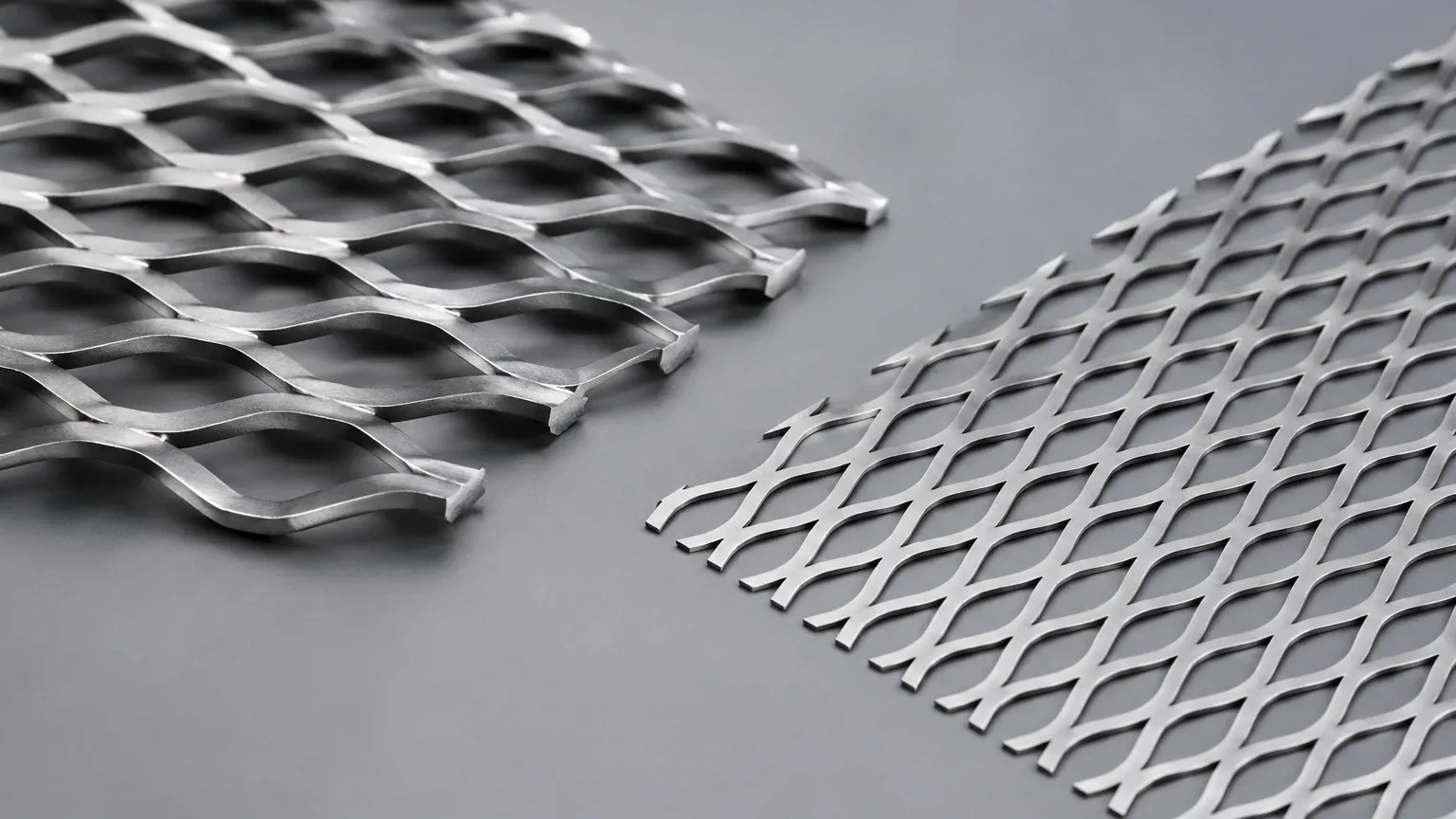
The immediate result of this process is "standard" or "raised" expanded metal. The strands and bonds (the points where strands intersect) are set at a uniform angle to the original plane of the sheet. To produce "flattened" expanded metal, this raised sheet is subsequently passed through a cold-roll reducing mill.
Raised Expanded Metal: Characteristics and Engineering Advantages
Raised expanded metal is the product in its primary state. Because the strands are tilted at an angle, the material possesses a three-dimensional texture. This geometry provides several distinct mechanical advantages:
1. Superior Strength-to-Weight Ratio
In raised expanded metal, the strands act like structural trusses. The angular orientation of the bonds provides significant directional rigidity. For applications where the material must support a load or resist deflection over a span, the raised profile offers better structural performance than a flattened sheet of the same gauge.
2. Enhanced Grip and Traction
The protruding edges of the raised strands create a naturally slip-resistant surface. This makes raised expanded metal the industry standard for catwalks, industrial flooring, stair treads, and ramps. The open diamond pattern allows liquid, oil, and debris to fall through, maintaining a safe contact surface for personnel.
3. Turbulence and Flow Dynamics
In filtration and heat exchange applications, the three-dimensional nature of raised metal can be used to manipulate fluid dynamics. The angled strands can induce controlled turbulence, which may be desirable in certain chemical processing or air-mixing scenarios. However, this same feature increases air resistance (pressure drop) compared to a flat surface.
4. Aesthetic Depth
From an architectural and design perspective, the raised profile offers a unique visual depth and shadow play. It is frequently used for building facades, security fencing, and decorative partitions where a robust, textured appearance is required.
Flattened Expanded Metal: The Cold-Rolling Transformation
Flattened expanded metal begins as raised expanded metal but undergoes a secondary cold-rolling process. This process flattens the strands and bonds back into a single plane, resulting in a smooth, level surface. This transformation changes several key properties:
1. Surface Smoothness and Safety
The primary reason for choosing flattened expanded metal is its smooth surface. By eliminating the sharp, angled edges of the raised strands, the material becomes safer to handle and less likely to snag clothing or skin. This is critical for shelving, storage bins, furniture, and machine guards where workers may come into frequent contact with the mesh.
2. Dimensional Consistency
During the flattening process, the overall thickness of the sheet is reduced—usually to the thickness of the original base metal—and the length of the sheet (the Long Way of the Diamond, or LWD) is slightly increased. This results in a material that is easier to integrate into assemblies that require tight tolerances or flush mounting against other flat components.
3. Ease of Cleaning and Coating
Flattened metal is significantly easier to clean than raised metal because it lacks the deep crevices formed by the angled bonds. Furthermore, when applying powder coatings or paint, a flattened surface allows for more uniform coverage and reduces the risk of "fatting" or buildup at the bond points, which can be a point of failure for corrosion resistance in raised meshes.
4. Material Handling and Protection
In the context of industrial filtration, flattened expanded metal is often used as a support layer or protective cage. Because it is smooth, it does not abrade or puncture delicate filter media, such as fine wire cloth or synthetic membranes, during high-pressure cycles or cleaning procedures.
Direct Comparison: Raised vs Flat Expanded Metal
When evaluating Perforated & Expanded Metal options, engineers should consider the following comparative metrics:
| Feature | Raised Expanded Metal | Flattened Expanded Metal |
| :— | :— | :— |
| Surface Texture | Three-dimensional, angular, and rough. | Two-dimensional, smooth, and level. |
| Total Thickness | Significantly thicker than the base metal. | Approximately the same as the base metal. |
| Rigidity | Higher rigidity and resistance to bending. | Slightly reduced rigidity due to cold rolling. |
| Safety | Sharp edges; requires careful handling. | Smooth edges; safer for human contact. |
| Open Area | Fixed by the expansion ratio. | Slightly higher LWD; open area may vary slightly. |
| Flow Resistance | Higher; creates more turbulence. | Lower; allows for more laminar flow. |
| Cost | Generally lower (fewer processing steps). | Slightly higher (includes cold-rolling costs). |
Application-Specific Selection: Filtration and Beyond
In the specialized field of industrial filtration, the choice between raised and flat expanded metal is dictated by the specific role the metal plays within the filter assembly.
Filter Support Cores
For internal support cores in high-pressure hydraulic or chemical filters, raised expanded metal is often preferred. The inherent rigidity of the raised strands helps the core resist collapsing under the differential pressure that builds up as the filter accumulates contaminants. The three-dimensional bonds provide a "stand-off" effect that can prevent the filter media from blinding against the core, ensuring more effective use of the available surface area.
Outer Protective Wraps
Conversely, for the outer protective wrap of a filter cartridge, flattened expanded metal is the superior choice. An outer wrap must be smooth to prevent damage during installation into a filter housing. A flattened surface also ensures that the filter can be handled safely by maintenance personnel during replacement cycles. Furthermore, in food and beverage or pharmaceutical applications, the ease of cleaning a flattened surface is a mandatory requirement for maintaining hygiene standards.
Security and Fencing
For security applications, raised expanded metal is almost always specified. The sharp edges and difficulty of climbing the angled strands provide a significant deterrent. In contrast, flattened metal might be used for interior partitions or tool room enclosures where the primary goal is visibility and airflow rather than high-level security.
Technical Specifications and Ordering Considerations
When sourcing Perforated & Expanded Metal, providing precise technical specifications is essential to ensure the material performs as expected. Engineers should define the following parameters:
1. Material Type: Common choices include Stainless Steel (304 or 316 for corrosion resistance), Carbon Steel, or Aluminum.
2. SWD (Short Way of Diamond): The distance from the center of a bond to the center of the next bond across the short axis.
3. LWD (Long Way of Diamond): The distance from the center of a bond to the center of the next bond across the long axis.
4. Strand Width: The amount of metal fed into the knives between slits.
5. Strand Thickness: The thickness of the original base metal.
6. Style Designation: Often expressed as a combination of gauge and opening size (e.g., 1/2" #13).
A Note on Tolerances
Flattening introduces additional variables. The cold-rolling process can cause the sheet to elongate and may introduce slight camber or out-of-squareness. If your application requires high precision—such as a filter component that must fit into a machined groove—it is vital to confirm the manufacturer’s tolerances for flattened products.
Common Risks and Selection Pitfalls
Failure to distinguish between raised and flat expanded metal can lead to several operational issues:
* Media Abrasion: Using raised expanded metal as a support for fine wire mesh can lead to premature failure. The angled bonds act as pressure points that can shear the fine wires over time as the system pulses.
* Flow Restriction: In high-velocity gas filtration, the thickness of raised metal might create an unacceptable pressure drop, leading to increased energy consumption by pumps or fans.
* Corrosion Vulnerability: In corrosive environments, the "nooks" in raised metal can trap moisture and chemicals, leading to localized pitting. Flattened stainless steel is often more resilient in these specific conditions because of its easier-to-clean profile.
Conclusion
The decision between raised vs flat expanded metal is not merely an aesthetic one; it is a functional choice that impacts the safety, durability, and efficiency of an industrial system. Raised expanded metal offers unparalleled grip and structural rigidity, making it ideal for heavy-duty flooring and support structures. Flattened expanded metal provides the smoothness, safety, and dimensional consistency required for material handling, protective wraps, and precision filtration components.
By understanding these differences, engineers can optimize their designs for the specific demands of their industry. Whether you are designing a high-pressure chemical filter or a robust industrial walkway, selecting the right expansion style is a critical step toward long-term reliability. For those seeking customized solutions, exploring the full range of Perforated & Expanded Metal options with a specialized manufacturer can help bridge the gap between standard specifications and high-performance application requirements.
