


Stainless Steel Expanded Metal for Grill
In industrial food processing and heavy-duty commercial cooking equipment, the choice of material for heating surfaces and filtration components is critical to both performance and longevity. Stainless steel expanded metal for grill applications has emerged as a superior alternative to traditional wire mesh or solid plate designs. This material offers a unique combination of structural integrity, thermal efficiency, and cost-effectiveness that meets the rigorous demands of high-heat environments.
As a specialized manufacturer, Kaifil provides precision-engineered Perforated & Expanded Metal solutions tailored to the specific needs of engineers and procurement professionals in the industrial sector. Understanding the technical nuances of expanded metal—from its manufacturing process to its mechanical properties under thermal stress—is essential for optimizing grill performance and ensuring food safety compliance.
Understanding the Structure of Perforated & Expanded Metal for Grills
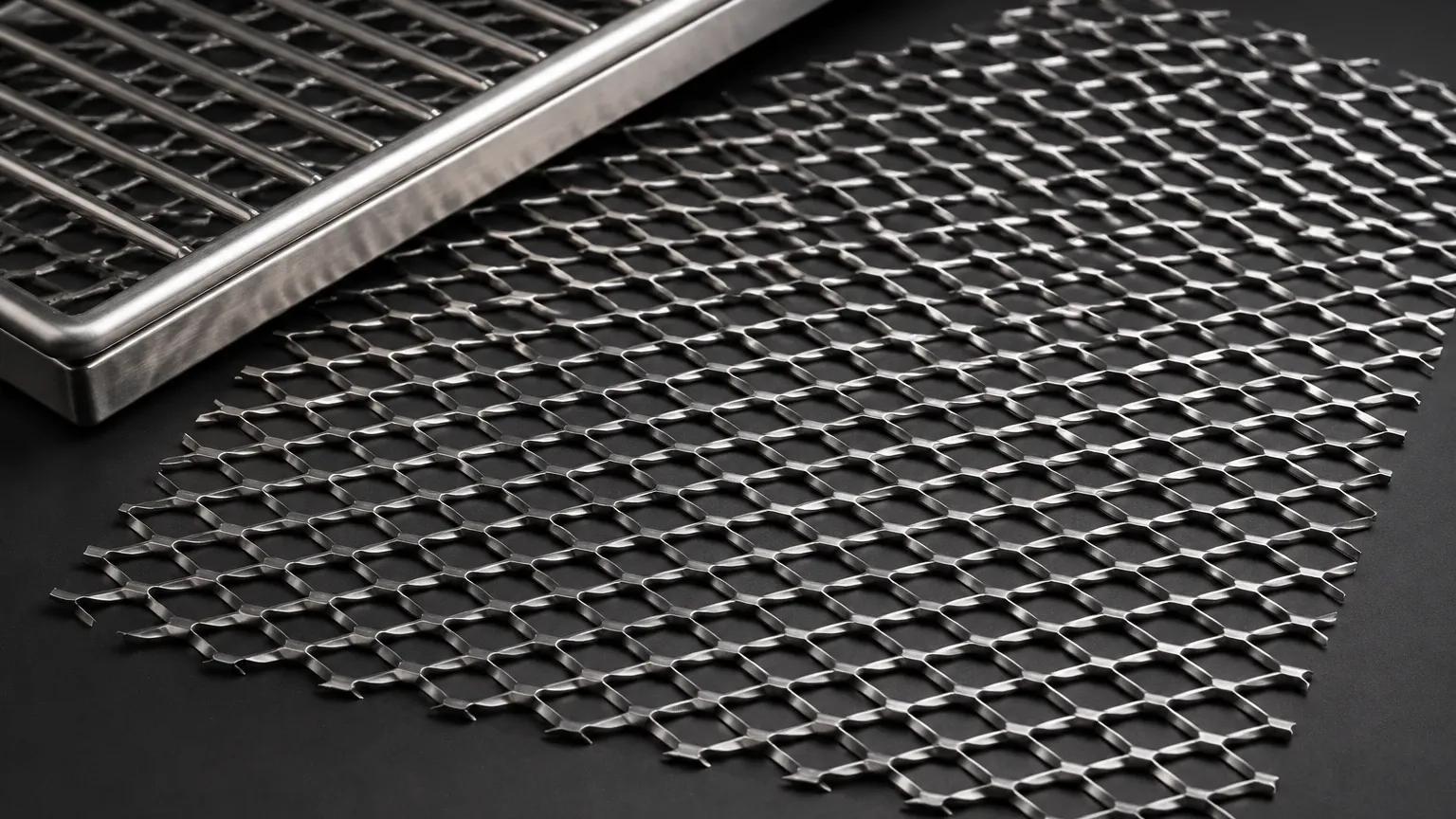
While both perforated and expanded metals are used in industrial filtration and heating applications, their manufacturing processes and physical characteristics differ significantly. Perforated metal is created by punching holes into a solid sheet of stainless steel, which results in material waste (the "slugs"). In contrast, expanded metal is produced by simultaneously slitting and stretching a single sheet of metal.
This process creates a diamond-shaped pattern of openings. Because the material is stretched rather than punched, there is virtually no waste, making it a more sustainable and often more cost-effective choice for large-scale industrial projects. For grill applications, the resulting structure is a single, continuous piece of metal without joins or welds. This lack of mechanical fasteners or welds is a distinct engineering advantage, as it eliminates potential failure points that could succumb to the intense thermal expansion and contraction cycles common in industrial grilling.
Raised vs. Flattened Expanded Metal
In the context of a stainless steel expanded metal for grill, engineers must choose between two primary forms:
1. Standard (Raised) Expanded Metal: The strands are set at an angle to the plane of the sheet. This creates a textured surface that provides excellent grip and high airflow, which is often used in industrial drying or heavy-duty searing applications where non-slip properties are required.
2. Flattened Expanded Metal: The raised sheet is passed through a cold-rolling reducing mill. This flattens the strands and bonds back into the original plane. For food-contact grill surfaces, flattened expanded metal is often preferred because it provides a smooth, uniform surface that is easier to clean and prevents food from sticking to the angled edges of the strands.
Material Properties: Why Stainless Steel is Essential
The environment within an industrial grill or food processing oven is characterized by high temperatures, corrosive cleaning agents, and organic acids from food products. Stainless steel is the industry standard for these applications due to its inherent resistance to oxidation and corrosion.
Grade 304 vs. Grade 316
* Type 304 Stainless Steel: This is the most common grade used for industrial grills. It offers excellent corrosion resistance and can withstand temperatures up to approximately 870°C (1600°F) for intermittent service. It is highly weldable and formable, making it ideal for custom OEM grill components.
* Type 316 Stainless Steel: For environments involving high salt concentrations (such as brine processing or coastal facilities) or highly acidic foods, Type 316 is recommended. The addition of molybdenum enhances its resistance to pitting and crevice corrosion, ensuring a longer service life in aggressive chemical environments.
Thermal Conductivity and Heat Retention
Stainless steel expanded metal provides a balanced thermal profile. Unlike thin wire mesh, which may lose heat rapidly, the solid strands of expanded metal retain enough thermal mass to provide consistent searing and heat distribution across the entire surface. This is critical for maintaining uniform product quality in automated food processing lines.
Key Technical Parameters for Grill Design
When specifying stainless steel expanded metal for grill components, engineers must define several key dimensions that dictate the material’s performance. These parameters influence airflow, heat transfer, and the structural load-bearing capacity of the grill.
* SWD (Short Way of Diamond): The distance from the center of a bond to the center of the next bond across the short axis of the diamond.
* LWD (Long Way of Diamond): The distance across the long axis of the diamond.
* Strand Width: The amount of metal fed into the machine for each stroke of the die.
* Strand Thickness: The thickness of the original base metal sheet.
* Open Area Percentage: This is perhaps the most critical metric for grill design. It determines how much heat and smoke can pass through the surface. A higher open area percentage allows for better convection but may reduce the structural rigidity of the sheet.
For example, a grill designed for small, delicate proteins might require a smaller SWD to prevent the product from falling through, whereas a heavy-duty industrial incinerator or large-scale meat broiler might utilize a larger LWD and thicker strands to support significant weight and maximize airflow.
Engineering Advantages in Industrial Applications
The use of Perforated & Expanded Metal in industrial grill design offers several mechanical advantages that contribute to a lower total cost of ownership (TCO).
Structural Rigidity and Weight
Expanded metal has an exceptional strength-to-weight ratio. The truss-like structure of the diamond openings provides inherent rigidity, allowing the material to span larger distances without sagging compared to solid sheets of the same weight. This allows for lighter support structures in large industrial ovens, reducing overall equipment weight and material costs.
Resistance to Thermal Warping
One of the primary challenges in grill design is managing thermal expansion. Solid plates often warp or buckle when subjected to uneven heating. The open structure of expanded metal allows the material to expand and contract more freely across its plane, significantly reducing the risk of permanent deformation. This dimensional stability is vital for automated systems where precise clearances must be maintained between the grill surface and other mechanical components.
Enhanced Airflow and Convection
The geometry of expanded metal promotes turbulent airflow. As heat rises through the diamond apertures, it is distributed more evenly than it would be through simple round holes in a perforated sheet. This turbulence helps eliminate cold spots, leading to faster cooking times and more efficient energy usage in industrial burners.
Critical Selection Criteria for Engineers and Purchasing Teams
Selecting the right stainless steel expanded metal for grill applications requires a thorough evaluation of the operational environment. Purchasing teams should confirm the following details with their manufacturer to ensure the component meets the intended application requirements:
1. Load Requirements: What is the maximum weight the grill surface must support at peak operating temperatures? Stainless steel loses yield strength as temperature increases, so calculations must account for the "hot strength" of the material.
2. Surface Finish: For food processing, a 2B mill finish is common, but electropolishing is often recommended. Electropolishing removes surface imperfections and creates a microscopically smooth finish that inhibits bacterial growth and simplifies the cleaning process (CIP – Clean-in-Place).
3. Edge Treatment: Expanded metal has sharp edges where the diamonds are cut. For safety and structural integrity, specify whether the sheets should be framed with U-edging, flat bars, or L-angles. This not only protects operators but also provides a secure mounting point for the grill within the larger assembly.
4. Compliance and Standards: Ensure the material and any secondary treatments comply with FDA, NSF, or relevant EU food contact regulations. Traceability of the stainless steel melt (MTRs – Material Test Reports) is often a requirement for pharmaceutical and high-end food applications.
Maintenance and Longevity in High-Heat Environments
The longevity of a stainless steel expanded metal grill is largely dependent on proper maintenance and the initial engineering choices. While stainless steel is durable, it is not indestructible.
Cleaning Protocols
In industrial settings, carbon buildup and grease can clog the openings of the expanded metal, reducing airflow and increasing the risk of fire. Because expanded metal is a single piece of material, it can withstand aggressive cleaning methods, including high-pressure steam, caustic chemicals, and abrasive scrubbing. However, engineers should ensure that the chosen cleaning chemicals are compatible with the specific grade of stainless steel (e.g., avoiding high concentrations of chlorides which can cause stress corrosion cracking in 304 stainless).
Inspection for Stress Fractures
Over thousands of thermal cycles, even the highest quality expanded metal may develop micro-fractures, particularly at the bonds (the points where the strands intersect). Regular inspection is necessary to identify these issues before they lead to structural failure. Choosing a manufacturer like Kaifil, which utilizes precision slitting and high-quality base materials, minimizes the internal stresses introduced during the expansion process, thereby extending the fatigue life of the component.
Customization and OEM Solutions
Every industrial application has unique requirements. A standard off-the-shelf expanded metal sheet may not provide the optimal balance of airflow and strength for a specific conveyor grill or smoking rack. Customization options include:
* Variable Diamond Sizes: Adjusting the SWD and LWD to match the specific dimensions of the food product.
* Custom Gauges: Utilizing thicker base materials for heavy-duty industrial applications or thinner gauges for lightweight, portable commercial equipment.
* Specialty Alloys: For extreme environments, alloys like 310S (for higher temperature oxidation resistance) or Duplex stainless steels can be utilized.
By partnering with a manufacturer that understands the complexities of filtration and metal fabrication, engineers can develop bespoke solutions that improve the efficiency and reliability of their equipment.
Conclusion
Stainless steel expanded metal for grill applications represents a sophisticated engineering solution for the industrial food sector. Its unique structural properties, combined with the durability of stainless steel, provide a high-performance surface that excels in heat distribution, structural stability, and hygiene. Whether you are designing a new industrial broiler or replacing components in an existing food processing line, focusing on the technical specifications—such as SWD/LWD, material grade, and surface finish—is essential for achieving long-term operational success.
For technical assistance or to request a quote for custom Perforated & Expanded Metal components, contact the engineering team at Kaifil. We specialize in providing high-precision, durable filtration and metal solutions designed to withstand the most demanding industrial environments.
