


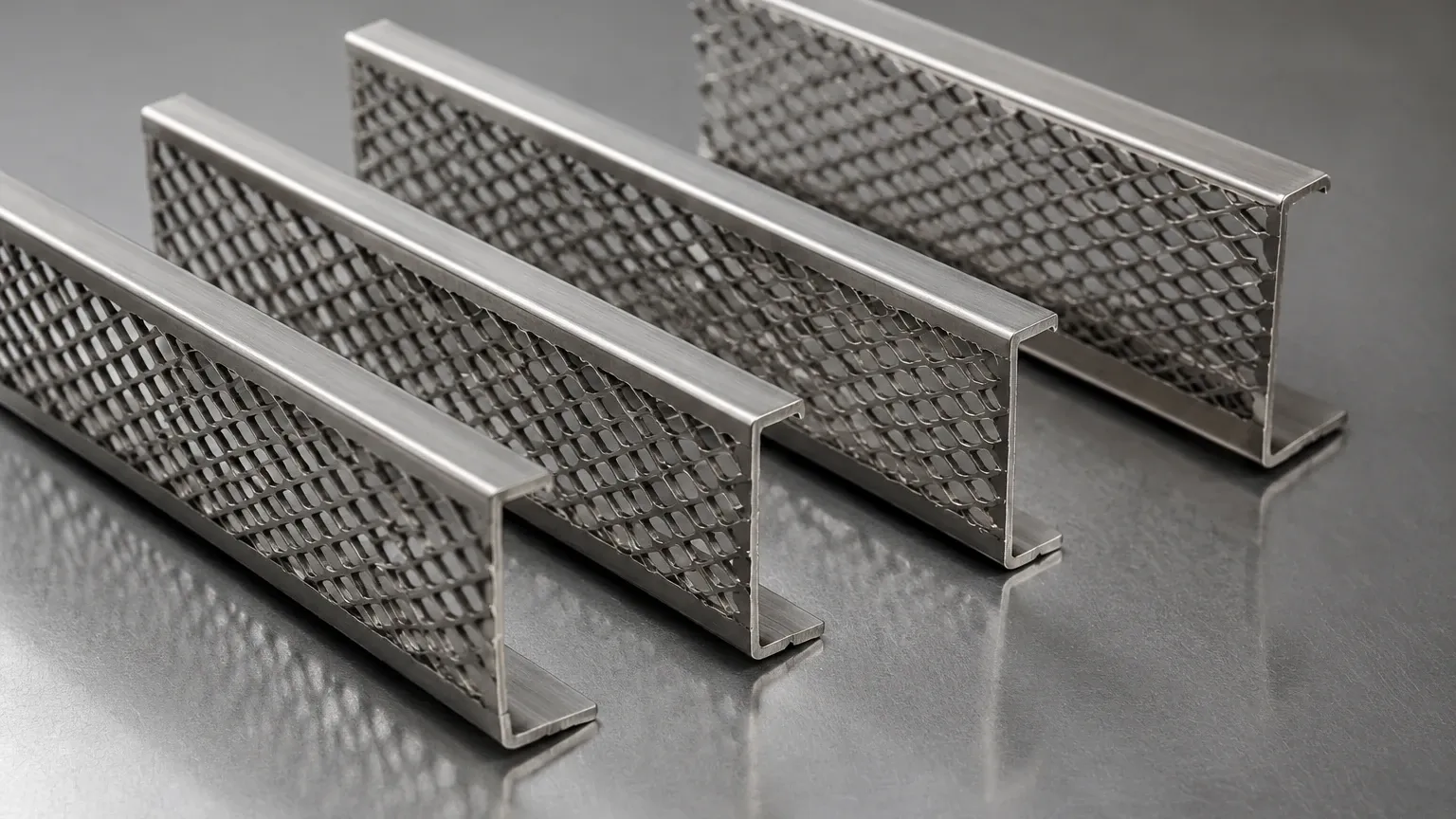
Expanded Metal U Channel
In industrial manufacturing and filtration engineering, the structural integrity of a component is often as critical as its functional performance. Expanded metal, a versatile material created by slitting and stretching metal sheets into a diamond-patterned mesh, offers excellent strength-to-weight ratios and open areas for fluid or air passage. However, the manufacturing process leaves raw, sharp edges that can compromise safety, complicate installation, and reduce the lifespan of the component under mechanical stress. To address these challenges, engineers utilize the expanded metal u channel—a specialized framing accessory designed to enclose raw edges, provide structural reinforcement, and facilitate seamless integration into larger systems.
For procurement teams and design engineers working with Perforated & Expanded Metal, understanding the technical nuances of U-channel selection is essential for ensuring the durability and safety of industrial filtration and guarding solutions.
The Role of U-Channel Edging in Industrial Applications
An expanded metal u channel is a cold-rolled or extruded metal strip formed into a "U" or "C" shape. Its primary function is to serve as a protective and structural border for expanded or perforated metal panels. In heavy-duty industrial environments, such as chemical processing plants or hydraulic systems, raw mesh edges are susceptible to catching debris, causing injury to personnel, or vibrating loose from their housings.
By encasing the perimeter of a mesh panel within a U-channel, manufacturers achieve several engineering objectives:
1. Safety and Handling: It eliminates the "burrs" and sharp strands inherent in the expanded metal manufacturing process, making the components safer to handle during installation and maintenance.
2. Structural Rigidity: The channel acts as a rigid frame, preventing the mesh from sagging or warping under pressure or high flow rates.
3. Simplified Mounting: A framed edge provides a flat, uniform surface that is much easier to weld, bolt, or slide into tracks compared to raw mesh.
4. Aesthetic and Professional Finish: In architectural or high-end industrial equipment, the U-channel provides a clean, finished appearance that signifies quality manufacturing.
Technical Specifications and Material Selection
Selecting the correct expanded metal u channel requires a precise match between the frame and the mesh it intends to hold. At Kaifil, where precision in filtration is paramount, material compatibility is the first consideration in the engineering phase.
Material Grades
For most industrial filtration and corrosive environment applications, stainless steel is the standard choice.
* Stainless Steel 304/304L: Offers excellent corrosion resistance and weldability, making it suitable for general industrial use, food processing, and architectural applications.
* Stainless Steel 316/316L: Contains molybdenum, providing superior resistance to chlorides and pitting. This is the preferred material for marine environments, pharmaceutical manufacturing, and aggressive chemical filtration.
* Carbon Steel: Often used in dry environments or where the component will be powder-coated or galvanized for rust protection.
* Aluminum: Selected for applications requiring lightweight components with moderate corrosion resistance.
Dimensional Accuracy
The "fit" of an expanded metal u channel is determined by three primary dimensions:
* The Throat (Opening): This must be slightly wider than the overall thickness of the expanded metal (including the thickness of the strands and the "rise" or pitch of the diamonds).
* The Legs: The height of the U-channel sides. Longer legs provide more surface area for welding and greater structural support.
* The Gauge (Thickness): The thickness of the channel wall itself, which must be robust enough to support the weight and pressure loads of the application.
Engineering Considerations for Filtration Systems
In the context of industrial filtration, the integration of Perforated & Expanded Metal with U-channel framing must account for fluid dynamics and mechanical stress. When expanded metal is used as a support core for fine wire mesh or as a standalone coarse filter, the U-channel frame must not obstruct the flow path significantly or create "dead zones" where particulates can accumulate and cause bacterial growth or localized corrosion.
Pressure and Load Distribution
In hydraulic or high-pressure water treatment systems, the mesh panel is subjected to constant force. Without a properly fitted expanded metal u channel, the edges of the mesh may pull away from their supports, leading to bypass—where unfiltered fluid escapes around the edges of the filter element. A securely welded U-channel ensures that the load is distributed evenly across the frame, maintaining the integrity of the filtration seal.
Thermal Expansion
For high-temperature applications, such as steam filtration or exhaust gas processing, engineers must consider the thermal expansion coefficients of both the mesh and the U-channel. Using identical material grades (e.g., both 316L stainless steel) ensures that the components expand and contract at the same rate, preventing warping or weld failure at the interface.
Manufacturing and Installation Techniques
Attaching an expanded metal u channel to a mesh panel requires precision to avoid distorting the diamond pattern or compromising the material's strength. There are several common methods used in professional manufacturing:
Spot and Tack Welding
This is the most common method for securing U-channels. Small, localized welds are placed at regular intervals along the length of the channel. This provides sufficient strength for most guarding and decorative applications while minimizing heat-induced distortion.
Continuous Welding
In high-pressure filtration or sanitary applications (such as food and beverage processing), a continuous weld may be required. This seals the gap between the mesh and the channel, preventing the entrapment of contaminants and making the component easier to clean (CIP – Clean In Place).
Mitering the Corners
For a professional finish and maximum structural integrity, the corners of the U-channel frame should be mitered at a 45-degree angle and welded shut. This creates a fully enclosed, continuous loop frame that is significantly stronger than a simple butt joint.
Selecting the Right Component: A Guide for Purchasing Teams
When sourcing an expanded metal u channel for a project, purchasing teams should confirm several key data points with their manufacturer to ensure the final product meets the technical requirements of the application.
1. Mesh Thickness vs. Throat Width: Ensure the internal width of the U-channel can accommodate the "flattened" or "raised" profile of the expanded metal. Raised expanded metal is thicker than the base sheet metal due to the angle of the strands.
2. Environment Compatibility: Will the component be exposed to salt spray, acids, or extreme heat? This dictates the move from 304 to 316 stainless steel or specialized alloys.
3. Tolerances: In precision filtration, even a millimeter of deviation can lead to improper fitting in a filter housing. Confirm that the manufacturer can maintain tight tolerances on the outer dimensions of the framed panel.
4. Surface Treatment: Depending on the application, the framed assembly may require electropolishing (for sanitary use), galvanizing (for rust prevention), or simple deburring.
Why Customization Matters in Industrial Filtration
Standard off-the-shelf U-channels often fail to meet the specific requirements of specialized industrial equipment. Custom manufacturing allows for the optimization of the frame to the specific mesh pattern. For instance, if the expanded metal has a large diamond opening, a wider U-channel leg may be necessary to ensure enough of the "bonds" (the intersection of the diamonds) are captured within the frame for a secure weld.
Kaifil specializes in these customized solutions, providing integrated Perforated & Expanded Metal components that are ready for immediate installation. By handling the framing and finishing in-house, we ensure that the filtration performance is not compromised by poor edge treatment or structural instability.
Conclusion
The expanded metal u channel is more than just a trim; it is a critical engineering component that transforms raw mesh into a functional, safe, and durable industrial tool. Whether used in a chemical strainer, a machine safety guard, or a structural walkway, the correct selection of material, size, and attachment method is vital. By focusing on technical compatibility and the specific demands of the operating environment, engineers can significantly extend the service life of their filtration and metal components while reducing maintenance costs and safety risks.
