


Expanded Metal Unit Weight
In industrial engineering and filtration design, the expanded metal unit weight is a critical parameter that influences structural integrity, material costs, and the overall efficiency of the filtration system. Unlike perforated metal, which is created by punching holes and removing material, expanded metal is produced by slitting and stretching a solid metal sheet. This process results in a diamond-shaped pattern that retains the structural continuity of the original material while significantly increasing its surface area. For procurement teams and engineers, understanding how to calculate and evaluate the expanded metal unit weight is essential for ensuring that the selected components can withstand mechanical stresses without adding unnecessary mass to the assembly.
At Kaifil, we specialize in providing precision-engineered Perforated & Expanded Metal solutions tailored to demanding industrial environments. Whether the application involves chemical processing, hydraulic filtration, or architectural support, the unit weight serves as the foundation for determining load-bearing capacities and filtration performance.
The Fundamentals of Expanded Metal Geometry and Weight
To understand expanded metal unit weight, one must first understand the manufacturing process. A solid sheet of metal—typically stainless steel for industrial filtration—is fed through a machine that simultaneously slits and expands the material. Because no metal is removed during this process (unlike perforation), the total weight of the expanded sheet is theoretically equal to the weight of the original solid sheet from which it was produced. However, the "unit weight"—expressed as weight per square foot or weight per square meter of the finished product—changes based on the degree of expansion.
There are four primary geometric variables that dictate the final unit weight and structural characteristics:
1. SWD (Short Way of Design): The distance from the center of one bond to the center of the next bond across the short axis of the diamond.
2. LWD (Long Way of Design): The distance across the long axis of the diamond.
3. Strand Width: The amount of metal fed between the dies to produce one strand.
4. Strand Thickness: The thickness of the original base metal.
When an engineer specifies a particular expanded metal unit weight, they are essentially defining the ratio of open area to solid material. A higher unit weight typically indicates a smaller expansion ratio, resulting in smaller openings and a stronger, heavier mesh. Conversely, a lower unit weight indicates a more aggressive stretch, creating larger openings and a lighter component.
Calculating the Expanded Metal Unit Weight
For technical professionals, calculating the theoretical expanded metal unit weight is a straightforward process based on the volume and density of the material. The most common materials used in high-performance filtration are Stainless Steel 304 and 316L, which have densities of approximately 0.284 lbs/in³ (7.93 g/cm³).
The basic formula for the weight of a solid metal sheet is:
Weight = Area × Thickness × Density
When this sheet is converted into expanded metal, the unit weight of the final product (per unit of area) is determined by how much the original sheet was "stretched." If a 1-meter long sheet is expanded to 2 meters, the unit weight per square meter of the resulting mesh will be exactly half of the unit weight of the original solid sheet.
In technical specifications, this is often represented as:
Unit Weight (Expanded) = [Strand Width / (SWD / 2)] × Unit Weight of Solid Sheet
This calculation allows engineers to determine if a specific mesh configuration will meet the weight constraints of a filtration housing or a support structure. It is important to note that "Flattened" expanded metal and "Standard (Raised)" expanded metal of the same specification will have the same unit weight, although their physical thickness and mechanical properties will differ significantly.
Material Density and Its Impact on Unit Weight
The choice of alloy is the primary driver of the expanded metal unit weight before the expansion process begins. In the context of Kaifil’s industrial filtration solutions, material selection is usually dictated by corrosion resistance and temperature requirements, but the density of these alloys varies slightly:
* Stainless Steel 304/304L: The industry standard for general filtration. It offers excellent durability and a standard density that provides a reliable baseline for weight calculations.
* Stainless Steel 316/316L: Preferred for marine or highly acidic environments due to the addition of molybdenum. Its density is slightly higher than 304, which may result in a marginal increase in unit weight for the same geometric specifications.
* Carbon Steel: Frequently used for support structures where corrosion is not a primary concern. It is slightly less dense than stainless steel but often requires thicker strands to compensate for potential oxidation, which can lead to a higher overall unit weight in the final application.
* Specialty Alloys (Monel, Inconel): Used in extreme chemical processing. These materials have significantly different densities, requiring precise recalculation of the expanded metal unit weight to ensure the filtration system remains within engineering tolerances.
Structural Implications of Unit Weight in Industrial Applications
In B2B industrial sectors, the expanded metal unit weight is not just a logistical figure; it is a proxy for structural performance. In filtration, expanded metal often serves as the support cage or the outer protective wrap for delicate wire mesh filter media.
Load-Bearing Capacity
A higher unit weight generally correlates with higher load-bearing capacity and greater resistance to internal pressure. In hydraulic systems, where filters are subjected to high-pressure pulses, the expanded metal must have sufficient unit weight to prevent the collapse of the filter element. Engineers must balance the need for a lightweight component with the mechanical requirement to resist deformation under flow stress.
Open Area and Flow Rates
The unit weight is inversely proportional to the percentage of open area. A lighter expanded metal unit weight means more open area, which results in a lower pressure drop (ΔP) across the filter. However, if the unit weight is too low, the mesh may lack the rigidity necessary to maintain its shape during the cleaning or backwashing cycles. Finding the "sweet spot" between a low unit weight for flow efficiency and a high unit weight for structural durability is a core challenge in filter design.
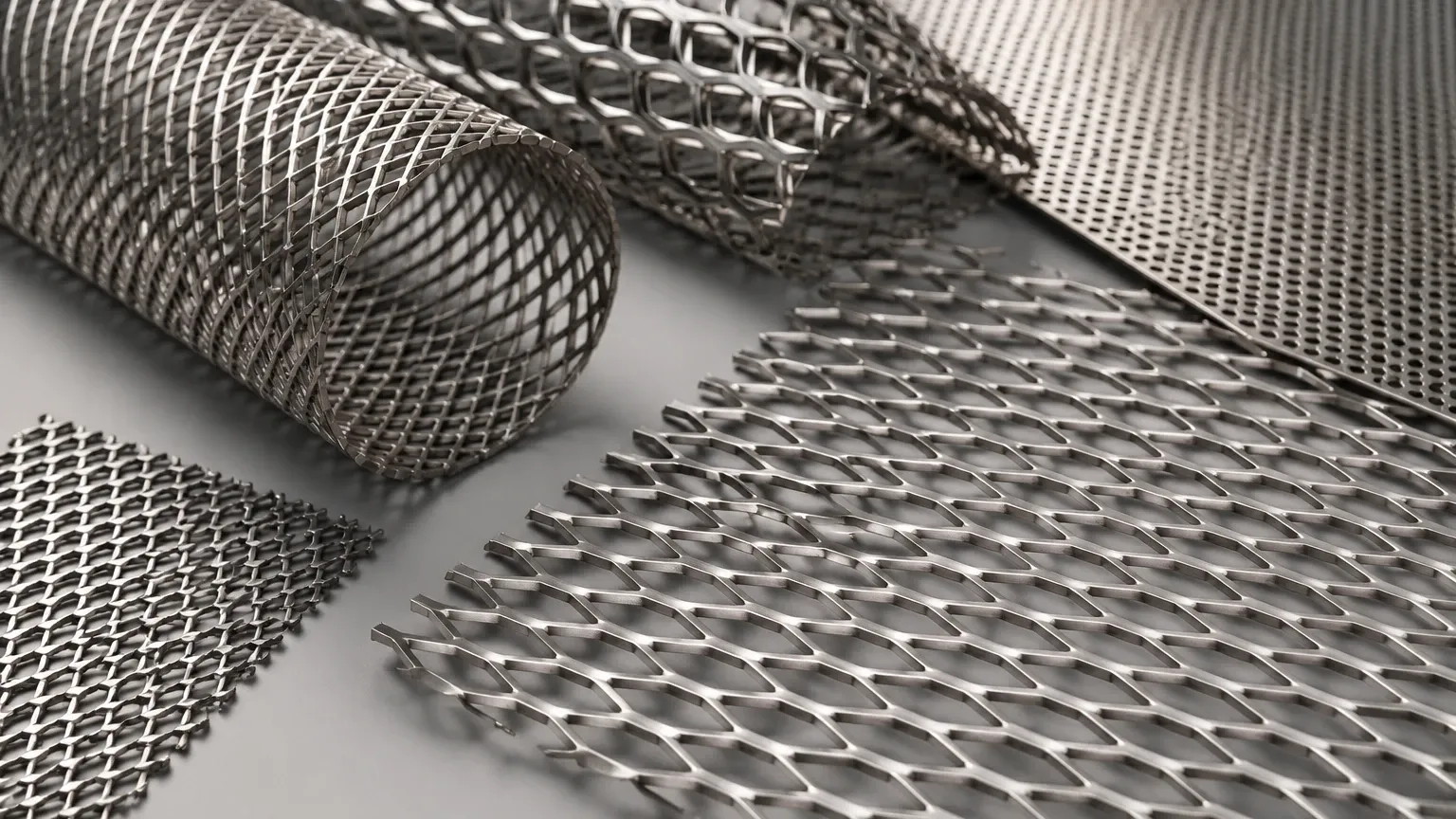
Comparing Weight Efficiency: Perforated & Expanded Metal
When selecting between Perforated & Expanded Metal, weight efficiency is often the deciding factor. Perforated metal involves the removal of material, which means that for a given thickness and open area, perforated metal is often heavier and more expensive because the "waste" material (the slugs) must be accounted for in the initial material cost.
Expanded metal is frequently considered more weight-efficient for the following reasons:
* Material Utilization: Since no material is lost, 100% of the purchased raw material ends up in the final product. This makes expanded metal a cost-effective choice for large-scale industrial projects.
* Strength-to-Weight Ratio: The strands of expanded metal are set at an angle to the plane of the sheet. This three-dimensional orientation provides greater structural rigidity than a flat perforated sheet of the same unit weight.
* Customization of Weight: By adjusting the strand width and the expansion ratio, manufacturers can fine-tune the unit weight to meet exact specifications, whereas perforated metal is limited by the standard die patterns and the structural limits of the remaining "ligaments" between holes.
Technical Specification Checklist for Procurement
Before finalizing a purchase order for industrial filters or support components, engineering and purchasing teams should confirm several factors related to the expanded metal unit weight to avoid performance failures or installation issues:
1. Confirm Actual vs. Theoretical Weight: While theoretical calculations are useful for design, manufacturing tolerances can lead to slight variations. Ensure the supplier provides the actual unit weight per sheet or roll.
2. Evaluate the Impact of Flattening: If the application requires a smooth surface (flattened expanded metal), confirm if the thinning of the strands during the flattening process affects the structural requirements, even though the unit weight remains constant.
3. Pressure Drop Requirements: For filtration applications, verify that the chosen unit weight provides an open area percentage that aligns with the system’s maximum allowable pressure drop.
4. Corrosion Allowance: In aggressive chemical environments, engineers often specify a higher initial unit weight (thicker strands) to provide a "corrosion allowance," ensuring the component remains functional even after minor surface material loss over time.
5. Handling and Installation: Consider the total weight of the finished assembly. A higher expanded metal unit weight might require specialized lifting equipment or more robust mounting brackets within the filtration housing.
The Role of Precision Manufacturing in Weight Control
At Kaifil, we understand that industrial filtration requires more than just a "standard" mesh. Precise control over the expanded metal unit weight is achieved through advanced manufacturing equipment that maintains tight tolerances on strand width and expansion angles. This precision ensures that every filter cartridge or support component performs consistently across its entire service life.
Our engineering team works closely with clients to determine the optimal balance of material grade, thickness, and expansion ratio. By focusing on the technical nuances of the expanded metal unit weight, we help our partners achieve efficient, durable, and cost-effective filtration performance in the most demanding industrial sectors, from pharmaceutical manufacturing to heavy-duty hydraulic systems. When specifying components, always consider how the unit weight interacts with the flow dynamics and mechanical stresses of your specific application to ensure long-term reliability.
